If you’ve noticed more Korean webtoons and web novels pitching themselves as “fantasy that crosses reality,” you’re not imagining it. This isn’t simply “more fantasy content.” It’s a format-native story design that fits how Koreans (especially Gen Z) read on mobile, how platforms monetize serialization, and how IP now travels from scroll to screen and back again.
What looks like a niche trope in IT/culture feeds is actually a clean signal of where attention—and therefore platform investment—is flowing in Korea’s reading ecosystem: serialized IP engineered for cross-media expansion.
What “fantasy that crosses reality” actually means in Korea’s serialized fiction
In Korean web-narrative terms, the trend clusters around a few adjacent modes:
- Reality–Fantasy Fusion : modern, recognizably Korean life (school, office, courts, military, idol industry) with one “rule-break” mechanic—status windows, regression, hunters/dungeons, possession, hidden systems.
- Reality infiltration / boundary collapse: the other world bleeds into daily life, or daily life is reinterpreted through fantasy logic (rankings, quests, supernatural economies).
- Meta-adjacent reading logic: stories designed to be legible instantly, escalate quickly, and sustain episode-by-episode dopamine.
KOCCA has effectively canonized this as a generational taste pattern: its PRISM framing for Gen Z content trends explicitly labels “Reality–Fantasy Fusion (현실판타지)” as a core keyword, alongside speed-oriented consumption and lower insistence on strict plausibility if the moment is entertaining.
In other words: this is not “escapism vs realism.” It’s real-life texture + fantasy mechanics—a hybrid that avoids heavy world-building while still delivering power, progress, and reversal.
Why it’s popping in IT/culture feeds (not just book charts)
Bestseller lists lag. Platform feeds don’t. IT/culture coverage tends to surface patterns that behave like product strategy:
- Short pitch, fast hook, high retention
Reality-crossing fantasy is exceptionally “one-sentence explainable,” which matters in a scroll economy where readers sample quickly and decide whether to pay. - Built for the “virtuous cycle” of IP backflow
When a drama or animation hits, it can push audiences back into the source material—web novel and webtoon alike—creating a measurable surge in views and revenue. Business Chosun recently described exactly that pattern, citing large jumps in webtoon consumption during a drama’s run and framing it as a representative web novel → webtoon → screen IP expansion arc. - Fits the “total IP solution” model platforms are selling
Asiae’s English coverage has described K-webtoons evolving from snack culture into a “giant” industry, with companies emphasizing secondary works using owned IP—especially dramas, but also merch and animation—because one hit can become a multi-vertical franchise.
That’s why tech-facing stories care about narrative form: the form is increasingly tied to globalization, localization, adaptation, and pipeline control.
The structural reason this hybrid wins: it minimizes friction
Serialized fiction lives and dies on friction:
- Entry friction (How much do I need to learn before it gets good?)
- Continuation friction (How quickly do I get payoff per episode?)
- Conversion friction (What makes me spend on the next chapter?)
Reality-crossing fantasy lowers all three. Readers recognize the real-world setting instantly (office politics, exams, status anxiety), then the fantasy mechanic provides a rationalized engine for escalation (systems, leveling, second chances). That’s why this mode is especially compatible with platforms whose business depends on frequent updates and cliffhanger economics.
KOCCA’s PRISM findings align with this: Gen Z respondents were more likely to prioritize 재미 (fun) over 개연성 (plausibility), and to tolerate unrealistic moments if the scene delivers.
The ecosystem implication: “reading” is now a loop, not a lane
The key shift is that “Korea’s reading ecosystem” is no longer just books → readers. It’s:
Serialized text (web novel) ↔ serialized visuals (webtoon) ↔ screen (drama/animation) ↔ backflow into platforms
The Korea Times has reported on webtoon platforms themselves moving further into drama production—an indicator that platforms want tighter control over the adaptation pipeline, not just licensing upside.
In that environment, reality-crossing fantasy is less a literary trend than an IP logistics advantage:
- easy to localize conceptually (modern life + one mechanic),
- easy to cast and stage (no fully alien world required),
- easy to extend (systems and regressions are sequel-friendly),
- easy to merchandise (guilds, rankings, icons, “badges,” character classes).
What to monitor next (practical signals for KLitReads)
If you’re tracking this as a “where attention is going” indicator, focus on measurable ecosystem signals rather than subjective hype:
- Backflow spikes: adaptations that trigger big surges in original webtoon/web novel views during broadcast windows.
- Platform packaging language: more “super IP ecosystem / total IP solution” framing, especially around drama and secondary works.
- Production pipeline consolidation: platforms directly financing or producing adaptations rather than only licensing.
- Gen Z taste framing: recurring evidence that “fun-first plausibility-light” consumption remains stable, reinforcing why this hybrid keeps winning.
Bottom line
“Fantasy that crosses reality” is best read as a consumer-economy-of-attention signal inside Korea’s reading ecosystem: a narrative design optimized for mobile serialization, monetization cadence, and IP expansion loops. It may not top traditional bestseller lists, but it can dominate the platform layer—and that layer increasingly decides what becomes the next franchise.
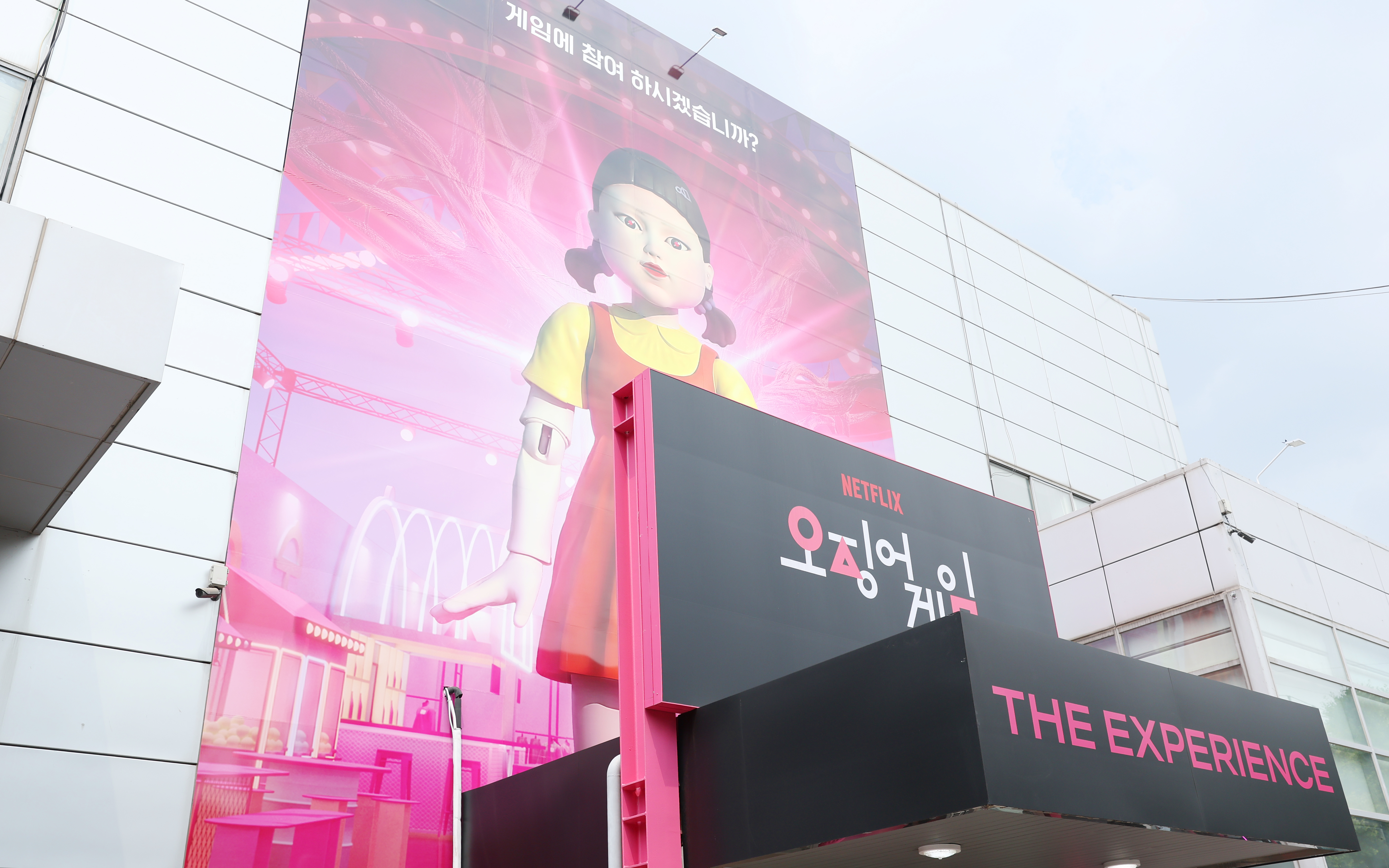
“SQUID GAME THE EXPERIENCE SEOUL” — Republic of Korea (KOREA.NET / Korean Culture and Information Service), via Flickr, CC BY-SA 2.0.




Leave a Reply