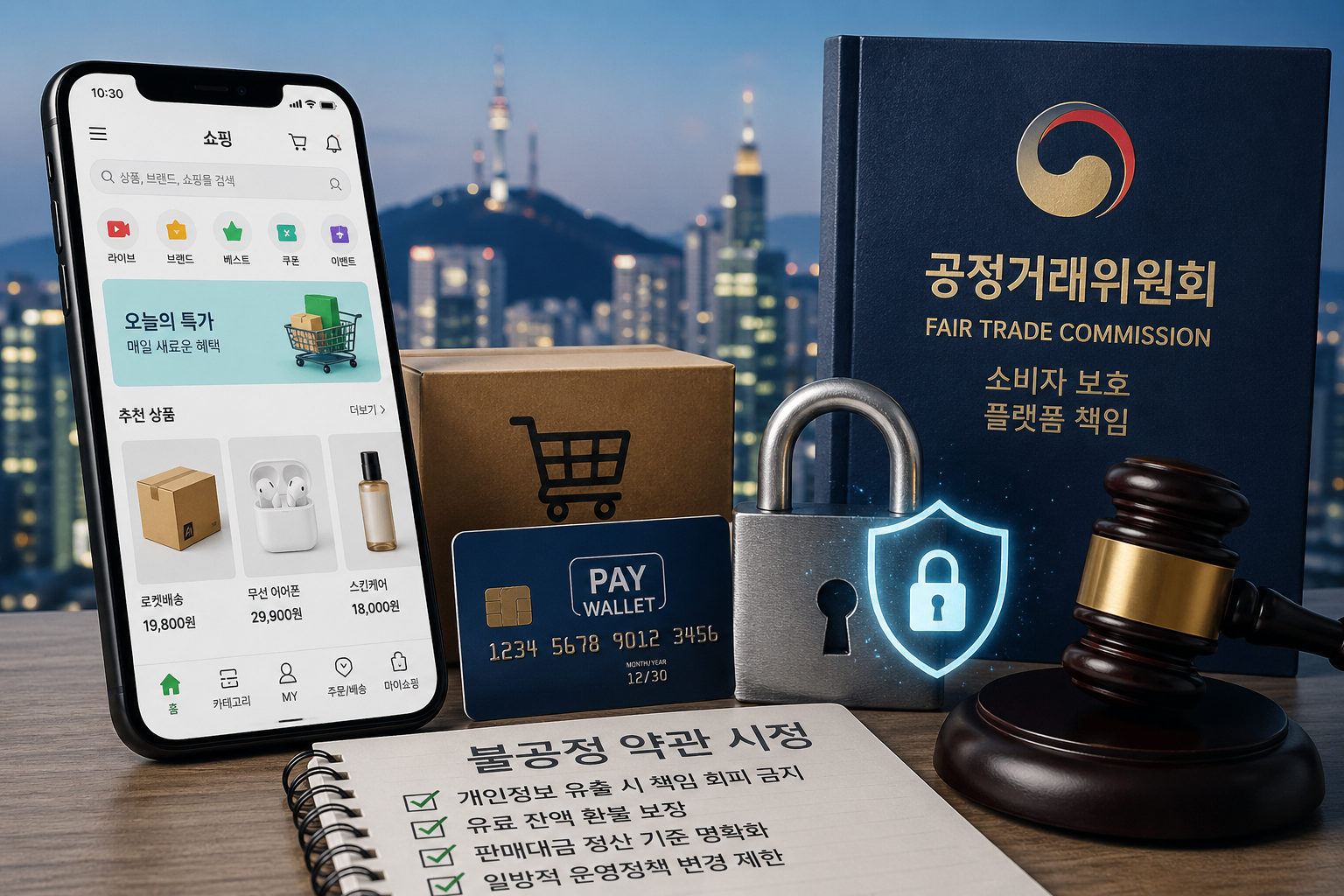
Korea’s FTC action against Coupang, Naver, and five other open-market platforms shows how privacy, refunds, seller settlements, and platform responsibility are becoming part of everyday digital culture.
South Korea’s platform debate is moving from abstract regulation into the daily experience of using shopping apps, payment wallets, seller marketplaces, and delivery-linked commerce systems. The latest signal came from the Fair Trade Commission, which reviewed the user agreements of seven major open-market operators — Coupang, Naver, Kurly, SSG.com, Gmarket, 11Street, and Nol Universe — and found 11 types of unfair clauses across four broad categories. The companies agreed to revise the terms following the regulator’s recommendations.
The core issue is liability. The FTC found clauses that broadly limited or avoided platform responsibility when users suffered harm from personal-data leaks, hacking, malicious programs, transaction disputes, delayed settlements, or platform-mediated sales. In the regulator’s view, those provisions shifted too much risk from platform operators onto ordinary users and sellers, even though the platforms collect, store, process, and monetize sensitive data as part of everyday commerce.
The action covered four areas: improper liability exemptions and damage limitations, arbitrary exercise of operational authority, disadvantages related to settlement and refunds, and other unfair provisions. Korea JoongAng Daily reported that Coupang had the highest number of identified clauses, with eight, followed by Kurly with seven; Naver, SSG.com, Gmarket, and 11Street with four each; and Nol Universe with three.
The personal-data issue is especially sensitive because the FTC review followed public concern over Coupang’s major data breach. The Korea Times reported that Coupang initially said around 3,000 user accounts were affected, but a joint public-private investigation later found the issue had affected more than 33.6 million accounts. That scale helps explain why platform terms are now being read not as routine fine print, but as part of the public conversation about digital safety.
Several platforms had used clauses that appeared to disclaim responsibility for personal-information leaks. Coupang, for example, had language saying the company was not responsible for damages caused by unauthorized third-party access, while other platforms also limited liability for data-related harms. The FTC said such clauses conflicted with the principle that personal-information processors cannot avoid liability unless they prove the absence of intent or negligence.
That distinction matters. The FTC is not saying platforms are automatically liable for every outside attack or every seller dispute. It is saying they cannot use blanket terms to preemptively avoid responsibility when their own fault, negligence, system design, or operational control is involved. In practical terms, platform liability is being moved out of vague legal language and closer to the actual relationship between users, sellers, and the companies that operate the marketplace.
The revisions also go beyond privacy. Coupang’s Coupay Money terms came under review because users could lose paid account balances when withdrawing from membership. Seoul Economic Daily reported that paid top-ups will now be refundable, while free promotional points may still be forfeited. The FTC viewed the loss of paid balances as an unfair extinguishing of property value without a refund process.
Seller-side rules are also being tightened. Coupang, Kurly, and 11Street had allowed sales proceeds to be withheld for broad reasons such as the occurrence of a dispute. Under the revised approach, the grounds for withholding settlement money must be more specifically limited. This matters because open-market operators do not merely host transactions; they control payment flows, settlement timing, search visibility, refund handling, dispute procedures, and the practical rulebook for small merchants.
The companies are expected to complete the revisions by early May. Seoul Economic Daily reported that if the corrections are not properly implemented, the FTC may issue additional corrective orders or file criminal complaints with prosecutors. That makes this more than a one-day regulatory notice. It is a compliance test for how major Korean platforms rewrite the terms governing everyday digital transactions.
This is why the story belongs in Korean digital culture, not only in business regulation. Korea’s largest online platforms are now infrastructure for daily life: shopping, delivery, payment balances, membership points, seller income, customer service, review systems, and identity-linked data. When those systems fail, users increasingly interpret the failure as a design problem and a responsibility problem, not simply as a private dispute between a buyer and a seller.
Korean platform culture has long been defined by speed, convenience, and dense app integration. Rocket delivery, one-click checkout, Naver shopping search, platform points, and loyalty benefits trained users to expect frictionless service. But the same convenience also concentrates personal data and transaction power inside a small number of companies. The FTC’s action reflects a harder question now being asked by regulators and users alike: when platforms make themselves indispensable, how much responsibility should they carry?
The answer emerging from this case is that terms of service cannot function as a universal shield. A platform may still defend itself when it was not at fault, but broad disclaimers are becoming harder to justify. Personal-data protection, refund access, seller settlement rules, and transaction safety are increasingly being treated as baseline platform responsibilities.
For consumers, the message is direct: privacy harms and platform-account balances are not just fine print. They are part of the value exchange between users and platforms. Users provide data, attention, addresses, phone numbers, payment behavior, purchase history, and loyalty to these systems. In return, platforms are expected to provide not only convenience but accountable governance.
For sellers, the case highlights the imbalance built into many open-market relationships. Merchants depend on platforms for access to customers, but platforms often control the terms under which payments are settled, disputes are handled, and operating policies are changed. The FTC’s action suggests that regulators are paying closer attention to how those terms distribute risk.
The broader cultural consequence is that “platform trust” in Korea is becoming more technical and more legal at the same time. People are not only asking whether an app is fast or cheap. They are asking whether it protects data, whether its refund rules are fair, whether paid balances are safe, whether sellers can rely on settlement rules, and whether a company can hide behind intermediary status when its own system shapes the transaction.
This is not a flashy viral controversy. It is a quieter but more durable digital-culture story. The FTC’s open-market action shows that Korea’s next phase of platform culture will be judged not only by speed and scale, but by how platforms allocate responsibility when convenience breaks down.




Leave a Reply