For years, international storytelling about Seoul leaned heavily on speed: skyscrapers, K-pop, beauty technology, neon shopping districts, delivery culture, and the city’s reputation for reinvention. But recent foreign travel and lifestyle coverage suggests that a different Seoul is becoming more visible overseas — not a slower Seoul exactly, but a more intimate one.
The emerging image is less about futurism alone and more about texture: disappearing alleys, traditional Korean houses known as hanok, ceramics, bathhouse rituals, reflective café life, and neighborhoods where modern consumption presses up against memory. A recent Condé Nast Traveler feature, for example, opens with a café that has already vanished, then moves through hanok-lined streets, art institutions, Korean ceramics, Seongsu’s café-and-boutique culture, and a late-night jjimjilbang, or Korean sauna and bathhouse. The piece frames Seoul not simply as a hypermodern capital, but as a place where loss, creativity, pressure, and cultural pride sit close together.
That tonal shift matters. Seoul’s global image is no longer only “the city where the future arrives first.” It is increasingly being presented as a city where the future keeps colliding with what might disappear next.
The city of speed is becoming the city of memory
This does not mean the old Seoul narrative is gone. Seoul is still being covered as fast, stylish, technologically fluent, and commercially restless. But newer travel writing is adding another layer: the emotional cost of that velocity.
Foreign readers are being invited to notice the city’s in-between spaces — narrow residential lanes, renovated hanok cafés, markets, galleries, ceramics shops, bathhouses, and cafés that may not last long in a redevelopment cycle. The emotional hook is no longer just “look how advanced Korea is.” It is also “look how much is being preserved, repurposed, remembered, or lost.”
Bukchon Hanok Village has become one of the clearest symbols of this tension. Official Seoul materials describe Bukchon as a preserved neighborhood of hanok homes and alleys, historically associated with Joseon-era elites and now valued for the way traditional architecture survives within a modern city. But Bukchon is also a lived-in neighborhood, not a film set. Seoul’s city government has restricted tourist access in designated areas from 5 p.m. to 10 a.m., with enforcement beginning in 2025, to protect residents’ housing rights and privacy.
That distinction — tourist landmark versus residential neighborhood — is exactly the kind of nuance now shaping Seoul’s overseas image. The Korea Times recently reported on the same restrictions, noting that officials guide visitors out after 5 p.m. so Bukchon can return to the rhythms of daily life for residents. The story is no longer only that foreigners want to photograph Korea’s traditional houses. It is that Korea is negotiating how much of its most photogenic heritage can be consumed without hollowing out the people who live inside it.
Hanok cafés and ceramics offer a softer visual language
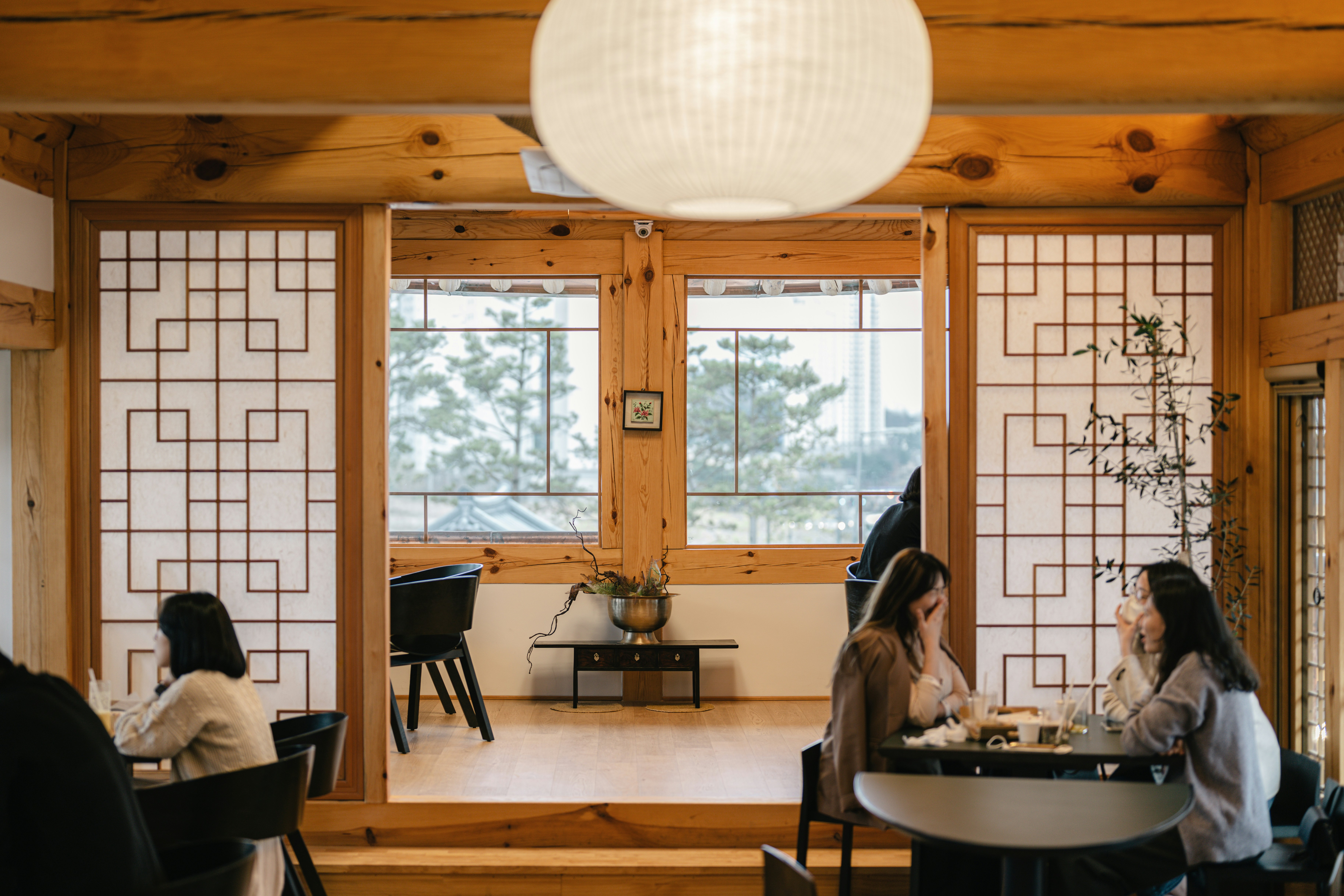
The rise of hanok cafés in travel coverage also reflects this shift. These spaces are attractive to foreign media because they are instantly legible: old roofs, wood beams, quiet courtyards, minimalist interiors, espresso machines, and curated desserts. They visually compress the Korea that overseas readers already recognize — tradition and modern design — into a single visit.
Official tourism platforms have also leaned into this format. Visit Korea has promoted hanok cafés as travel destinations, while Seoul’s official “Seoul Stay” program includes registered hanok stays supported for tourism purposes. In other words, the tourism industry itself understands that visitors are not only seeking famous palaces or futuristic shopping streets. They are looking for atmosphere.
Ceramics serve a similar role. In recent coverage, Korean ceramics are not treated merely as museum objects but as part of a broader lifestyle vocabulary: tableware, craft shops, restaurants, galleries, and design-conscious hospitality. When a foreign travel piece moves from a museum’s Korean ceramics collection to a ceramics shop or a soju brand rooted in craft culture, it turns Seoul into a place of touch, material, and continuity rather than pure spectacle.
That is a powerful reframing for Korean culture. K-pop and K-drama made Seoul globally desirable through sound, faces, fashion, and story. The new travel gaze is asking what the city feels like when the screen is turned off.
Jjimjilbang culture gives Seoul a human rhythm
The attention to jjimjilbangs, Korean sauna and bathhouse spaces, also shows how foreign coverage is moving toward embodied experience. A jjimjilbang is not futuristic in the obvious sense. It is communal, repetitive, inexpensive compared with luxury spas, and closely tied to everyday Korean routines of sweating, bathing, snacking, resting, and staying out late.
Visit Korea describes a jjimjilbang as a Korean-style sauna combining bathhouse and hot steam rooms, and notes that it is often ranked highly among unique experiences chosen by foreign visitors. The same appeal appears in lifestyle coverage: a night out in Seoul does not end only at a cocktail bar or club, but may conclude with a sauna, a towel, and the quiet comedown of heat and rest.
This is a different kind of soft power. It does not rely on perfection or glamour. It relies on habit. It tells foreign readers that Korean culture is not only something to watch or buy, but something to inhabit for a few hours.
Why this matters for Korea’s global image
The new Seoul story is more mature because it allows contradiction. Seoul can be fast and nostalgic, sleek and crowded, curated and fragile, global and intensely local. It can be a city of pop-up stores and vanishing storefronts, luxury hotels and old bathhouses, art fairs and residential alleys, high-end cafés and neighborhoods worried about overtourism.
That complexity may be more compelling than the older futurist image. “Future city” branding is impressive, but it can also feel generic; many global capitals now advertise themselves through technology, design, and skyline. Seoul’s more distinctive advantage may be the emotional density underneath its speed.
For K-culture audiences abroad, this also marks a second stage of Hallyu travel. The first stage was destination recognition: people wanted to visit Korea because they saw it in dramas, music videos, beauty content, and food media. The next stage is atmospheric tourism: visitors want the mood behind the image — the alley, the courtyard, the late café, the bathhouse, the handmade bowl, the neighborhood that still feels lived in.
That is why foreign coverage of Seoul’s disappearing spaces should not be dismissed as mere nostalgia. It is a sign that global audiences are beginning to read Seoul as a layered cultural text, not just as a high-speed content machine.
The challenge for Seoul is whether that intimacy can survive its own popularity. As Bukchon shows, the very places that make the city feel emotionally specific can become strained when they are turned into global backdrops. The future of Seoul tourism may depend not on making the city look even more advanced, but on protecting the fragile, ordinary textures that make visitors feel they have encountered something real.



Leave a Reply