A dispute over a historical film moved from criticism to canceled festival events, advertising pressure and police protection for its lead actor. The escalation tests where cultural debate ends and coercion begins.
Audiences can argue over a film’s interpretation of history. They can reject its premise, challenge its evidence and decide not to buy a ticket. The controversy around Hur Jin-ho’s 암살자(들) (The Assassin(s)) crossed a different line when protesters took the dispute to lead actor Yoo Hae-jin’s home.
The film opened in South Korea on September 23. It dramatizes questions surrounding the August 15, 1974 attempt to assassinate President Park Chung-hee, in which First Lady Yuk Young-soo was killed. The official investigation concluded that Mun Se-gwang fired the fatal attack while acting under instructions linked to North Korea. The film instead builds a mystery around possible involvement by state and intelligence figures.
That fictional interpretation drew accusations of historical distortion from conservative politicians, organizations connected to Park and Yuk, and activist groups. The production team denied that the film identified a real person as the mastermind.
The argument did not remain an argument about the screen. By early October, activists had announced demonstrations near Yoo’s residence, the film’s team had withdrawn from public events at the Busan International Film Festival and police had placed the actor under protective measures.
The sequence matters because it changes who bears the cost of cultural disagreement.
A film about an unsettled public memory
The Korea Film Council’s magazine presented 암살자(들) (The Assassin(s)) before its release as the first Korean feature to address the 1974 shooting directly. Its production feature explains that the film uses missing bullets and long-circulating questions about the investigation as material for a mystery thriller.
That makes the film neither a documentary nor a neutral reconstruction. It is a commercial historical drama using real trauma, public figures and disputed theories. Viewers have legitimate reasons to scrutinize what it invents, what it implies and whose memories it unsettles.
The bereaved family’s concerns also belong in that discussion. A coalition of Korean film organizations acknowledged that works based on real events can invite serious objections and that the pain of families and people who remember the period deserves respect. Its objection was to what happened next: criticism of a work became pressure on individuals who participated in it.
That distinction is easy to state and harder to maintain. Actors give a film its public face, but they do not write every scene or certify its historical claims. Treating participation as personal endorsement collapses the differences between acting, directing, financing, distribution and historical research.
The consequences became physical
On October 2, distributor Hive Media Corp. canceled the cast and crew’s planned appearances at the Busan International Film Festival. Yoo and Lee Min-ho had been expected at the opening ceremony, while Hur, Park Hae-il and other cast members were scheduled for an outdoor stage event. The company cited safety concerns in its announcement, according to Yonhap’s report.
The cancellation did more than remove a promotional stop. Festival talks are among the places where audiences can question filmmakers directly, hear how a work was made and encounter interpretations they may reject. Threats reduced that space for everyone, including critics who wanted a public answer.
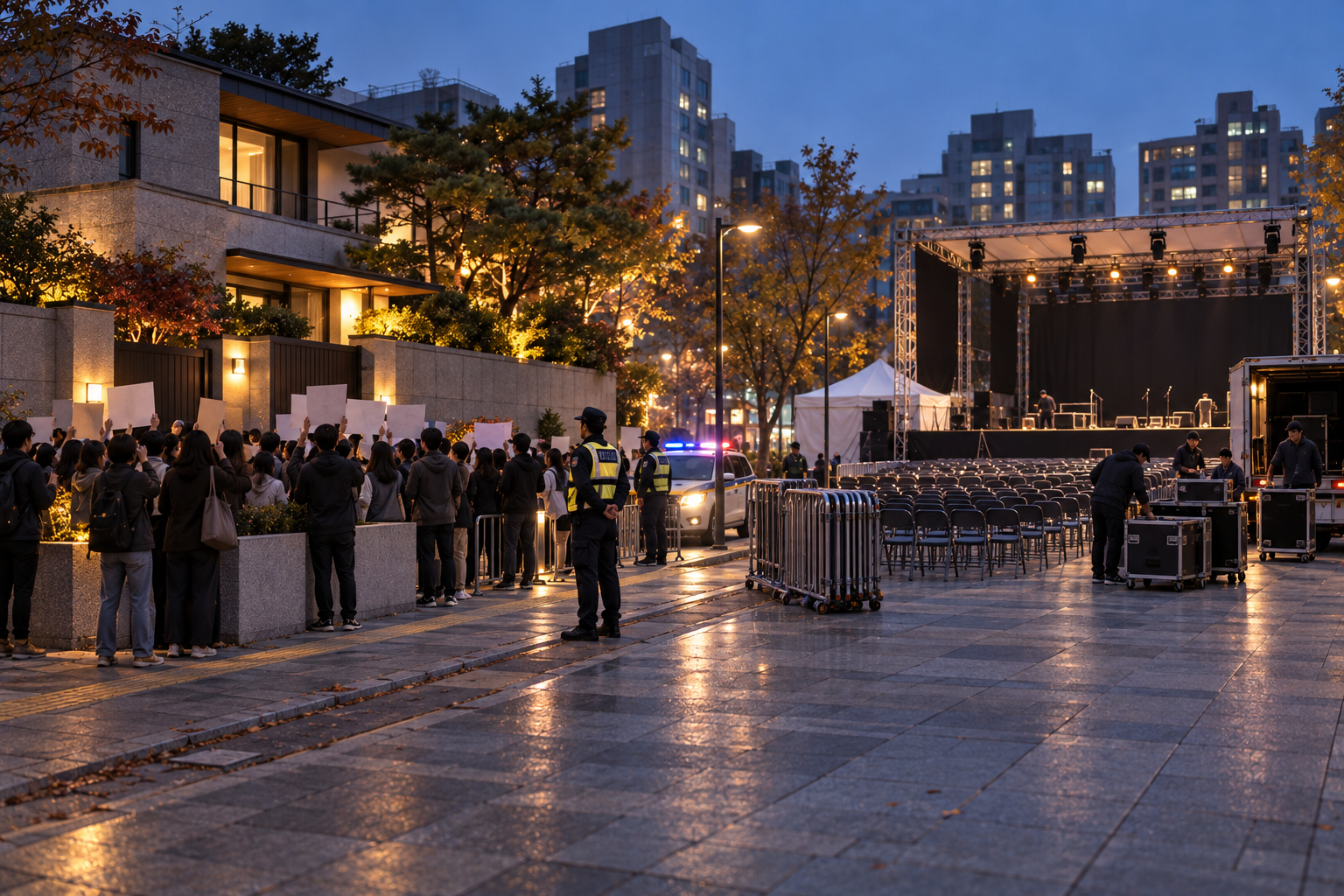
Activists then demonstrated near Yoo’s home in Seoul’s Seongbuk District and demanded that the film be withdrawn. VAST Entertainment said it was collecting material and would respond to conduct that threatened the actor’s privacy, safety or reputation. Culture Minister Chae Hwi-young asked police and other authorities to protect the filmmakers and respond to illegal threats and intimidation.
On October 6, Seoul Seongbuk Police Station gave Yoo a safety smartwatch, registered him with the emergency 112 system and increased patrols near his residence. The measures did not include a dedicated protection officer, but they marked a concrete shift: a disagreement over a film had created enough concern that police anticipated possible harm. The Korea Times reported the protective measures.
Pressure traveled through advertising
The campaign also moved into Yoo’s commercial work. Critics called for boycotts of products he endorsed and pressured companies connected to him. Kiwoom Securities halted an advertising campaign featuring the actor. A fast-food company restricted comments on promotional posts, while later saying the end of its short-term contract with Yoo was unrelated to the controversy.
Those details require care. A company changing a campaign is not proof that protesters dictated the decision. Public timing can still create a chilling signal. If brands treat an actor’s participation in a controversial work as a reputational risk, the consequences can extend beyond one film into future employment.
The same logic can reach less famous workers more quickly. A major star has an agency, legal resources and public attention. A screenwriter, assistant director, researcher or independent actor may have none of those protections. When political pressure follows workers away from the production and into their homes or unrelated jobs, the safest career choice becomes avoiding difficult history altogether.
The film industry drew a collective line
The Producers Guild of Korea and the Cinematographers Guild of Korea issued separate statements on October 2 warning that personal attacks, threats and exposure of private information had exceeded legitimate criticism. On October 5, a coalition of 19 organizations spanning production, directing, cinematography, art direction, theaters, festivals and independent film released a joint response.
The coalition did not ask audiences to accept the movie’s interpretation. It defended the right to dispute the work while arguing that participation in it should not place a person’s daily life or safety at risk. Korea JoongAng Daily documented the industry response.
That is an important boundary for a film industry increasingly drawn to modern Korean history. Recent productions have found large audiences by dramatizing political events and institutions. The commercial success creates incentives to revisit contested periods, but it also makes those films convenient targets in present-day political fights.
By October 5, 암살자(들) (The Assassin(s)) had drawn 2.23 million moviegoers, according to Korean Film Council data cited by Korea JoongAng Daily. The controversy did not remove the film from public life. It may have increased attention. What it did remove were planned encounters between audiences and the people who made it.
Criticism needs access, not intimidation
There is no requirement to treat a historical drama gently. Viewers can demand better sourcing, challenge omissions and compare a screenplay’s implications with archival evidence. Journalists can investigate the production’s claims. Families can describe the harm they believe a dramatization causes. Courts can address specific allegations of defamation or other unlawful conduct.
Those forms of response keep the work available for examination. Protests at a performer’s residence and threats that make public events unsafe work differently. They transfer the argument from the film to the private vulnerability of the people associated with it.
The practical consequence is not limited to Yoo Hae-jin. Festival audiences lost scheduled events. Other cast and crew lost opportunities to discuss their work. Employers were pulled into a political campaign. Future creators received a warning about what can happen when fiction approaches a disputed national memory.
암살자(들) (The Assassin(s)) can be criticized without making its participants personally unsafe. Korea’s film community is defending that separation because cultural debate depends on it. A public argument is strongest when the work remains visible, the evidence can be examined and the people involved can answer without being followed home.