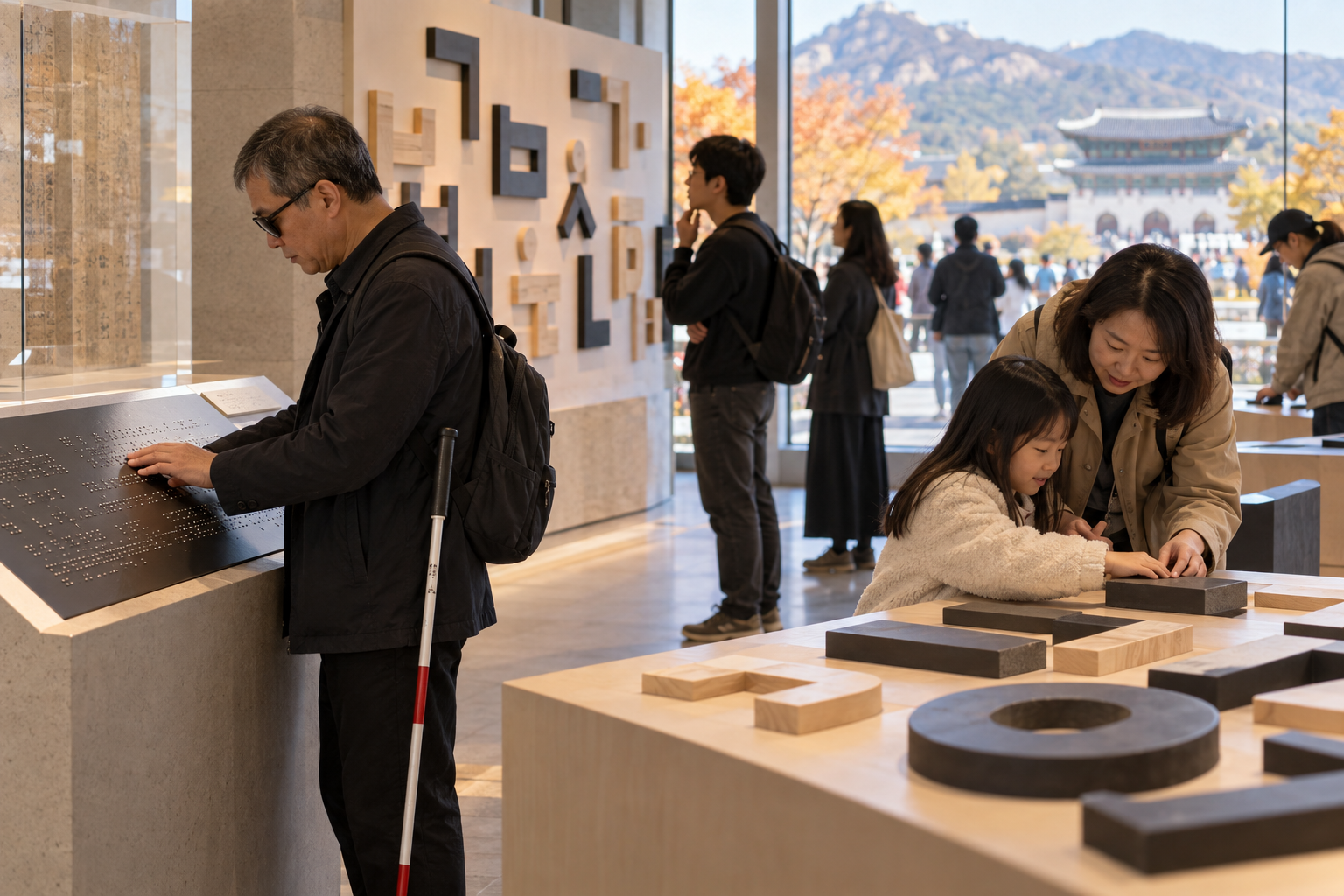
The centenary of Korea’s first Hangeul Day commemoration arrives alongside the 100th anniversary of Korean Braille. The strongest programs treat writing as access, not ornament.
Hangeul Day reaches an unusual milestone this year. In 1926, the Korean Language Research Society organized the first 가갸날 (Gagya Day) to mark the promulgation of Hunminjeongeum. A century later, the anniversary is being staged across public squares, museums and temporary learning spaces rather than through a single ceremony.
The calendar carries three overlapping histories. It is 580 years since the promulgation of Hunminjeongeum, 100 years since the first Gagya Day, and 100 years since Park Du-seong introduced 훈맹정음 (Hunmaengjeongeum), the six-dot Korean Braille system.
That overlap makes 2026 more useful than a conventional anniversary year. It shifts attention from the visual prestige of Hangeul to a harder question: who can use a writing system, learn it and participate in public life through it?
A commemoration moved into public space
The National Hangeul Museum’s Hangeul Week runs from October 6 through 17. Its central public program, Hangeul Hanmadang, occupies Gwanghwamun Square from October 6 through 8. The museum is also running the free 우리 곁에 한글날 (Hangeul Day Beside Us) program at the former officers’ quarters in Yongsan Park through October 11.
The venues matter. Gwanghwamun is closely associated with King Sejong, state ceremony and national memory. Yongsan Park offers a more informal setting built around making postcards and Hangeul lanterns, learning about Sejong and taking part without an advance reservation.
Together they turn the anniversary into a spectrum of participation. One space carries civic symbolism; the other treats the script as something handled, assembled and used by families. Neither requires the visitor to enter a specialist language institution.
This is also a practical response to the National Hangeul Museum’s own circumstances. Its main Yongsan building is not the only place where Hangeul culture can be presented. Partnerships and temporary sites distribute the work across the city and beyond it.
The centenary exhibition asks how a holiday survives
The special exhibition 일구이륙 무한이륙 (From 1926 to Infinity) opened at the National Museum of Korean Contemporary History on October 2 and continues through February 9. Organized with the National Hangeul Museum, the Korean Language Society and the King Sejong Memorial Society, it follows the learning materials and cultural practices that carried Gagya Day into the present.
That history is less tidy than the annual red date on a calendar suggests. The commemoration began under colonial rule, changed names, moved dates as historical records were reassessed, and gained and lost legal status before returning as a public holiday.
The exhibition’s value lies in presenting Hangeul Day as an institution people built and defended. A national commemoration can appear inevitable once it becomes routine. The centenary restores the decisions, organizations and teaching practices that made the routine possible.
It also places learning at the center. Hangeul is often promoted through the elegance of its shapes or the logic of its design. Those qualities matter, but a script becomes public culture through primers, classrooms, newspapers, signs and the repeated labor of teaching people to read.
Korean Braille changes the meaning of the anniversary
The clearest argument for treating this year as an access project opens on October 7 at the National Museum of World Writing Systems in Incheon. 점에서 세상으로: 훈맹정음 100주년 (From Dots to the World: 100 Years of Korean Braille) traces the system Park Du-seong introduced in 1926.
Hunmaengjeongeum adapted six-dot Braille to Korean. Its importance is not symbolic duplication—a tactile version of a celebrated alphabet—but the expansion of education and communication for blind readers. The exhibition follows that history into the present and asks what another century of accessible writing should require.
Placing the Braille centenary beside the Hangeul Day centenary corrects a common weakness in language celebrations. A writing system is not fully public because a majority can read it. Public access depends on teaching, format, technology and the removal of barriers that make literacy easier for some people than others.
The same standard should apply to the anniversary programs themselves. Exhibitions about inclusive writing need tactile material, audio description, navigable spaces and digital information that visitors can actually use. The subject sets a higher bar for the institution presenting it.
Hangeul is being presented as a living tool
The centenary program avoids reducing Hangeul to calligraphy, typography or a national logo. Those visual forms remain present, but they sit beside education, local speech, children’s play, Korean-language learning and Braille.
That breadth matches the history being commemorated. The first Gagya Day was not a branding exercise. It was an assertion that Korean could organize modern learning and public knowledge. Hunmaengjeongeum made a parallel claim: the right to read should not be limited by the format in which writing is delivered.
One hundred years later, the most convincing tribute is therefore not a larger monument. It is a wider field of use.
The 2026 program makes that field visible across Seoul and Incheon: a square, a former residential compound, a history museum and a museum devoted to the world’s writing systems. The geography is dispersed, but the principle is consistent. Hangeul survives because people keep making it available.