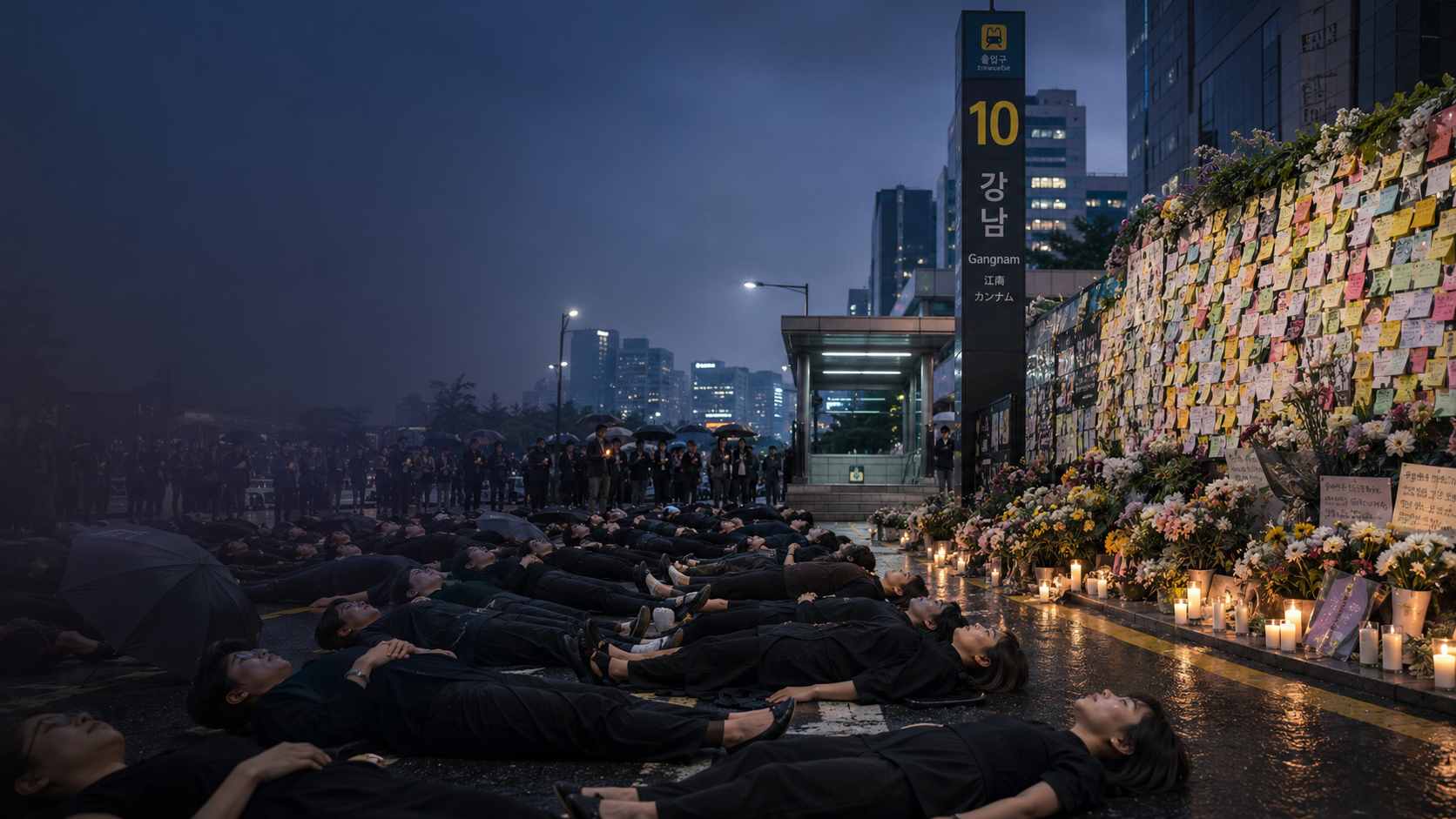
On May 17, hundreds of people dressed in black gathered near Gangnam Station Exit 10 in Seoul. They held signs against violence targeting women, filled the wall again with handwritten memorial notes, and finally lay down across the road in a mass die-in performance. The act was stark and deliberate: ten years after the Gangnam Station murder became a turning point for Korean feminism, participants wanted the country to see that grief had not faded into private memory. It had become public action.
The memorial marked the 10th anniversary of the 2016 killing of a 23-year-old woman in a public restroom near Gangnam Station. The perpetrator, a man who did not know her, said women had ignored him; the case ignited mass outrage because many women saw it not as random violence but as violence made possible by misogyny and social indifference. The Hankyoreh notes that he had ignored several men who entered before the victim and targeted the woman when she came in.
The latest memorial action, shared on Dmitory through a reposted news article, described about 500 participants and 157 women’s and civic organizations joining the anniversary event. The event’s central slogan translated to “We who survived will change the world,” a line that has come to carry both mourning and defiance in Korean feminist activism.
The die-in was not simply symbolic theater. A die-in is a protest in which participants lie still as if dead to represent lives lost or lives endangered. At Gangnam Station, the image of bodies filling the road replaced the image from 2016: a wall covered with sticky notes. Ten years ago, those notes expressed shock, fear, anger, and the realization that the victim’s death felt painfully close to many women’s own daily sense of risk. This year, the bodies on the road carried the same message in a more physical form: remembrance is not enough when similar violence continues.
The anniversary also came shortly after another case that intensified public anger. Reports cited the May 5 killing of a teenage girl in Gwangju by a man she did not know, connecting it to the broader fear that women and girls remain vulnerable in public spaces. The Hankyoreh described the Gwangju case as part of why activists saw the Gangnam Station anniversary as urgently relevant rather than historical.
Korean women’s groups have also pointed to longer-term numbers. Korea Women’s Hot Line, a major women’s rights organization, reported that in 2025 at least 137 women were killed by male intimate partners in cases covered by the media, and at least 389 women were killed or survived attempted killings in such intimate-partner cases. The group emphasized that these figures are based on reported media cases, meaning the real scale may be larger.
That data matters because activists argue that Korea still lacks an adequate official system for tracking femicide and misogyny-based violence. Korea Women’s Hot Line has said it has compiled annual reports on such killings since 2009 to expose the severity of violence against women and to push for official statistics.
The 10th anniversary events were therefore not only about memorializing one victim. They were also a criticism of policy failure. A Kyunghyang Shinmun report ahead of the anniversary quoted civic groups calling femicide a systemic problem rather than personal misfortune, and urging the government to treat repeated violence against women as a structural safety issue.
This distinction is central to why Gangnam Station remains such a powerful name in Korea. To some, the 2016 killing was an isolated crime. To many Korean women, it revealed something broader: the fear that ordinary spaces—restrooms, streets, workplaces, homes, schools—can become dangerous because women are treated as acceptable targets for male anger. That is why Gangnam Station became connected in public memory to later movements against workplace sexual abuse, illegal filming, stalking, digital sex crimes, and deepfake abuse.
The anniversary also showed the persistence of backlash. According to the Dmitory-linked article, organizers could not use the usual memorial space because an anti-feminist group had occupied it in advance, while a small counter-protest took place nearby. This detail captures the tense climate around feminism in Korea: even memorializing a murdered woman can become a contested public act.
Yet the turnout suggested that the movement has not disappeared. The same report said more than 6,500 people joined a nationwide women’s declaration pledging not to forget Gangnam Station. For activists, that number is not just a petition count. It is evidence that the memory of 2016 has become part of a continuing civic network.
The question now is whether Korea’s institutions will respond with more than temporary measures. After the 2016 murder, authorities announced safety steps such as more emergency bells, cameras, crime-prevention teams, and restroom-related measures. Critics quoted by the Hankyoreh argue that these responses addressed visible symptoms more than the underlying gendered nature of violence.
Ten years later, the scene at Gangnam Station was therefore both a memorial and an indictment. The participants lying in the road were not only remembering a woman killed in 2016. They were asking why, after a decade of mourning, women still have to explain that their fear is rational, their anger is political, and their safety should not depend on whether society chooses to believe them.



Leave a Reply