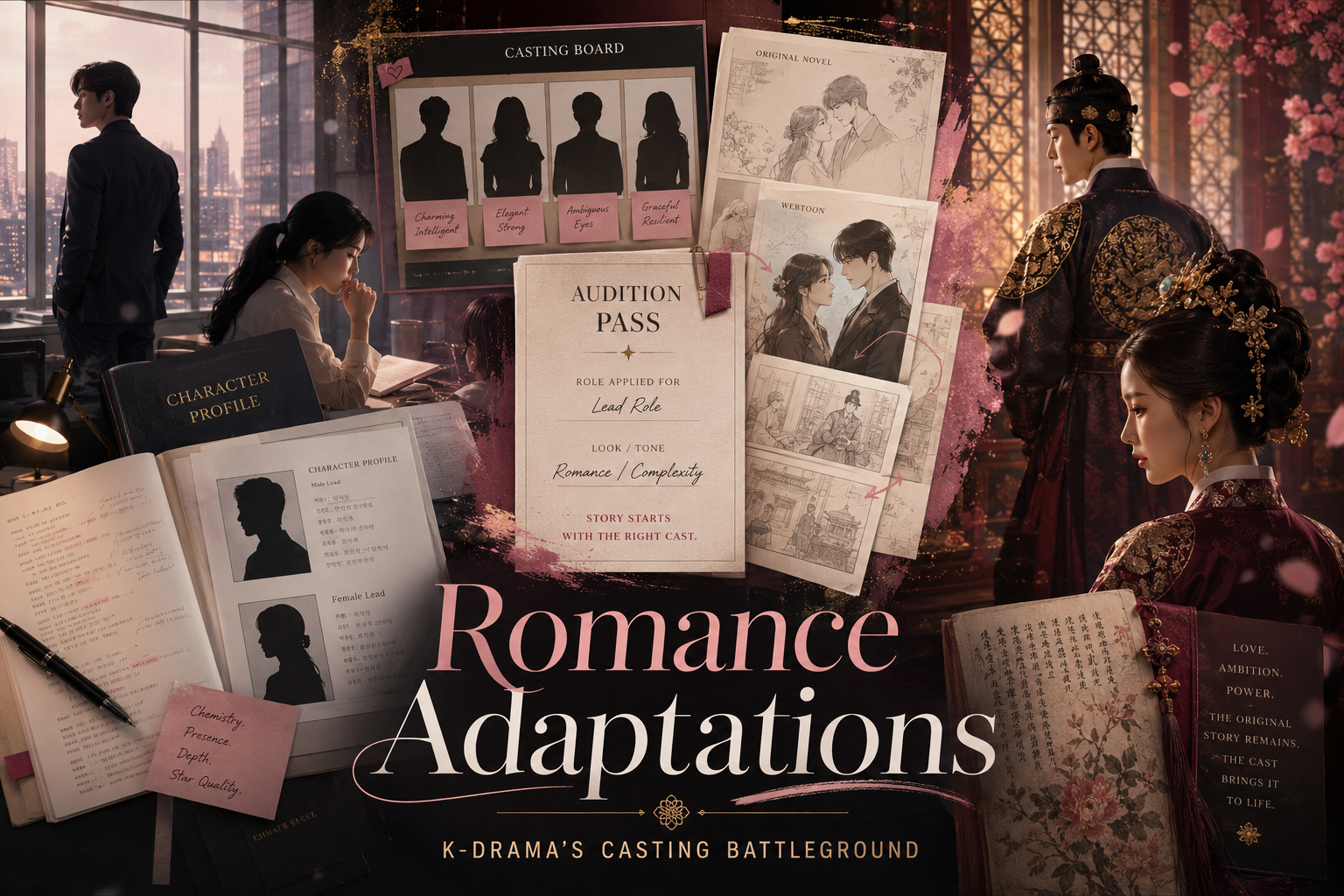
Korean romance fiction is moving deeper into the K-drama production pipeline, and the latest cluster of reported adaptations shows how quickly the genre is becoming a strategic source of screen IP. Across office romance, corporate succession drama, palace romance, and darker psychological romance, titles that began as novels, web novels, or webtoons are now being assembled for live-action drama through confirmed castings, agency-reviewed offers, and production-company packages.
The most concrete examples are Iseop’s Romance and A Casual Lie, two connected romance adaptations based on works by Kim Eon Hee. Lee Jong Suk has been announced for Iseop’s Romance, while Lee Jun Hyuk has been announced for A Casual Lie. The two dramas are set in the same fictional universe and are scheduled to be produced simultaneously, with filming expected to begin within the year.
That shared-universe structure makes the pair more than a standard adaptation announcement. Iseop’s Romance centers on Tae I Seop, a third-generation chaebol heir, and Kang Min Kyung, a highly capable TK Group employee. A Casual Lie follows Tae Jun Seop, grandson of TK Group’s chairman, and Yeon Woo Kyung, a copywriter who becomes drawn into both romance and a corporate succession race. The two male leads are cousins, connecting the stories through TK Group and giving the projects room to operate as parallel romances inside one broader corporate world.
Production reporting around the pair also suggests a more ambitious adaptation strategy. Zapzee reported that Bon Factory, Ace Factory, and A-Man Media are involved, with the two series being developed in tandem and production planned for later this year. That combination of established romance IP, name actors, and linked story-world design makes Iseop’s Romance and A Casual Lie the clearest examples of Korean romance fiction being packaged for drama expansion rather than adapted one title at a time.
The casting around A Casual Lie also shows why production-status language matters. Lee Jun Hyuk’s role is confirmed, but Gong Seung Yeon’s participation has not been finalized. Her agency VARO Entertainment confirmed that she received an offer, while emphasizing that no final decision had been made. In adaptation coverage, that distinction is important: “confirmed,” “offered,” “reviewing,” and “in talks” all describe different stages of the production process.
The historical-romance lane is represented by The Princess Covets the Scholar, a palace romance based on a webtoon of the same name. OSEN, carried in Chosun’s English edition, reported that Yoo Yeon Seok and Lee Se Young received the script, reviewed it positively, and decided to appear. The project has been described as a romance historical drama combining court romance and political period-drama elements.
That makes The Princess Covets the Scholar part of a familiar but durable K-drama mode: emotionally direct romance framed by family conflict, court politics, and the heightened stakes of historical setting. The project’s appeal is not only the central couple, but the built-in dramatic scale that comes with palace settings. Romance adaptations of this kind give producers a ready-made emotional hook while still allowing for political intrigue, family opposition, and visual spectacle.
The Palace Is Home to Dog Flowers moves further into fictional-court melodrama. The drama is based on Yoon Tae Roo’s historical romance web novel and has been linked to Park Eun Bin and Kim Jae Won. Soompi reported that Kim Jae Won received an offer for the male lead role and that his agency Mystic Story said he was reviewing it; the same report noted Park Eun Bin was also in talks for the project. Chosun’s English coverage reported Scene & Studio as the production company, with broadcast and streaming options still under discussion.
That status places The Palace Is Home to Dog Flowers in a different category from the confirmed Lee Jong Suk and Lee Jun Hyuk projects. It is not merely rumor, but it also has not reached the same level of finalized casting or platform clarity. The project is best understood as an active adaptation package: a known source work, a reported production company, high-profile actors under offer or review, and distribution still being negotiated.
Flowers Are Bait points to a darker side of the same trend. The title has been reported as an SBS drama planned for 2027, with Woo Do Hwan and Chae Soo Bin linked to the lead roles. VvipTimes described it as a black romance based on a web novel, with Why Not Media and Kim Jonghak Production named as production companies and May 2027 listed as the expected broadcast window. Because the available production details are still circulating primarily through entertainment reporting rather than a broad broadcaster or agency rollout, the safer reading is that Flowers Are Bait is a reported developing project rather than a fully settled broadcast product.
Taken together, these projects show how Korean romance IP is being sorted into several drama-ready lanes. The office-romance and corporate-succession lane offers workplace tension, chaebol family structure, and connected-universe potential. The historical-romance lane offers court politics, forbidden affection, and high visual appeal. The darker romance lane brings psychological tension and more mature emotional stakes. What unites them is not setting, but production logic: each title arrives with preexisting story architecture and an audience already familiar with the emotional premise.
This is why casting has become such a decisive early stage for romance adaptations. In action, thriller, or fantasy projects, scale and worldbuilding can dominate the first wave of attention. In romance, the central question is often more immediate: can the actors carry the emotional fantasy of the source material? The answer depends on star image, chemistry, tone, and whether the casting fits the character dynamic readers already associate with the work.
For producers, romance fiction offers clear advantages. It provides tested relationships, recognizable character archetypes, serialized story engines, and source material that can be marketed before a drama airs. For actors, these adaptations offer roles with built-in emotional intensity and established fan interest. For platforms and broadcasters, they can reduce some of the uncertainty that comes with launching original romance dramas from scratch.
The risk is that romance IP also carries unusually specific expectations. A corporate romance lead must balance power and vulnerability. A palace-romance heroine must feel both emotionally compelling and credible inside a political world. A darker romance pairing must convince viewers that intensity, danger, and attraction can coexist without flattening the story. Casting is therefore not cosmetic. It is the first visible production decision that tells audiences how the adaptation understands the original work.
The current wave of Korean romance adaptations should be read less as scattered casting news and more as an industrial pattern. Romance novels, web novels, and webtoons are becoming a steady source of K-drama development, while production companies and broadcasters test how far connected universes, palace melodramas, and darker romantic premises can travel on screen.
The next test will come as these projects move from announcements and casting reports into filming, platform confirmation, and first-look promotion. For now, the pattern is already clear: Korean romance fiction is no longer just feeding the drama pipeline. It is shaping the pipeline’s casting logic, production strategy, and next wave of screen fantasies.