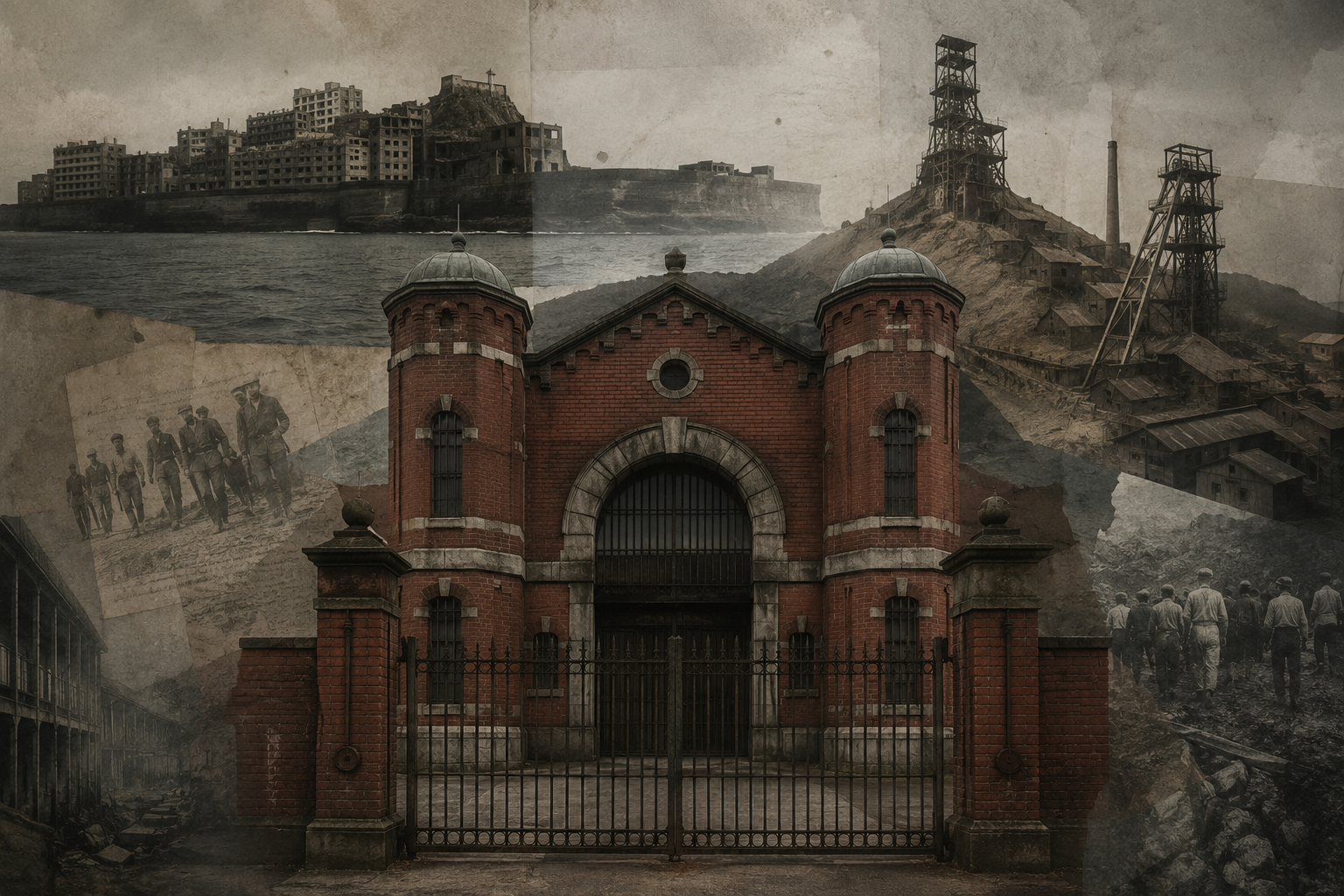
The Nara Prison hotel, Hashima and Sado expose a recurring struggle over Japanese heritage: whether imperial violence is confronted as wrongdoing or repackaged as modernization, beauty and national prestige.

Hoshino Resorts
When Hoshino Resorts opened HOSHINOYA Nara Prison on June 25, 2026, it presented the former penitentiary as a triumph of architectural preservation. The 48-room hotel occupies the only almost completely intact survivor of Japan’s “Five Great Prisons of Meiji.” Its official concept, “From Historic Walls to Timeless Elegance,” promises guests a luxury experience inside a structure originally built, in the company’s own words, to symbolize the prestige of a modernizing nation. (hoshinoresorts.com)
Two months earlier, the company had opened the adjoining Nara Prison Museum. Unlike the hotel advertising, the museum does address incarceration, discipline, prison life and the meaning of freedom. Its exhibitions invite visitors to consider the regulated lives of inmates and the “social structure of incarceration.” Yet its dominant public framing still begins with the beauty of the red-brick architecture, the modernization of Japan’s judicial system and the supposed early concern for rehabilitation and human rights embodied by the prison’s design. (hoshinoresorts.com)
The issue is not simply about sleeping in a former prison.
It concerns what happens when the architecture of coercion is preserved more carefully than the memory of the people coerced within it.
It concerns a state and its cultural institutions retaining the bricks, machinery and administrative achievements of empire while allowing the victims, laws and political purposes of that empire to recede into the background.
And it raises a larger question extending beyond Nara: When does preservation become a way of forgetting?
The problem is not remembrance. It is remembrance without judgment.

Hoshino Resorts
A difficult site should not necessarily be destroyed. Demolishing prisons, labor camps or mines can eliminate physical evidence and make denial easier. Adaptive reuse and World Heritage designation can protect structures that might otherwise disappear.
The issue is therefore not whether an imperial prison may be preserved, whether an industrial mine may receive heritage status, or even whether a former prison can ever contain a hotel.
The issue is the moral structure of the story told around it.
Does the interpretation identify who possessed power and who was subjected to it? Does it name the political system that produced the suffering? Are victims central to the site, or are they confined to an optional display, a QR code or an archive most visitors will never see? Does the institution acknowledge wrongdoing and explain why it must never recur? Or does it offer a generalized meditation on “freedom” while avoiding the historical actors who took freedom away?
UNESCO’s broader principles for sites associated with recent conflicts provide a useful ethical standard. They call for factual accuracy, meaningful participation by affected communities, multiple evidence-based narratives and interpretation that presents the full history of a place. UNESCO also warns that one-sided narratives can produce exclusion and renewed injustice rather than reconciliation. Those principles do not automatically govern every industrial or architectural property, but they describe the minimum moral discipline required whenever suffering is converted into heritage. (whc.unesco.org)
This article uses the term memory laundering for the opposite process: the physical site survives, but responsibility is filtered out. Architecture becomes “beauty.” Expansion becomes “modernization.” Coercion becomes “labor.” Empire becomes a neutral historical period. Victims become supplementary information while the achievements of the state remain the main attraction.
Political scientist Ryoko Nakano has described a comparable process in Japan’s promotion of its Meiji industrial sites. Her research argues that a celebratory narrative of Meiji modernization encourages the forgetting of Korean forced labor, colonialism and war, pushing alternative memories away from the internationally promoted heritage story. (cambridge.org)
Nara Prison should be understood within that wider politics of selection.
The people missing from the luxury narrative

Hoshino Resorts
One of the Korean activists imprisoned at Nara was Jeong Hwi-se, a labor organizer involved in Korean political and youth movements in Kyoto and Osaka.
Jeong joined a Korean labor union in Kyoto, became one of its leading organizers and participated in the Kyoto branch of the Shinganhoe, a Korean nationalist organization. He was also active in the Japanese branch of the Korean Communist Youth League. Japanese authorities arrested him during a crackdown on Korean political organizing, and the Kyoto District Court sentenced him to three years in prison in May 1931 under the Peace Preservation Law.
After initially being held in Kyoto, Jeong was transferred to Nara Prison. South Korea’s Ministry of Patriots and Veterans Affairs records that he died there on November 24, 1931, from the aftereffects of torture. The South Korean government posthumously awarded him the Patriotic Medal of the Order of Merit for National Foundation in 2006. (e-gonghun.mpva.go.kr)

Hoshino Resorts
Another Korean activist incarcerated at Nara was Park Se-yong, also known as Park Hwi-il.
Park organized Korean workers in Japan’s Toyama and Hokuriku regions and took part in anti-colonial labor activity. He was arrested during a mass detention of unionists in November 1931 and received a six-year sentence. After approximately two years in Kanazawa Prison, he was transferred to Nara.
Park developed pleurisy and pulmonary tuberculosis. He was conditionally released in June 1935 because of his deteriorating health but continued to suffer from the effects of his imprisonment. He died on August 12, two months after his release. South Korea posthumously awarded him the National Medal of the Order of Merit for National Foundation in 2006. (search.i815.or.kr)
Their cases should not be merged into a single simplified story. Jeong died inside Nara Prison, and the official Korean record attributes his death to the aftereffects of torture. Park died after his release following serious illness and physical deterioration during incarceration.
Together, however, their histories establish something the hotel’s luxury framing does not: Nara Prison was part of the carceral reach of an imperial state that prosecuted Korean labor organizers and anti-colonial activists.
The principal public-facing English materials and historical timeline reviewed for this article do not name Jeong or Park. The hotel foregrounds architectural beauty, Meiji prestige, early globalization and cultural preservation. The museum foregrounds Japanese corrections, discipline, rehabilitation, art and philosophical questions about freedom. (hoshinoresorts.com)
That finding does not prove that no object, caption or guided program inside the physical museum mentions Korean prisoners. A complete judgment of the on-site exhibition would require a systematic visit and catalogue review.
It does show that two documented Korean prisoners—one of whom died within the institution from torture-related injuries—are not central to the story presented to prospective visitors.
Their absence is not a minor gap in an otherwise neutral chronology. It changes the moral identity of the site.
What Nara’s timeline does with 1910

Hoshino Resorts
The politics of heritage often operates through dates.
Nara Prison’s official online chronology describes its history as moving alongside the history of modern Japan. It includes international treaties, wars, legal reforms, world exhibitions and major political events. For 1910, however, the timeline records two matters: the prison exceeded its official capacity, and a model of the institution was displayed at the Japan–British Exhibition to demonstrate Japan’s modernized prison system. (hoshinoresorts.com)
The timeline does not mention that 1910 was also the year Japan formally annexed Korea. Japan’s own National Diet Library records that the annexation treaty was signed on August 22, 1910, after which Japan annexed Korea. (ndl.go.jp)
This omission is revealing because the official timeline is not narrowly confined to developments inside the prison. It deliberately includes events “within and without Japan.” It finds room for the first modern Olympic Games, the Japan–US treaty, the Sino-Japanese War, the Russo-Japanese War and world fairs.
Yet at the precise point when Japan’s modern state formally absorbed Korea, the chronology offers overcrowding figures and an exhibition model advertising prison modernization.
The entries are not factually false. The model was displayed. The prison was overcrowded.

Hoshino Resorts
But factual accuracy is not the same as historical adequacy.
A timeline is an argument about significance. Its inclusions tell visitors which events belong to the site’s meaning and which can be treated as external. At Nara, the expansion of Japan’s imperial authority is separated from the development of its legal and correctional institutions—even though Korean subjects of that empire would later be prosecuted and confined within those institutions.
Modernization and imperialism were not two unrelated Japanese histories. The modern courts, police forces, prisons and political laws celebrated as evidence of national advancement also supplied the administrative machinery through which dissent and anti-colonial resistance could be suppressed.
The prison cannot be understood merely as a benevolent attempt to meet international standards. Its history must also ask what the modern state did with the institutional power it acquired.
Seodaemun Prison demonstrates another choice

Photo by Noh Mun Duek
The visual resemblance between Nara Prison and Seodaemun Prison intensified the Korean response because Seodaemun has a fundamentally different public identity.
Seodaemun opened in Seoul in 1908, the same year Nara Prison was completed. During Japanese colonial rule, it held numerous Korean independence activists. Its surviving prison buildings, interrogation facility and execution ground are now presented as a historical and educational site centered on people who endured torture and sacrificed their lives in the struggle for independence. Its prisoner records have also been made available through a searchable archival database. (sdm.go.kr)
Nara and Seodaemun were not administratively identical, but both belonged to the carceral order of Japanese imperial power. Nara Prison formed part of the Meiji government’s metropolitan penal system. Gyeongseong Prison—later Seodaemun—was established in 1908 under pressure from the Japanese Residency-General and through a Japanese-led administration; after Japan’s 1910 annexation of Korea, it was administered through the Government-General of Korea’s colonial apparatus. The relevant distinction is therefore between the metropolitan and colonial branches of the same empire, not between separate or unrelated authorities.
The important contrast lies in their contemporary moral centers.
At Seodaemun, architecture serves the story of the incarcerated. The cells matter because of the people confined in them. The prison’s historical meaning is organized around colonial repression, resistance and sacrifice.
At Nara, the public-facing story remains organized principally around the building: its brickwork, radial plan, modernity, preservation and transformation.
That is not an unavoidable difference between a museum and a hotel. It is an interpretive decision.
Nara could preserve its architecture while making Korean and other political prisoners indispensable to its identity. Seodaemun demonstrates that preserving a prison does not require admiring the authority that built it.
Hashima: World Heritage and the historical cutoff

Photo by kntrty
The “mine island” often invoked in this discussion is Hashima, commonly known as Gunkanjima or Battleship Island. It is one component of the 23-part “Sites of Japan’s Meiji Industrial Revolution,” inscribed on UNESCO’s World Heritage List in 2015.
UNESCO did not designate forced labor as a human achievement. The property was inscribed for its industrial significance: the transfer and adaptation of Western technology and Japan’s rapid development of iron, steel, shipbuilding and coal mining. Its formally recognized period of Outstanding Universal Value runs from the 1850s to 1910. Hashima Coal Mine is specifically identified as one of the components. (whc.unesco.org)
The date boundary is historically consequential.
The recognized industrial story ends in 1910. Korean and other wartime workers subjected to coercive labor at some of the sites arrived decades later, particularly during the 1940s.
A period can be legitimately defined for evaluating a site’s architectural or technological significance. But that period cannot become a moral border beyond which later human suffering is treated as irrelevant. A mine does not stop having history when its nomination period ends.
UNESCO recognized this problem from the beginning by requesting interpretation that would permit an understanding of each site’s full history. In 2021, the World Heritage Committee went further. It “strongly regretted” that Japan had not fully implemented the relevant decisions and explicitly requested measures explaining that large numbers of Koreans and others had been brought against their will and forced to work under harsh conditions. It also called for an account of the Japanese government’s requisition policy and appropriate measures to remember the victims, including history outside the period covered by the property’s formal World Heritage value. (whc.unesco.org)
The record since then is not one of complete inaction. In 2023, UNESCO acknowledged that Japan had taken additional measures and made progress. At the same time, it urged continued implementation, further research, verification of testimonies and dialogue with concerned states. (whc.unesco.org)
That distinction matters. The responsible criticism is not that Japan has done literally nothing. It is that recognition of the victims has repeatedly required external negotiation, UNESCO monitoring and sustained pressure, while the celebratory narrative of Meiji industrial achievement was ready from the beginning.
The achievement received the headline. The coercion became an interpretive obligation to be fulfilled later.
That hierarchy is itself part of the problem.
Sado: a second mining controversy

Photo by 番記者
Sado Island Gold Mines is a separate World Heritage property, inscribed in 2024.
Its officially recognized value is concentrated on unmechanized mining and social organization during the Edo period, particularly from 1603 to 1868. As with Hashima, UNESCO recognition was not granted for twentieth-century coercive labor. It was granted for mining technology and the surviving industrial landscape. (whc.unesco.org)
But Koreans were later mobilized to work at Sado under Japanese colonial rule.
At the 2024 World Heritage Committee session, Japan promised to present the mine’s whole history, including workers from the Korean Peninsula. The Japanese delegation’s own statement acknowledged that wartime requisition made labor compulsory, that violations could result in imprisonment or fines, that Korean workers were disproportionately assigned to dangerous underground jobs, and that records documented food shortages, labor disputes, escapes and imprisonment. Japan also promised an annual memorial event for workers. (mofa.go.jp)
Those acknowledgements are significant. They demonstrate that a fuller interpretation is possible within Japan’s own official language.
But the implementation remains under scrutiny.
A state-of-conservation assessment prepared for UNESCO’s July 2026 World Heritage Committee session says that current interpretation appears to respond only in part to the request for a comprehensive account. It notes an Aikawa History Museum exhibition concerning mine workers, including Koreans, but says the available information remains too limited to determine whether the property’s whole history is effectively conveyed throughout the site. The draft recommends further clarification and continued dialogue with concerned parties. (whc.unesco.org)
As of July 20, 2026, this remains a draft before the Committee rather than a final adopted decision; the 48th session is taking place in Busan from July 19 to 29. (whc.unesco.org)
Once again, the central issue is not whether a museum panel exists somewhere.
It is whether the colonial history is structurally central to the visitor’s understanding of the place—or whether it remains a qualification attached to a dominant narrative of technical achievement and national pride.
How memory becomes disguised
The Nara, Hashima and Sado controversies are not identical, but they reveal several recurring mechanisms.
Architecture replaces agency
At Nara, the prison’s arches, red bricks, central guard station and radial cell blocks are treated as objects of beauty and innovation. The buildings appear to speak for themselves.
But buildings do not explain who ordered arrests, which laws were enforced, who was tortured or why political organizing was criminalized.
When architecture becomes the main protagonist, state power disappears into design.
Periodization separates achievement from consequence
At Nara, 1910 is remembered through a model displayed at an international exhibition rather than through annexation. At the Meiji industrial sites, the formally recognized period ends in 1910, decades before the forced labor that later occurred at some components. At Sado, the World Heritage value ends in 1868, separating Edo-period technology from twentieth-century colonial mobilization.
Each historical period may be defensible for a narrowly defined conservation assessment.
The distortion occurs when the period of recognized value becomes the limit of public responsibility.
Abstraction replaces named victims
“Freedom,” “human rights,” “workers,” “hardship” and “history” can all be legitimate terms. They can also become evasive when they replace names, political systems and documented acts.
At Nara, a universal meditation on freedom is easier to market than the specific history of Jeong Hwi-se dying from the aftereffects of torture.
At a mining memorial, commemorating “all workers” may be inclusive. But it can also blur the distinction between ordinary employment and the status of colonized Koreans compelled through wartime mobilization and requisition.
Universal language is ethically useful only after specific injustice has been named, not instead of naming it.
Victim history is displaced from the principal experience
A visitor should not have to locate a side room, scan a code, consult a research archive or travel to a distant information center to encounter the most morally consequential history of a site.
At Nara, the hotel’s prestige language reaches the visitor before any account of Korean prisoners. At Sado, UNESCO’s 2026 assessment questions whether references at one museum are sufficient to convey the whole history at site level. At Hashima, the main international identity was established through industrial achievement while victim remembrance became the subject of later compliance and diplomatic dispute. (hoshinoresorts.com)
Information can technically exist while remaining narratively marginal.
Commercialization fixes the emotional register
Luxury branding does more than preserve a building. It tells visitors how to feel about it.
The Nara hotel invites admiration, curiosity, exclusivity and escape. The cells become suites; institutional severity becomes atmosphere; the architecture of surveillance becomes a rare travel experience.
Commercial use does not automatically make responsible interpretation impossible. But it gives the operator a stronger obligation to prevent suffering from becoming aesthetic texture.
The more profit a project derives from a coercive site’s uniqueness, the less acceptable it is to treat the people harmed there as optional background.
To understand what a more accountable approach to such sites might look like, it is useful to consider another society’s treatment of places associated with state persecution—without collapsing fundamentally different histories into an equivalence.
A comparison must clarify, not equate
Germany’s treatment of sites connected to National Socialism offers a useful comparison, provided that the histories are not collapsed into one another. The Holocaust was a distinct, systematic project of genocide. Japanese colonial repression in Korea had its own institutions, chronology, objectives and forms of violence. Comparison is legitimate only when it helps identify differences as well as shared questions of responsibility.
The relevant comparison is therefore not between the scale or nature of the crimes. It is between the principles used to interpret places where states persecuted human beings.
Germany’s present memorial culture was not established immediately after 1945. For years, much of German society avoided responsibility, minimized personal involvement or treated the Nazi period as something to be left behind. The more self-critical culture visible today developed gradually through survivor testimony, civic campaigns, historical research, political confrontation and institutional reform. Germany’s response remains contested and incomplete, but several principles have become central: historical sites should identify perpetrators, name victims, preserve evidence, support education and connect remembrance to the defense of democracy.
One instructive example is Stuttgart’s Hotel Silber. The building served as a regional Gestapo headquarters during the Nazi period. When redevelopment plans threatened it with demolition, a citizens’ campaign fought to preserve it. It ultimately became a public place of historical and civic education whose exhibition examines the Gestapo, the police, persecution, victims, perpetrators and postwar institutional continuities.

Photo by Silesia711
Hotel Silber is not identical to Nara Prison, just as Japanese colonial repression should not be equated with the Holocaust. The comparison nevertheless exposes a consequential difference in treatment. In Stuttgart, the former site of repression was made to confront the institution that operated there. At Nara, the architecture of imprisonment has become part of a luxury experience while documented Korean prisoners remain peripheral to the site’s public identity.
Jewish memorial institutions offer another relevant principle: remembrance should restore individuality to those whom oppressive systems attempted to erase. Names, biographies, testimony and family histories are not secondary additions to a building’s architectural story. They are the moral center of the site. Applied to Nara, that principle would require Jeong Hwi-se, Park Se-yong and other prisoners to become part of the main historical narrative rather than material left for specialized archives.
The lesson is not that Japan must imitate every feature of German memorial culture. Nor is Germany a completed model of repentance. The lesson is that preservation becomes ethically meaningful only when the institution identifies responsibility, gives victims narrative authority and explains why the abuses were wrong. Without those elements, heritage can preserve the appearance of history while protecting the nation from its moral meaning.
This comparison does not provide Japan with a ready-made formula. It does, however, clarify the principles that genuine historical accountability would require at Nara, Hashima and Sado.
What genuine regret would require
Regret does not mean demanding hereditary guilt from every living Japanese person.
It means requiring institutions that inherit the authority, property, prestige or economic benefit of the past to accept responsibility for telling the truth about it.
Institutional regret begins by identifying agency. It says which government enacted the laws, which authorities enforced them, which companies or institutions benefited, which populations were targeted and why the conduct was wrong.
It does not hide behind the passive voice.
At Nara, Jeong Hwi-se and Park Se-yong should appear in the museum’s central chronology and in the hotel’s public historical material. Their stories should be available in Japanese, Korean, English and other visitor languages. The exhibitions should explain the Peace Preservation Law, Japanese colonial rule, the suppression of Korean political and labor organizations, and the relationship between Japan’s modern legal institutions and its expanding empire.
A permanent memorial should be developed with Korean historians, descendants, labor researchers, Japanese scholars and relevant civic organizations. Its content should not be controlled solely by the hotel operator or by institutions invested in celebrating Meiji modernization.
The hotel should also recognize that its revenue is produced partly by the historical character of the prison. A portion of that revenue could support archival research, translation, educational programs and preservation of prisoner records. Guests should encounter the site’s difficult history as part of the stay, rather than being able to consume the prison aesthetic while bypassing the people who suffered there.
At Hashima and Sado, responsible interpretation requires more than adding a sentence about “harsh conditions.” It requires an account of colonial status, recruitment and requisition systems, restrictions on movement, dangerous work assignments, punishment, deaths and the governmental and corporate structures involved.
Victim testimony must be given equal interpretive authority—not treated as a diplomatic concession, a research supplement or a separate national perspective competing with an otherwise neutral Japanese story.
Affected communities must also participate in determining what the sites mean. UNESCO’s principles emphasize precisely this combination of full history, evidence-based multiple narratives and inclusive stakeholder participation. (whc.unesco.org)
Finally, remembrance must contain a commitment to non-repetition.
A memorial that identifies suffering but refuses to judge the system that caused it remains incomplete. A former imperial site should be able to state plainly that colonial domination, political torture and coerced labor were wrong; that modernization does not excuse them; and that preserving the site is intended to prevent their recurrence, not restore the prestige of the era that produced them.
Imperialism must be remembered against itself
Japan’s Meiji transformation produced genuine architectural, administrative and technological changes. Those facts need not be denied.
But modernization is not a moral alibi.
A state’s institutions can be modern without being humane. Advanced courts can be used to criminalize dissent. Architecturally sophisticated prisons can be used to confine and torture people resisting colonial rule. Technologically innovative mines can generate industrial growth while exploiting workers deprived of meaningful freedom.
Recognizing those achievements does not require treating them as a moral counterweight to colonial violence. Historical complexity means explaining how modernization expanded the state’s capacity both to build and to dominate. It does not mean placing innovation on one side and human suffering on the other until the two appear to cancel each other out. The achievements may be historically significant, but the abuses must still be identified and judged as wrong.
The question facing Nara Prison is therefore larger than whether a hotel should occupy former cells. It is whether Japan’s imperial modernity will be remembered primarily through what it built, or also through what those institutions enabled the state to do to human beings.
Hashima and Sado demonstrate how easily international heritage prestige can magnify this problem. UNESCO status does not erase the victims, but it can be used domestically and commercially to elevate a national achievement narrative. That makes complete interpretation more necessary, not less.
Imperialism must be remembered.
But it must be remembered against the flattering image it created of itself.
Its prisons should not be allowed to speak only of architecture. Its mines should not speak only of innovation. Its timelines should not stop where colonial responsibility begins. Its museums should not ask abstract questions about freedom while leaving unnamed those whose freedom was destroyed.
Preserving the walls is not enough.
The opposite of forgetting is not preservation.
It is accountability.