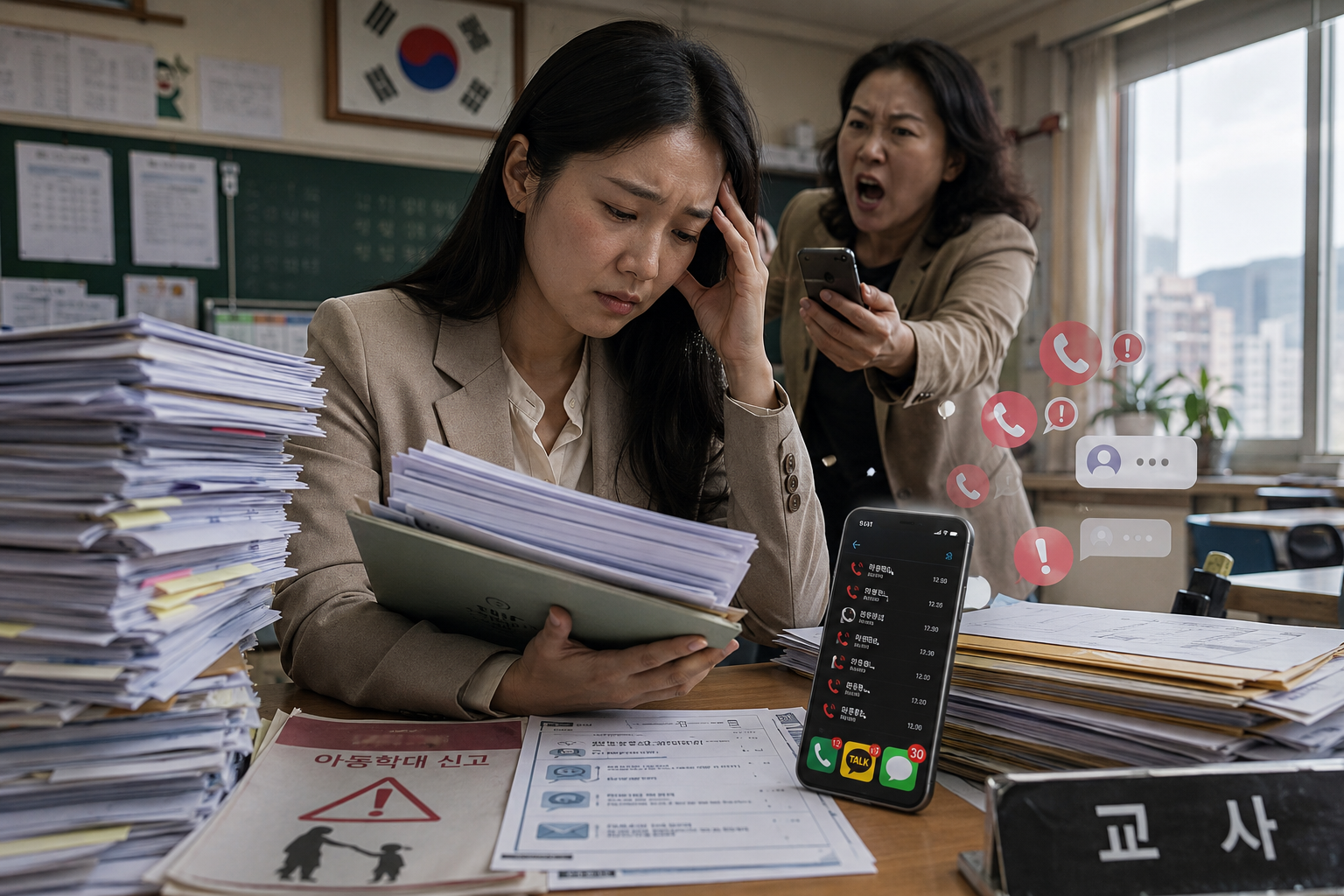
South Korea’s debate over parent complaints against school teachers has moved far beyond a workplace dispute. It has become a national argument about what schools are for, who holds authority in the classroom, how children should be protected, and whether teachers can still do their jobs without fear of legal retaliation.
The issue exploded into public view after the 2023 death of a young teacher at Seoi Elementary School in Seoul. Her death became a rallying point for thousands of teachers who said the education system had left them exposed to abusive complaints, legal threats, and accusations of child abuse for routine classroom management. The protests that followed were not only about one school or one tragedy. They reflected a deeper anxiety among Korean teachers that the balance of power among teachers, parents, students, and school administrators had broken down.
The Complaint System Has Become the Conflict
At the center of the controversy is the parent complaint. On paper, complaints are a necessary part of school accountability. Parents should be able to raise concerns about bullying, discrimination, grading, negligence, unsafe supervision, or abusive behavior. But Korean teachers argue that the complaint system has increasingly become a tool of pressure rather than communication.
The complaints teachers describe are not limited to formal reports. They include repeated phone calls, messages through private apps, direct contact through personal phones, threats to report teachers for child abuse, demands over discipline or class assignments, and pressure on principals to discipline teachers before facts are established. The practical result, many teachers say, is that a single conflict with a parent can become a professional and psychological crisis.
This is why the debate is not simply “teachers versus parents.” It is a governance problem. Schools need a way to distinguish legitimate parental concern from harassment, repeated intimidation, or tactical legal threats. Without that distinction, every complaint becomes a potential emergency, and every teacher becomes personally exposed.
The Numbers Show an Unusual Level of Stress
International data suggests that Korea’s teacher-parent conflict is not just anecdotal. In the OECD’s TALIS 2024 teacher survey, 56.9% of lower-secondary teachers in Korea said addressing parent or guardian concerns was a source of stress, ranking Korea second out of 55 participating systems on that indicator.
Korean coverage of the same TALIS results emphasized that parent complaints were one of the leading stressors for Korean teachers, ahead of or alongside heavy administrative workloads and classroom discipline. The Korea Herald reported that Korea’s figure was well above the OECD average of 41.6%, with only Portugal ranking higher among OECD member countries in that category.
This matters because parent complaints are not a marginal irritation. They are now part of the everyday labor structure of teaching in Korea. A teacher’s workload is no longer just lesson planning, grading, supervision, and classroom instruction. It also includes risk management: anticipating parental reaction, documenting interactions, avoiding activities that could trigger complaints, and navigating school bureaucracy when conflicts arise.
Why Child-Abuse Law Became Central to the Debate
One of the most sensitive parts of the issue is Korea’s child-protection framework. Teachers say that some parents use child-abuse accusations as a way to punish or remove teachers, even when the dispute involves ordinary discipline, classroom rules, or student conflict.
During the 2023 protests, teachers argued that current law made them vulnerable to accusations of emotional abuse, which could lead to suspension, investigation, reputational damage, or career disruption. Some demonstrators called for legal protection from what they viewed as excessive or malicious claims. At the same time, child-rights advocates warned that granting teachers too much immunity could weaken protections for children who genuinely experience mistreatment at school.
That tension remains unresolved. Teachers need professional discretion to maintain order, but children need credible protection against abusive authority. Parents need complaint channels, but teachers need protection from harassment. Korea’s challenge is to build a system that can handle all three truths at once.
The Government’s Response: Move Complaints Away From Individual Teachers
The Ministry of Education has tried to shift complaint handling from individual teachers to institutions. In January 2026, the ministry and provincial education leaders announced stronger measures to protect educational activities and improve school complaint response. The plan emphasized that complaints should be handled through school-designated channels, not teachers’ personal phones or private social media accounts.
The 2026 measures also gave principals and education officials more responsibility in severe cases. According to official and Korean media summaries, principals may take emergency actions such as warnings, removal requests, and access restrictions in response to serious interference or abusive complaint behavior. Education superintendents may also become more directly involved in legal responses to serious violations of teachers’ educational activity.
The ministry’s broader approach is clear: a teacher should not have to personally absorb every parent conflict. Schools and education offices are supposed to act as buffers, investigators, and institutional decision-makers. The government also announced plans to expand regional education-activity protection centers and add dedicated complaint-counseling spaces in schools.
But the policy challenge is implementation. A formal channel does not automatically replace a parent’s direct message. A complaint room does not help if teachers still feel pressured to respond immediately on private apps. A legal framework does not protect teachers if principals avoid confrontation or push the burden back onto classroom staff.
Risk Avoidance Is Changing School Life
One of the clearest consequences is the rise of risk avoidance. Teachers are not only worried about direct complaints. They are changing what they are willing to do with students.
Field trips are the most visible example. A 2026 survey of 21,918 elementary school teachers found that 96.2% responded negatively toward experiential learning programs such as picnics and school excursions, largely because of legal liability concerns in the event of an accident.
Other Korean reports describe similar concerns: teachers cite legal uncertainty, administrative burden, safety risk, and parent complaints as reasons field trips have become harder to justify. Some schools have also reduced or restricted outdoor play and sports activities because of injury risk and possible parental backlash.
This is where the issue becomes larger than teacher morale. If schools avoid field trips, sports, outdoor activities, performances, competitions, or public recognition because each carries complaint risk, children lose part of school life. The classroom becomes safer in the narrow legal sense, but poorer in the educational sense.
Korea’s schools may be entering a risk-avoidance era: fewer excursions, fewer spontaneous activities, fewer teacher-led initiatives, and more decisions shaped by fear of what might happen if something goes wrong.
Parents Are Not the Only Problem
It would be too simplistic to blame parents alone. Parent anxiety in Korea is produced by a high-pressure education system. School performance, peer comparison, private tutoring, university admissions, and social mobility are tightly linked in the public imagination. In that environment, even small school conflicts can feel high-stakes.
Parents also have legitimate reasons to distrust schools in some cases. Korea, like other countries, has had real problems involving bullying, negligence, abuse, and institutional cover-ups. A parent who feels the school is ignoring a child’s suffering may see persistent complaints as the only available tool.
That is why the solution cannot be to silence parents. The goal should be to professionalize complaint handling. Legitimate complaints should be heard, documented, investigated, and resolved. Abusive or repetitive complaints should be filtered, redirected, or sanctioned. Teachers should not be personally reachable at all hours. Parents should not have to rely on informal pressure to get a response. Students should not become invisible inside a teacher-protection agenda.
What a Better System Would Require
A functioning system would need several layers.
First, Korea needs a clear separation between complaints about school services and allegations of teacher misconduct. A complaint about lunch supervision, homework volume, or classroom communication should not be treated the same way as a credible allegation of abuse. Mixing them together encourages overreaction and defensive behavior.
Second, parent communication must become institutional. Teachers should not be expected to manage parent conflict through private phones or personal messaging apps. Schools need official channels, response timelines, documentation standards, and escalation rules.
Third, school leaders need accountability. If principals avoid difficult parents by sacrificing teachers, the policy fails. If teachers dismiss all complaints as harassment, the policy also fails. Leadership must protect teachers from abuse while ensuring that serious concerns about students are addressed.
Fourth, Korea needs clearer liability standards for school activities. Teachers will keep avoiding field trips and outdoor activities if the legal consequences of accidents remain unpredictable. Educational experiences outside the classroom cannot depend on whether an individual teacher is willing to absorb personal legal risk.
Finally, the system needs a cultural reset. Parents, teachers, and administrators need a shared understanding that education cannot function if every disagreement becomes a threat. Trust cannot be restored by slogans. It requires procedures that are fair enough for parents and strong enough for teachers.
The Larger Meaning of the Crisis
The Korean teacher-parent complaint crisis reveals a school system struggling with too much pressure and too little trust. Teachers feel they have responsibility without authority. Parents feel they have anxiety without assurance. Principals often face conflict without enough institutional tools. Students are caught in the middle.
The question now is whether Korea can build a school culture where complaints are handled seriously but not weaponized, where teachers are protected but not placed above scrutiny, and where children can still experience a full school life.
The debate began with teachers asking to be protected from malicious complaints. It has become something broader: a test of whether Korea can redesign school accountability without turning education into permanent risk management.



Leave a Reply