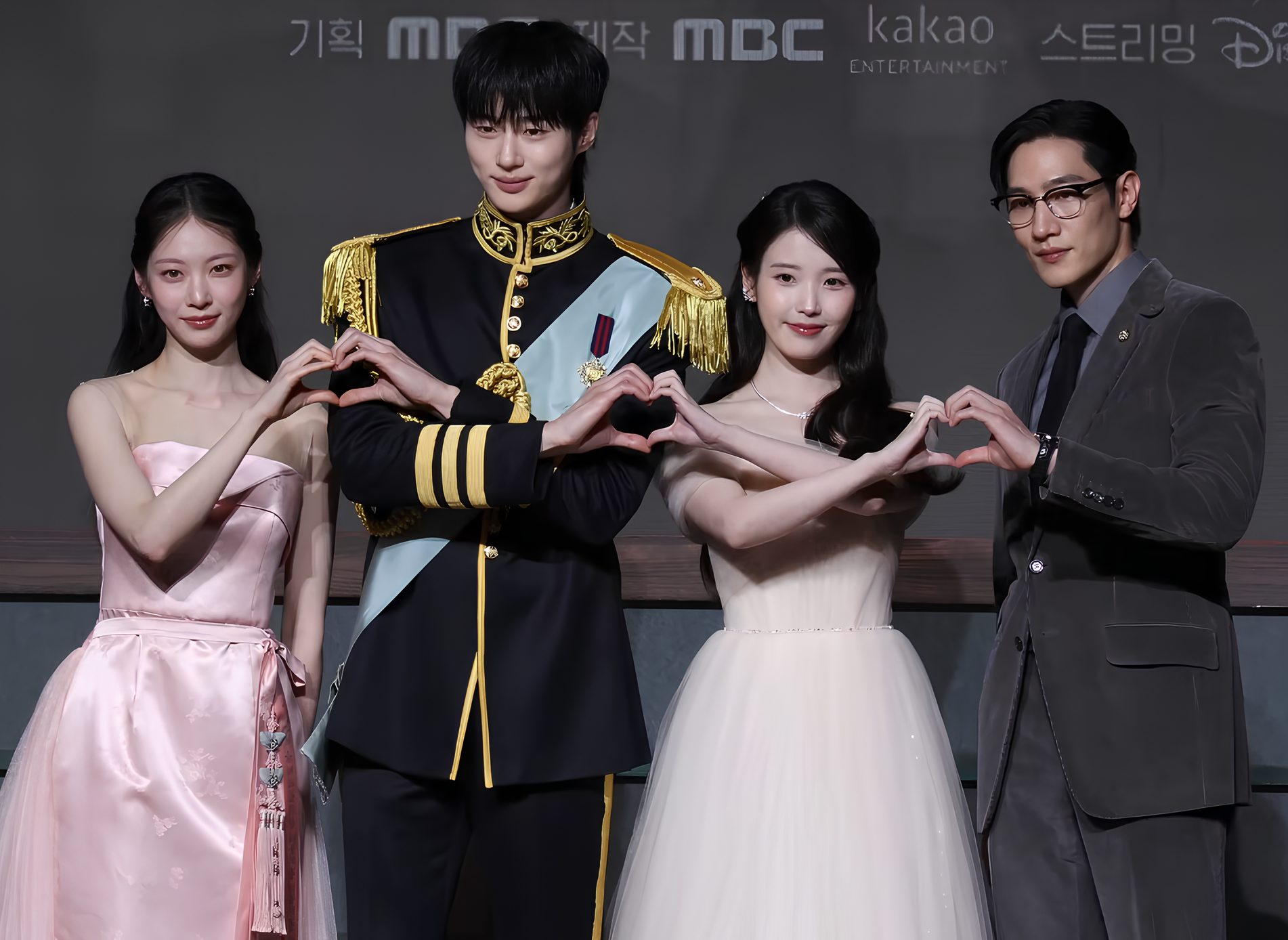
MBC’s 21세기 대군부인 (Perfect Crown, literally The 21st-Century Grand Prince’s Wife) was built around an attractive fantasy premise: a fictional 21st-century Korea where the royal family still exists. The drama follows Seong Hui-ju, played by IU, a chaebol heiress who has wealth but not aristocratic status, and Grand Prince I-an, played by Byeon Woo-seok, a prince with title but little real power. The series aired as a 12-episode MBC Friday-Saturday drama and was also distributed globally through Disney+.
That global packaging is central to why the controversy became so intense. Perfect Crown was not a small domestic drama experimenting quietly with historical fantasy. It was a major Korean drama starring two of the country’s most visible celebrities, promoted with palace visuals, royal costumes, and the premise of a modern Korean constitutional monarchy. Disney+ also said the drama became one of its strongest Korean titles internationally, with reporting citing 43 million global viewing hours and strong performance across North America, Europe, Latin America, and other regions.
The immediate controversy came from episode 11, which aired on May 15. In the enthronement scene, Grand Prince I-an ascends to the throne while wearing a nine-string ceremonial crown, and courtiers use an acclamation meaning “long live for one thousand years” rather than the higher-status phrase meaning “long live for ten thousand years.” Korean viewers objected because the combination made the fictional Korean ruler appear symbolically subordinate rather than fully sovereign.
The crown created a similar problem. Critics said the nine-string crown appeared to signal a lower royal rank, while a twelve-string crown would better match the sovereign status the scene seemed to be trying to portray. Together, the phrase and the crown made the enthronement scene look politically miscalibrated. The problem was not simply that the drama used the wrong costume or line. It was that the scene seemed to misunderstand the hierarchy encoded in royal ritual.
The production team apologized on May 16, saying it took seriously viewers’ criticism that the scene damaged Korea’s autonomous status. The team acknowledged that Perfect Crown is both a romance and an alternate-history drama, and that it had failed to think deeply enough about places where fictional worldbuilding intersects with real historical context. It also promised to revise the relevant audio and subtitles for reruns, video-on-demand, and streaming platforms.
The correction process then became part of the controversy. MBC’s rerun removed the disputed audio, and by May 19, reporting said the problematic acclamation had been muted or removed from replay services, Wavve, Disney+, and official online clips. Yonhap also reported that the audio and subtitles had been revised through Wavve and Disney+.
VANK, the Voluntary Agency Network of Korea, also entered the issue by urging Disney+ to correct the audio and subtitles. VANK argued that the use of the lower-status acclamation and the nine-string crown could be understood internationally as making Korea look like a subordinate state within a Chinese imperial order. It also warned that because the drama was being streamed globally with multiple language subtitles, the error could spread beyond Korea as a distorted image of Korean history and sovereignty.
The controversy spread into publishing as well. The publisher of the Perfect Crown scriptbook said it was discussing corrections with the production team and would provide guidance for first-print buyers while reflecting corrected expressions in later production. Later reporting said the corrected scriptbook materials changed the contested acclamation to the phrase meaning “long live for ten thousand years,” and the publisher opened a form for physical correction stickers.
The lead actors then issued their own apologies. On May 18, Byeon Woo-seok posted a handwritten apology, saying he had not fully considered the historical context and message carried by the work. IU also apologized, saying she had carefully read viewer comments and felt she had failed to show enough responsibility as a lead actor. She said that because the drama drew on Korean history and traditional beauty, she should have studied the script more carefully before participating.
IU had already addressed fans more indirectly at a final-episode group viewing event on May 16, saying that if she had disappointed people or shown shortcomings, that was her responsibility. She told fans she believed their criticism had reasons behind it and that she would accept it and try to become better.
The creative team’s accountability widened further on May 19. Director Park Joon-hwa apologized in a press interview and said he bore the greatest responsibility on behalf of the production team. Writer Yoo Ji-won later posted an apology on the drama’s official homepage, acknowledging that her research and historical verification had been insufficient while applying Joseon royal ritual to a fictional modern royal family. She specifically identified the enthronement scene’s crown and acclamation as her mistake.
The fallout has now reached public-support scrutiny. Korea-side reporting said the Broadcasting Media and Communications Commission was reviewing whether any support connected to Perfect Crown could be recovered. The issue is not straightforward because the support was reportedly tied to overseas market promotion and a Canneseries-linked investment presentation rather than direct production funding. Still, the fact that a globally promoted Korean drama became the subject of a domestic historical-distortion controversy has raised questions about whether future support programs should consider historical and cultural review more seriously.
Viewer reaction has been intense because many Korean viewers did not read the error as a harmless costume mistake. Reports summarized viewer criticism as saying the drama made Joseon or Korea appear like a subordinate state, and some reactions connected the scene to wider concerns over China-related historical and cultural disputes. In that reading, the disputed line and crown were not isolated props; they became symbols of how Korea’s sovereignty and royal culture might be misunderstood by overseas viewers.
The criticism also drew in public educators and experts outside the drama fandom. Korean history educator Choi Tae-sung criticized the production system, asking why drama productions spend heavily on casting while treating historical verification as an afterthought. He suggested that Korea needs a more systematic historical-consultation structure for dramas using royal, historical, or traditional imagery.
That is why the reaction grew beyond the details of one coronation scene. The criticism was not simply “this drama is historically inaccurate.” Viewers were asking a larger question: if a Korean drama uses the symbolic language of monarchy, sovereignty, court hierarchy, and royal ritual, how much responsibility does it have to understand the meanings attached to those symbols?
This is especially sensitive because Perfect Crown is not a straightforward historical drama. It is an alternate-history romance set in a fictional modern Korea. On paper, that gives the production creative freedom. But the drama’s fantasy world still depends on recognizable Korean royal imagery. The more it borrows from real court culture, the more viewers expect the worldbuilding to be internally coherent and historically aware.
The controversy also shows how Korean audiences now watch export-oriented dramas with international interpretation in mind. A scene that might once have been dismissed as a production oversight can now be clipped, translated, reposted, and interpreted by audiences across regions. For viewers concerned about cultural ownership and historical representation, the fear is not only that the drama made a mistake. It is that the mistake could become a misleading global image of Korean tradition.
That concern is sharpened by the Korea-China cultural context. In recent years, debates over clothing, food, rituals, and historical influence have made many Korean viewers more sensitive to how Korean cultural symbols are portrayed. In Perfect Crown, the royal acclamation, ceremonial crown, and tea-scene criticism all landed inside that broader anxiety. Whether every viewer reads the scenes the same way or not, the public reaction shows that historical fantasy is now judged through the politics of cultural representation as much as through entertainment value.
There is also an accountability dimension. As Korean dramas become part of national soft power, viewers increasingly expect broadcasters, producers, platforms, publishers, and cultural institutions to treat historical imagery as more than decoration. The online reaction has moved toward questions about review processes, expert consultation, overseas promotion, and whether highly visible Korean content should be held to a higher standard when it uses historically loaded symbols.
That does not mean Korean dramas should avoid alternate history. Fantasy can be bold, playful, and speculative. A fictional monarchy can invent rules that never existed. But the response to Perfect Crown suggests that alternate history needs discipline. It must know which symbols it is changing, why it is changing them, and how those changes may be read.
The lesson for future K-dramas is not that imagination is dangerous. The lesson is that cultural imagery carries weight, especially when the work is designed for global streaming. Viewers can accept invented kingdoms and fictional royal families. What they are less willing to accept is a drama that borrows the beauty of royal tradition while appearing careless with the meanings behind it.
In that sense, the Perfect Crown controversy is bigger than one crown or one phrase. It is a sign of how Korean audiences now understand K-drama as cultural export. A globally distributed drama is not only a story; it is also a visual explanation of Korea to the world. When that explanation involves sovereignty, court ritual, and historical memory, accuracy becomes part of the storytelling.
Leave a Reply