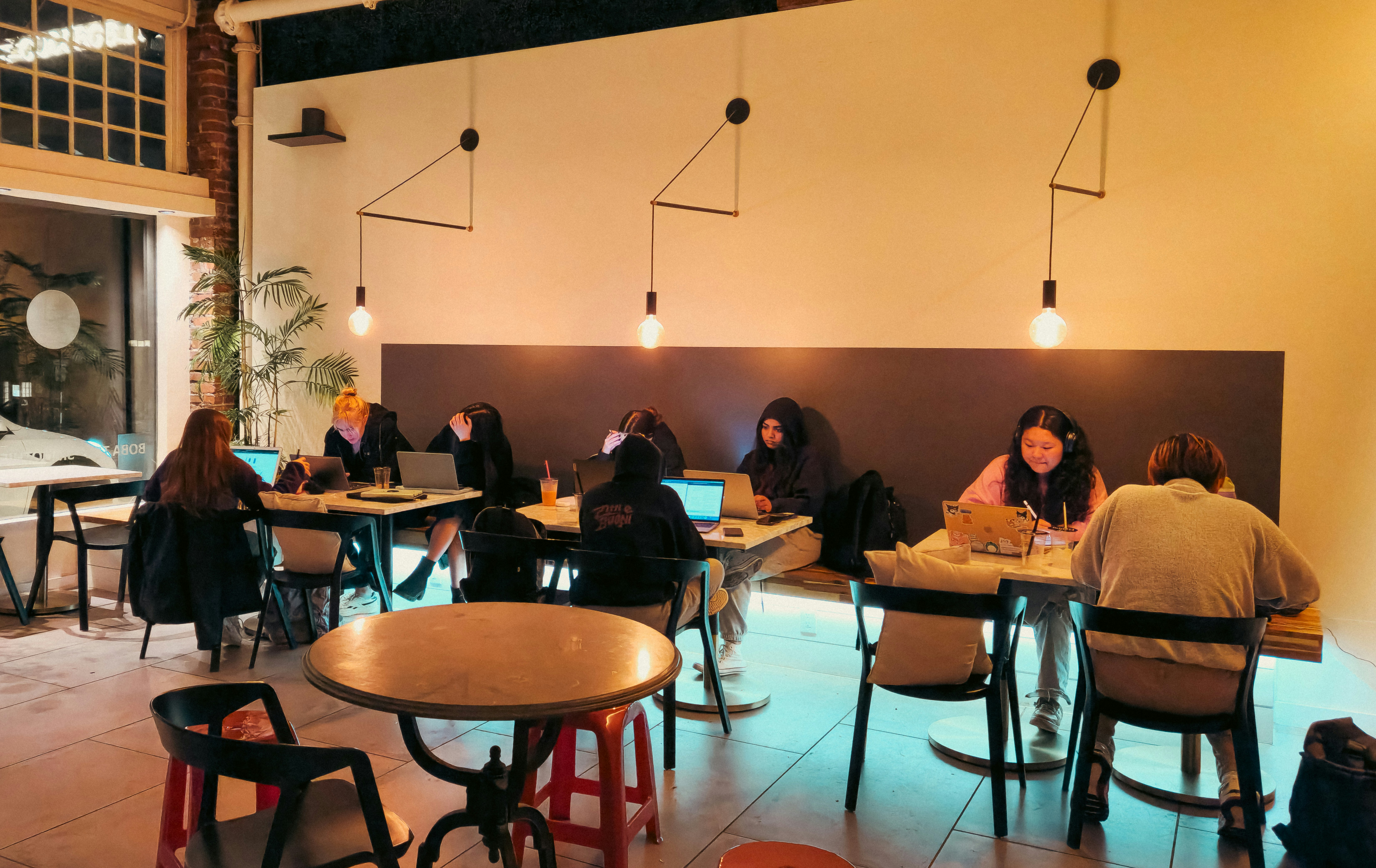
A Korea Times feature on Mapo District shows how Seoul’s low-cost public study spaces are drawing students away from private study cafés and putting pressure on a once-stable small-business niche.
Cheap study space has become one of Seoul’s quieter urban policy successes. It is also becoming a problem for the small businesses that once sold the same thing at market rates.
A Korea Times feature this week captures the shift in Mapo District, where publicly run study spaces are drawing heavy use while nearby private study cafés are losing one of their core advantages. Users under 25 can access Mapo’s public study spaces for 500 won a day, while private study cafés in the area typically charge about 150,000 won to 200,000 won a month. Mapo District currently operates nine public study spaces and plans to expand the network to 20 by the end of next year.
The pricing gap is the story. This is not a slight public discount competing with a commercial service at the margins. It is a public option cheap enough to reset what many students think a study seat should cost. For years, private study cafés made sense by selling quiet, laptop-friendly space outside home, school and ordinary cafés. That business becomes harder to sustain when local government offers a close substitute at a fraction of the price. This is an inference from the pricing and expansion plans reported in the Korea Times feature.
The article grounds that shift in a neighborhood-level contrast. At Mapo Naru Space, only three of 114 seats were available after 9 p.m. A nearby private study café, by comparison, had 27 of 70 seats empty. One owner told the paper that sales had fallen sharply since the public facility opened nearby and said the business was no longer meaningfully profitable. Another operator described a wave of refund requests after a public study space opened in the area, followed by a halving of sales and eventual closure.
From the district’s perspective, the policy appears easy to defend. Mapo says its public study facilities recorded 158,772 users last year, with 135,251 of them under 25, or about 85 percent of total usage. A satisfaction survey of 115 users found 93 percent satisfaction and 96.5 percent willingness to continue using the spaces. Those numbers suggest the city is serving clear demand, particularly among younger users looking for affordable study space during a period of higher living costs.
The wider Seoul context makes the Mapo case look less isolated. Korea JoongAng Daily previously reported on a growing network of free youth study and work spaces across the city, including centers in Mapo that offer desks, outlets, free coffee, free printing and reservable rooms. It also noted a nearby late-night Mapo public study option charging 500 won for users 24 or younger and 5,000 won for older users. That broader network helps explain why this is starting to look like an urban infrastructure shift rather than a one-off local complaint.
That leaves private study cafés in an awkward position. Demand for quiet work space has not disappeared. What has changed is who can provide it cheaply. Private operators are increasingly being pushed out of the role of basic study infrastructure and toward something more premium, specialized or convenience-driven. That conclusion is not stated directly in the source, but it follows from the competitive pressure described by business owners and the strong uptake of public alternatives.
So this is no longer just a feature about one struggling operator in Mapo. It is a sharper story about what happens when a city decides that a once-commercial service should also function as public infrastructure. For students, the benefits are obvious. For private study cafés, the business model now looks much harder to defend.



Leave a Reply