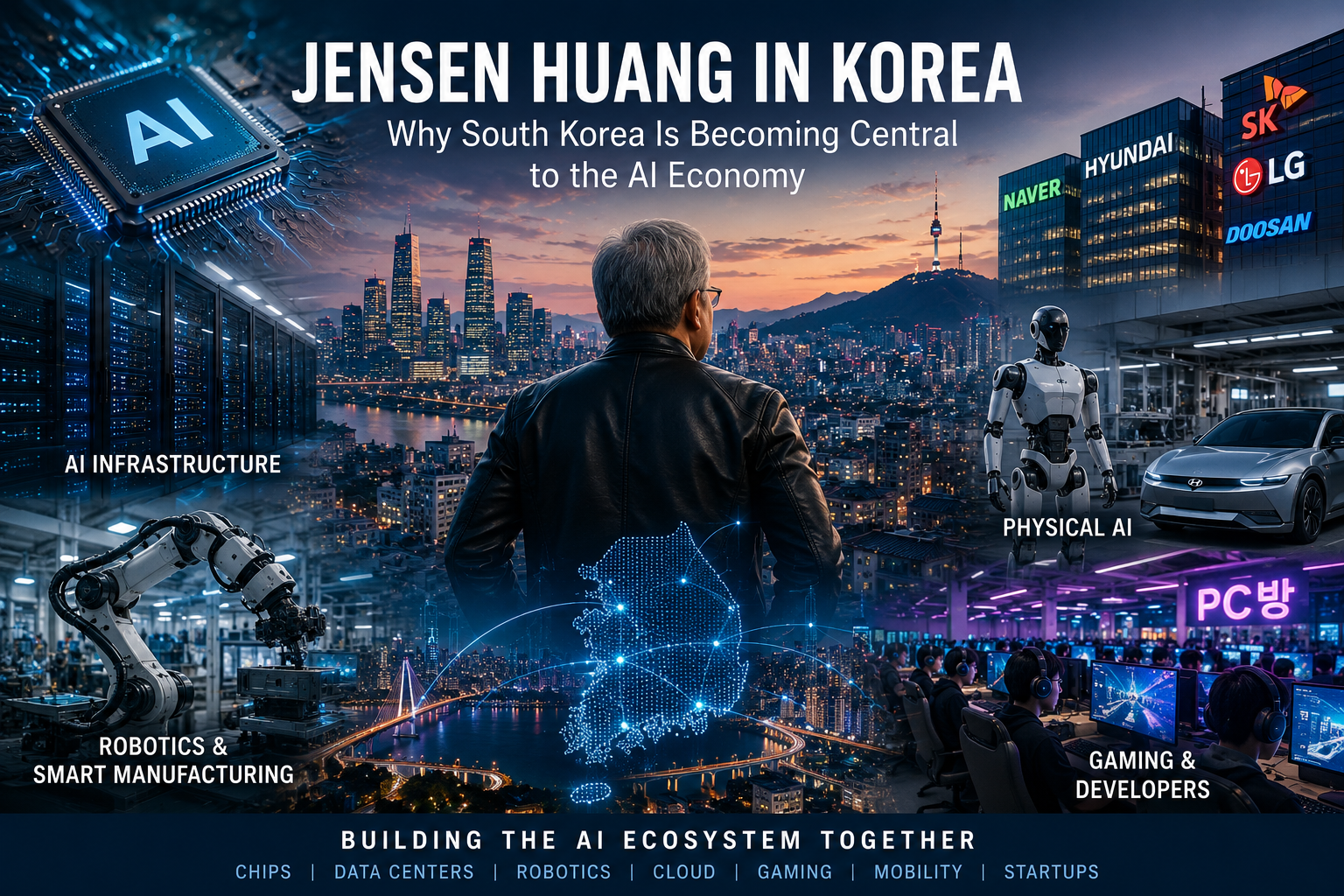
Nvidia CEO Jensen Huang’s Seoul visit was not just a celebrity business trip. It showed how South Korea’s AI story is expanding beyond memory chips into data centers, robotics, gaming, manufacturing, cloud infrastructure, and the question of whether ordinary Koreans will feel part of the boom.
Jensen Huang’s visit to South Korea became one of the biggest business stories of the week for a reason.
The Nvidia CEO did not come to Seoul only to shake hands with chip executives. His visit mapped out something much larger: Nvidia now sees Korea as a full AI ecosystem, not just a supplier of memory chips.
That is a major shift.
For years, Korea’s place in the AI boom was often explained through semiconductors. Samsung Electronics and SK Hynix make the memory chips that AI servers need. Korean exports rise when global data-center demand rises. Investors buy Korean technology stocks when they want exposure to the AI infrastructure cycle.
That story is still true. But Huang’s Seoul visit showed that it is no longer enough.
During the trip, Nvidia’s Korean agenda stretched across high-bandwidth memory, sovereign AI infrastructure, AI data centers, robotics, smart factories, gaming, startups, university researchers, telecom, cloud services, and heavy industry. Meetings and announcements involved SK Group, Hyundai Motor Group, LG Group, Naver, Doosan, gaming companies, students, developers, and Korea’s broader AI builder community.
Huang’s visit turned Korea’s AI role from component supplier to ecosystem partner
The biggest message from Huang’s visit was that Korea is no longer being discussed only as a memory-chip supplier.
Memory still sits at the core of the relationship. SK Hynix remains one of Nvidia’s most important high-bandwidth memory partners, and Samsung is still trying to strengthen its position in the AI memory supply chain. Without Korean memory, the global AI infrastructure buildout would be much harder.
But Huang’s Korea visit expanded the story beyond chips.
The visit highlighted Korea’s strength in manufacturing, robotics, automotive systems, industrial automation, gaming technology, cloud platforms, telecom infrastructure, and advanced electronics. Those are exactly the fields Nvidia needs as AI moves from digital services into the physical world.
This is what Huang and Nvidia call “physical AI”: AI systems that interact with the real world through robots, autonomous machines, smart factories, vehicles, and industrial systems.
Korea is unusually well positioned for that shift. It has world-class manufacturers, global car companies, robot developers, semiconductor firms, battery makers, telecom operators, online platforms, game studios, and a government willing to coordinate industrial policy.
That mix is rare.
The visit’s real meaning is that Nvidia is not simply looking to buy Korean components. It is looking to build with Korea.
SK Hynix and Samsung remain the foundation
Even as Huang’s visit broadened the story, semiconductors still sit at the center.
Nvidia’s AI systems depend heavily on advanced memory, especially high-bandwidth memory. That gives Korea a strategic role that few countries can match. SK Hynix has been a leading supplier in the HBM race, while Samsung is working to strengthen its own position in the Nvidia supply chain.
This matters because AI infrastructure is memory-intensive. Training and running large AI models requires not only GPUs, but also fast, advanced memory systems. That is why Korean memory companies have become central to the global AI economy.
But the chip story is no longer only about export numbers. It is about Korea’s position inside the AI hierarchy.
If Korea supplies essential memory, it has leverage. If Korea also builds data centers, AI clouds, robotics systems, and smart factories, it becomes more than a supplier. It becomes part of the operating system of the AI economy.
That is the larger transformation Huang’s visit made visible.
Naver shows why AI is becoming infrastructure
One of the clearest signs came from Naver.
Naver’s collaboration with Nvidia around AI factories and data-center infrastructure shows how Korea’s platform companies are moving into the physical infrastructure layer of AI. Naver is not only a search, portal, cloud, and content company. It is trying to become part of Korea’s sovereign AI foundation.
That phrase, “AI factory,” matters.
An AI factory is not a normal data center. It is designed to produce intelligence at scale: training, post-training, inference, model deployment, agent platforms, and enterprise AI services. In other words, it is the industrial facility behind the AI economy.
It makes the Naver-Nvidia relationship strategically important. If Korea wants to be more than an exporter of chips to foreign AI giants, it needs domestic compute capacity. It needs Korean companies that can build, operate, and commercialize AI infrastructure inside Korea.
That is why Huang’s visit matters beyond corporate headlines. It pointed to a future where Korea is not just selling the parts of AI. It is trying to host and operate the machinery of AI.
Hyundai and Doosan show why robotics became the headline
The most culturally interesting part of Huang’s visit was the focus on robotics.
Huang praised Hyundai Motor Group’s robotics and manufacturing capabilities and signaled expanded cooperation in mobility, manufacturing, and robotics. That is significant because Hyundai is not only a car company anymore. Through Boston Dynamics and its own manufacturing network, Hyundai is one of Korea’s most visible routes into humanoid robots, smart factories, autonomous systems, and physical AI.
Doosan also fits this story. Huang’s public appearance connected Nvidia’s AI platforms with Doosan’s robotics, power-generation, industrial automation, and electronics-materials businesses. That combination points directly to the kind of economy Nvidia wants to build: AI that can move, manufacture, inspect, lift, assemble, simulate, and operate in the physical world.
This is why Korea is attractive to Nvidia.
A country with software talent alone is not enough for physical AI. Nvidia needs places where robots can be tested in factories, vehicles can be connected to manufacturing systems, industrial companies can share production data, and heavy industry can adopt AI at scale.
Korea has those environments.
The social question is what happens to workers when those environments become more automated. Robotics can help Korea deal with labor shortages, aging demographics, and productivity pressure. But it can also change factory work, subcontractor relationships, training needs, and employment security.
LG shows how AI is moving into industrial production
LG’s role in Huang’s Korea visit also points to the same shift.
Korea’s large industrial groups are not treating AI only as a consumer-service tool. They are looking at AI factories, smart manufacturing, robotics, materials, energy systems, and industrial automation. LG’s collaboration with Nvidia fits this broader strategy: use AI to upgrade the way products are designed, manufactured, inspected, and delivered.
That is important because Korea’s next productivity challenge is not only about creating new apps. It is about modernizing the industrial base.
Korea faces demographic pressure, rising labor costs, intense Chinese competition, and the need to keep high-value production at home. AI factories are one answer to that challenge. They allow manufacturers to use simulation, robotics, digital twins, predictive maintenance, automated inspection, and AI-based optimization to raise output and reduce waste.
This is where Korea’s old strengths become relevant again.
The country already knows how to build factories, manage complex supply chains, and scale manufacturing quickly. Nvidia’s physical AI push gives those strengths a new role in the AI era.
Gaming was not a side show
Huang’s PC-bang visits and gaming-related events may have looked like celebrity moments, but they were more than publicity.
Korea’s gaming industry matters to Nvidia because gaming has always been part of Nvidia’s technical foundation. Graphics, simulation, rendering, physics engines, digital worlds, and high-performance computing all connect gaming to AI. The same technologies that make games realistic can help train robots, simulate environments, test autonomous systems, and build digital twins.
Korea’s gaming culture also gives Nvidia something valuable: a mass public audience that understands high-performance hardware emotionally, not just technically.
That is why Huang’s PC-bang appearances made sense. They connected Nvidia’s AI future to one of Korea’s most familiar digital cultures. For Korean gamers, GPUs are not abstract infrastructure. They are part of everyday digital life.
The gaming layer also makes Korea different from many other AI partners. Korea is not only a semiconductor country. It is a gaming country, an esports country, a platform country, a manufacturing country, and a robotics country.
Huang’s visit brought those identities together.
The stock market reaction shows the opportunity and the danger
The visit also landed in the middle of a volatile Korean market.
AI-related expectations have helped push Korean stocks sharply higher this year. The KOSPI’s move above 8,000 became a symbol of how strongly investors believe in Korea’s AI-linked growth story. But the same market has also shown how quickly enthusiasm can turn into volatility when chip shares move sharply.
That volatility is important.
When Nvidia’s CEO visits Korea, investors do not treat it as a normal business trip. They look for clues: which companies he meets, which sectors he praises, which partnerships are announced, and which parts of the Korean economy Nvidia may pull deeper into its ecosystem.
That attention can lift stocks quickly. It can also create speculative pressure.
This is not just a finance story. In Korea, where retail investors are highly active and where many households feel shut out of traditional wealth-building opportunities, AI stocks can become a public mood story. The same people who feel squeezed by housing, inflation, and debt may still look at AI-linked stocks as a way to participate in Korea’s future growth.
That is why Huang’s visit carried so much emotional weight.
He arrived as a global tech leader, but he also became a symbol of access: access to Nvidia, access to AI, access to future growth, access to stock-market gains, and access to Korea’s next industrial chapter.
Symbols can move markets. But they can also raise expectations faster than the real economy can deliver.
What Huang’s visit reveals about Korea
Huang’s Korea visit revealed five things about the country’s AI position.
First, Korea is no longer just a memory supplier. It is becoming a potential full-stack AI infrastructure partner.
Second, physical AI is now the major story. Robots, smart factories, vehicles, industrial automation, and data centers are moving to the center of Korea’s AI future.
Third, Korea’s old strengths are becoming new strengths. Manufacturing, gaming, semiconductors, cars, telecom, batteries, and electronics are being recombined into an AI ecosystem.
Fourth, the financial market is reacting faster than the real economy. Stocks can price in Nvidia-linked hopes immediately, while factories, data centers, robots, and worker training take years.
Fifth, the benefits remain uneven. Large companies, strategic startups, investors, and high-skill workers may gain first. Households, smaller suppliers, regions, and workers in weaker sectors may wait longer.
This is why Huang’s visit hit Korean news so hard.
It was not just about one foreign CEO. It was about recognition.
The world’s most important AI company came to Korea and treated it not as a secondary market, but as a central partner. That kind of recognition matters in a country where national competitiveness is deeply tied to public identity.
But recognition also raises pressure.
If Korea is now central to physical AI, it must build the infrastructure, train the workers, manage the energy demands, support startups, and make sure the gains do not remain trapped in a few companies and sectors.
The everyday question: who gets to feel part of the AI economy?
The most important question is not only what Nvidia wants from Korea.
It is what ordinary Koreans will feel from this transformation.
A visit like Huang’s can make Korea look globally powerful. It can lift national pride. It can boost market confidence. It can help Korean companies appear central to the next stage of AI.
But ordinary people experience the economy differently. They experience it through jobs, wages, housing costs, prices, training opportunities, regional investment, and whether their industry is included in the next growth cycle.
That is why physical AI matters socially.
If robots, AI factories, data centers, and smart manufacturing create new opportunities across regions and company sizes, Korea’s AI boom could become broader than the semiconductor cycle. It could support new jobs, new suppliers, new engineering careers, new regional projects, and new startup pathways.
If the gains stay concentrated among a few conglomerates and investors, the boom may feel distant to many households.
Huang’s visit made Korea’s AI future feel closer. The test is whether that future becomes widely shared.



Leave a Reply