From Ansan and Daerim to Gwanghui-dong, Hyehwa-dong and Pyeongtaek, foreign-resident neighborhoods show how Korea’s social geography is changing
For decades, South Korea described itself — and was often described by others — as a largely homogeneous nation. The idea carried cultural power: one people, one language, one national story. But that image no longer explains the Korea visible on the ground.
Across the country, foreign residents, migrant workers, overseas ethnic Koreans, international students, military communities and transnational families have created neighborhoods where Korean life is multilingual, multiethnic and globally connected. These areas are sometimes casually called “foreign towns,” but that phrase misses the deeper reality. They are not spaces outside Korea. They are Korean neighborhoods shaped by migration, labor demand, housing markets, religion, food businesses, remittance networks, military history and local survival.
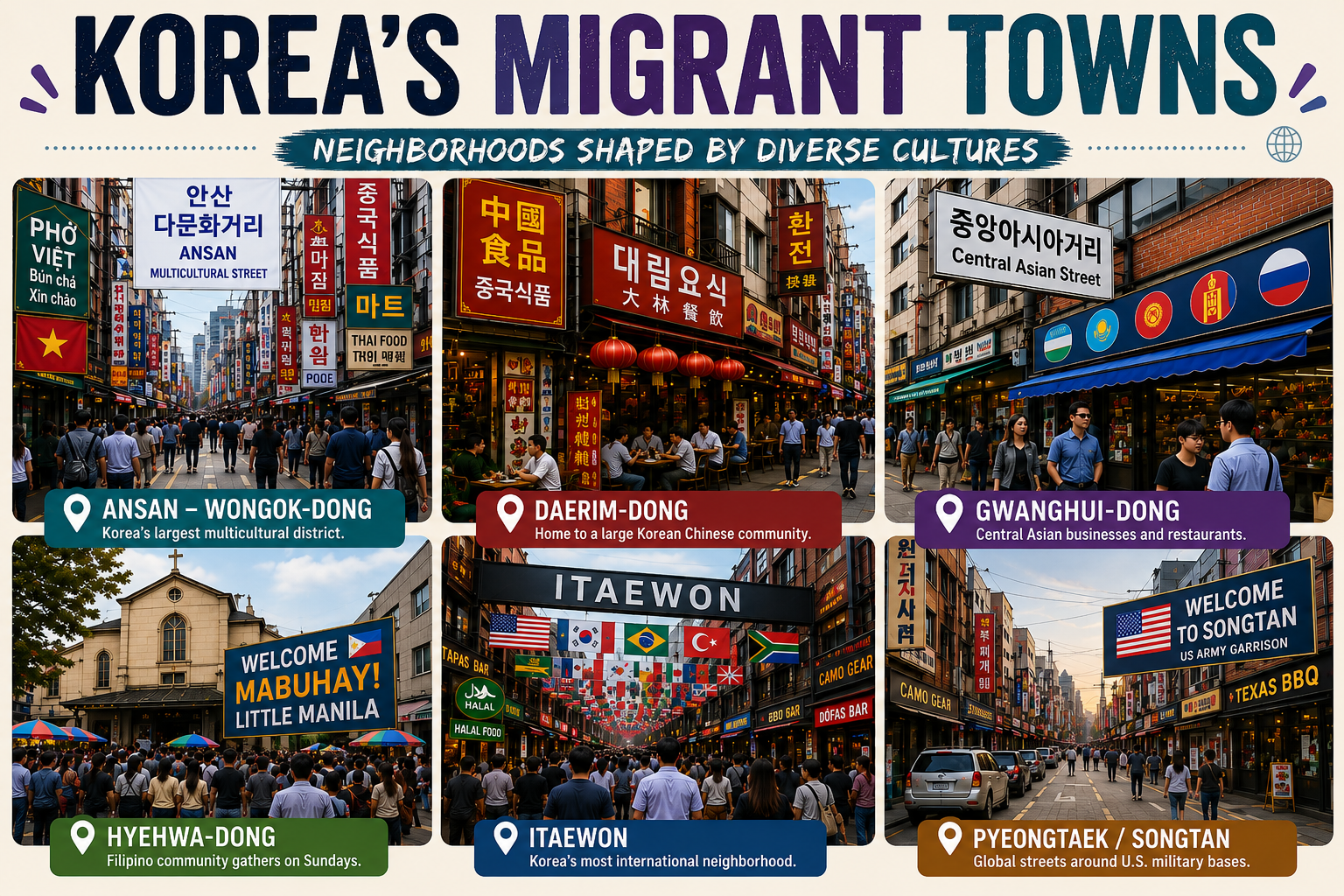
From Ansan’s Wongok-dong to Seoul’s Daerim-dong, from Central Asian streets near Dongdaemun to Filipino Sunday gatherings in Hyehwa-dong and U.S. military-linked communities in Pyeongtaek and Songtan, these places are redrawing the map of Korean society. They show that multicultural Korea is no longer a future possibility. It is already part of everyday geography.
Ansan’s Wongok-dong: Korea’s most visible multicultural district
The clearest example is Wongok-dong in Ansan, Gyeonggi Province. Located near Ansan Station and close to major industrial zones, the area is widely recognized as one of Korea’s most concentrated multicultural neighborhoods.
Its development is tied directly to work. The nearby Banwol and Sihwa industrial complexes have long relied on migrant labor in manufacturing and related industries. As workers from China, Vietnam, Uzbekistan, Indonesia, Nepal, Thailand, the Philippines, Mongolia and other countries settled nearby, Wongok-dong became a practical hub for daily life.
The district’s streets reflect that role. Store signs, menus and notices appear in multiple languages. Restaurants, grocery stores, phone shops, travel agencies, religious spaces, labor services and remittance businesses serve residents who work in Korea while maintaining family, financial and emotional ties abroad.
For visitors, Wongok-dong may look like a food street. For residents, it is much more than that. It is a place to find familiar ingredients, speak one’s own language, meet people from home, get help with paperwork, send money to family and build a community in a society where formal belonging can be difficult.
That makes Wongok-dong one of Korea’s most important social laboratories. It is where industrial policy, migration, labor rights, urban planning and everyday multiculturalism meet.
Daerim and Garibong: Korean Chinese Seoul
Daerim-dong and nearby Garibong-dong in southwest Seoul tell a different migration story. Their identity is closely tied to Korean Chinese communities. Korean Chinese are ethnic Koreans from China, many with family histories connected to migration across Northeast Asia in the nineteenth and twentieth centuries.
Their place in South Korea is complicated. They may share Korean ancestry, language and cultural memory, yet many are Chinese citizens or have lived within Chinese schools, workplaces and institutions. In South Korea, they are often perceived as both familiar and foreign.
That ambiguity is visible in Daerim. Chinese-language signs, northeastern Chinese restaurants, Korean Chinese food businesses, travel agencies, remittance shops and employment services create a neighborhood that is not simply a tourist Chinatown. It is a working enclave built around housing, labor markets and migrant networks.
The area’s roots are also tied to Seoul’s industrial history. Garibong-dong and the nearby Guro Industrial Complex were once central to Korea’s export-manufacturing era. As factories moved, redevelopment reshaped the area and cheaper housing remained available, Korean Chinese residents and businesses consolidated in nearby districts, including Daerim.
Daerim has also carried a heavy stigma. Korean films, news reports and online discourse have often associated the area with crime or disorder. Those portrayals flatten the neighborhood’s ordinary life: restaurants run by families, elderly residents gathering in parks, workers commuting before dawn, small businesses serving transnational households and community groups trying to improve relations with local government.
Daerim matters because it challenges simple ideas of Korean identity. It shows that Korea’s changing ethnic geography is not only about “foreigners.” It is also about overseas Koreans, co-ethnic migration and the question of who is accepted as Korean.
Gwanghui-dong: Central Asia near Dongdaemun
Near Dongdaemun, Gwanghui-dong offers another model of migrant placemaking. Often associated with Central Asian, Mongolian and Russian-speaking communities, the area includes businesses serving Uzbek, Kazakh, Kyrgyz, Mongolian, Russian and other transnational networks. It is also connected to Koryo-saram, ethnic Koreans whose communities developed in the Russian Far East, Central Asia and other former Soviet regions.
The neighborhood’s signs often include Cyrillic, the script used in Russian and many Central Asian languages. Restaurants serve kebabs, plov, dumplings, soups, breads and other foods connected to Central Asian and Russian-speaking food cultures. Shops sell imported groceries, clothing, cosmetics, phone services and travel connections.
Gwanghui-dong differs from both Ansan and Daerim. It is not only an industrial-worker district, nor only a Korean Chinese enclave. It is shaped by trade, tourism, small business and Seoul’s central geography. Its location near Dongdaemun connects migrant commerce to one of the city’s major shopping and wholesale areas.
As local governments increasingly recognize such districts as cultural and tourism assets, Gwanghui-dong also raises an important question: will official recognition support the people who built the neighborhood, or will it turn a living migrant community into a packaged destination for outsiders?
Recognition can bring investment, better signage, public events and business support. But it can also create pressure to make complex communities more consumable. A migrant neighborhood should not have to become tourist-friendly in order to be valued.
Hyehwa-dong: Little Manila on Sundays
Hyehwa-dong’s Filipino community shows that migrant towns are not always residential enclaves. Sometimes they are created through time, ritual and gathering.
On Sundays, Catholic religious life and community networks have long made parts of Hyehwa-dong a gathering place for Filipino migrants. Church services, food stalls, informal markets, friendship networks and support groups have helped create what is often called Little Manila.
This kind of migrant space is different from Daerim or Wongok-dong. It may not dominate the neighborhood throughout the week. Instead, it appears most visibly through Sunday rhythms: worship, rest, shared meals, information exchange and social support.
For many Filipino workers and residents, Hyehwa-dong offers more than food or shopping. It provides spiritual continuity, emotional comfort and practical help in a country where migrant workers can be isolated by long hours, visa restrictions, language barriers and distance from family.
Hyehwa-dong expands the meaning of ethnic geography. A migrant town does not always require territorial dominance. It can be built through church courtyards, weekend markets, shared language and the relief of belonging for a few hours each week.
Itaewon: Korea’s most famous international neighborhood
Itaewon remains Korea’s best-known international district, but its history is distinct from newer migrant enclaves. Its identity was shaped by the U.S. military presence around Yongsan, as well as embassies, diplomats, tourists, English teachers, migrant workers, nightlife and international restaurants.
Over time, Itaewon became a symbol of cosmopolitan Seoul. It has been associated with foreign food, halal restaurants, African and Middle Eastern businesses, LGBTQ nightlife, international schools, embassies and global youth culture. Unlike some working-class migrant districts, Itaewon’s difference has often been marketed as an asset.
That contrast is important. Foreignness in Itaewon can be treated as stylish, global and consumable. Foreignness in places such as Daerim or Wongok-dong is more likely to be framed through anxiety about disorder, crime or failed integration.
This double standard reveals how class shapes Korea’s reception of diversity. A foreign restaurant in a fashionable district may be praised as proof of Seoul’s global sophistication. A foreign-language sign in an industrial migrant neighborhood may be treated as a threat to Korean public space.
The difference is not simply ethnicity. It is class, location, consumption and the type of foreignness Korea finds comfortable.
Pyeongtaek and Songtan: military-linked global streets
Pyeongtaek and Songtan add another layer to Korea’s foreign-resident geography. Around Camp Humphreys and Osan Air Base, local commercial districts have developed around U.S. military personnel, civilian workers, contractors, families, Korean merchants and international businesses.
These areas are not migrant-worker enclaves in the same way as Ansan, nor ethnic enclaves in the same way as Daerim. They are military-linked global towns. Their streets include English-language businesses, international restaurants, bars, real estate offices, tailor shops, schools and services designed around long-term foreign presence.
The history is complex. U.S. military towns in Korea are tied to security policy, land use, local economies, nightlife, gendered labor histories, anti-base activism and everyday cultural exchange. They should not be romanticized as simple multicultural spaces. But they are part of Korea’s changing map because they show how foreign communities can shape local economies and public space over generations.
Pyeongtaek is especially significant because Camp Humphreys has become one of the most important U.S. military installations overseas. As military personnel, families and civilian workers concentrate in the area, surrounding neighborhoods continue to adapt through housing markets, international schools, restaurants and English-language services.
These towns show that Korea’s global geography is not produced only by immigration. It is also produced by military alliances, geopolitics and long-term foreign institutional presence.
Multicultural Korea is spreading beyond famous districts
The most important trend is not any single neighborhood. It is the spread of foreign-resident concentration into ordinary industrial and regional cities.
Gyeonggi Province cities such as Ansan, Hwaseong, Siheung, Suwon and Bucheon have large foreign-resident populations because they combine jobs, transit, housing and existing migrant networks. Farming counties, shipbuilding regions, port cities and university towns across Korea also increasingly rely on foreign workers and international students.
This is changing the geography of multicultural Korea. Diversity is no longer confined to famous Seoul districts. It is visible in factory towns, farming areas, logistics hubs, university neighborhoods and regional economies facing population decline.
In some places, foreign residents help sustain schools, small businesses and local labor markets. In others, they face precarious work, poor housing, wage theft, discrimination and limited political voice.
That tension defines Korea’s migration moment. The country increasingly needs foreign residents, but it has not fully decided how to include them as neighbors, workers, parents, students, entrepreneurs and future citizens.
Food streets are not just food streets
Many Koreans first encounter migrant neighborhoods through food. That is natural. Food is often the easiest and least confrontational way to experience unfamiliar cultures.
But migrant food streets should not be reduced to weekend tourism. A halal butcher, Vietnamese grocery, Uzbek bakery, Filipino food stall or Chinese medicine shop may serve cultural memory, religious practice, family care and economic survival all at once. Restaurants employ people, circulate information, introduce newcomers to jobs and function as informal community centers.
When local governments brand these places as “global food streets,” there is both opportunity and risk. The opportunity is recognition: investment, sanitation support, lighting, public events, maps and business promotion. The risk is flattening: turning complex migrant communities into marketable “exotic” experiences while ignoring labor rights, housing insecurity and discrimination.
A serious multicultural policy would do both. It would celebrate food culture while also addressing the conditions under which migrant communities live.
Language in public space
Migrant towns are also changing Korea’s visual language. In many neighborhoods, Korean text remains dominant. In places such as Daerim, Wongok-dong and Gwanghui-dong, public space becomes multilingual.
Chinese characters, Cyrillic, Vietnamese, Thai, English, Arabic, Nepali and other scripts appear on signs, menus, church notices, phone-card advertisements, employment postings and community flyers.
For residents, this is practical. Multilingual signs tell people where to eat, send money, find religious services, get a haircut, consult a lawyer, buy groceries or ask for help. For some Korean observers, however, foreign-language signage can produce unease. It may be read as separation, lack of assimilation or loss of Korean identity.
That reaction reveals a deeper question. Can Korean public space remain Korean while becoming multilingual?
The answer depends on whether Korean identity is imagined as a fixed ethnic boundary or as a civic culture capable of including new residents. A multilingual street does not mean a neighborhood has stopped being Korean. It may mean Korean society has become more complex.
Selective multiculturalism
Korea’s migrant neighborhoods face different kinds of stigma. Daerim has been burdened by crime narratives. Wongok-dong is sometimes viewed through anxiety about foreign workers. Muslim and Middle Eastern communities have faced prejudice around religion and security. Korean Chinese residents are often caught in anti-China sentiment. Southeast Asian and South Asian workers may be treated as labor resources rather than neighbors.
At the same time, Korea celebrates global culture when it appears in controlled, elite or easily consumable forms: international cuisine, foreign influencers, English-language education, K-pop’s global reach, foreign tourists and cosmopolitan shopping districts.
This is selective multiculturalism. Diversity is welcomed when it enhances Korea’s brand, economy or lifestyle. It is resisted when it asks for rights, recognition, housing, schools, religious space or political belonging.
Migrant towns make that contradiction visible. They ask whether Korea’s multicultural future will be built only for consumption or also for coexistence.
The next Korean neighborhood
The question is not whether Korea will become multicultural. It already has. The real question is what kind of multicultural society it will become.
One possibility is a segmented model: foreign workers fill labor shortages, ethnic enclaves serve their own communities, food streets become tourism products and Korean society remains emotionally separate from the people it economically depends on.
Another possibility is a civic model: migrant residents are treated as part of local society, public institutions adapt to multilingual life, schools prepare children for diversity and neighborhoods become shared spaces rather than tolerated exceptions.
Korea’s migrant towns are not marginal. They are previews of the country’s future.
Ansan’s Wongok-dong shows the industrial face of multicultural Korea. Daerim and Garibong show the complexity of Korean Chinese identity and co-ethnic migration. Gwanghui-dong shows Central Asian and Russian-speaking networks turning central Seoul into a transnational marketplace. Hyehwa-dong shows how religion and weekly gathering can create community. Itaewon shows the long history of cosmopolitan Seoul. Pyeongtaek and Songtan show how military alliances create global streets.
Together, these places redraw the map of Korea. They show that the country’s future will not be defined only by palaces, apartment towers, university districts, K-pop venues or tech campuses. It will also be defined by multilingual markets, migrant churches, halal restaurants, Central Asian bakeries, Chinese-language travel agencies, Filipino Sunday gatherings, foreign-worker support centers and neighborhoods where belonging is negotiated every day.
Korea’s migrant towns are not outside the national story. They are now among the places where that story is being rewritten.