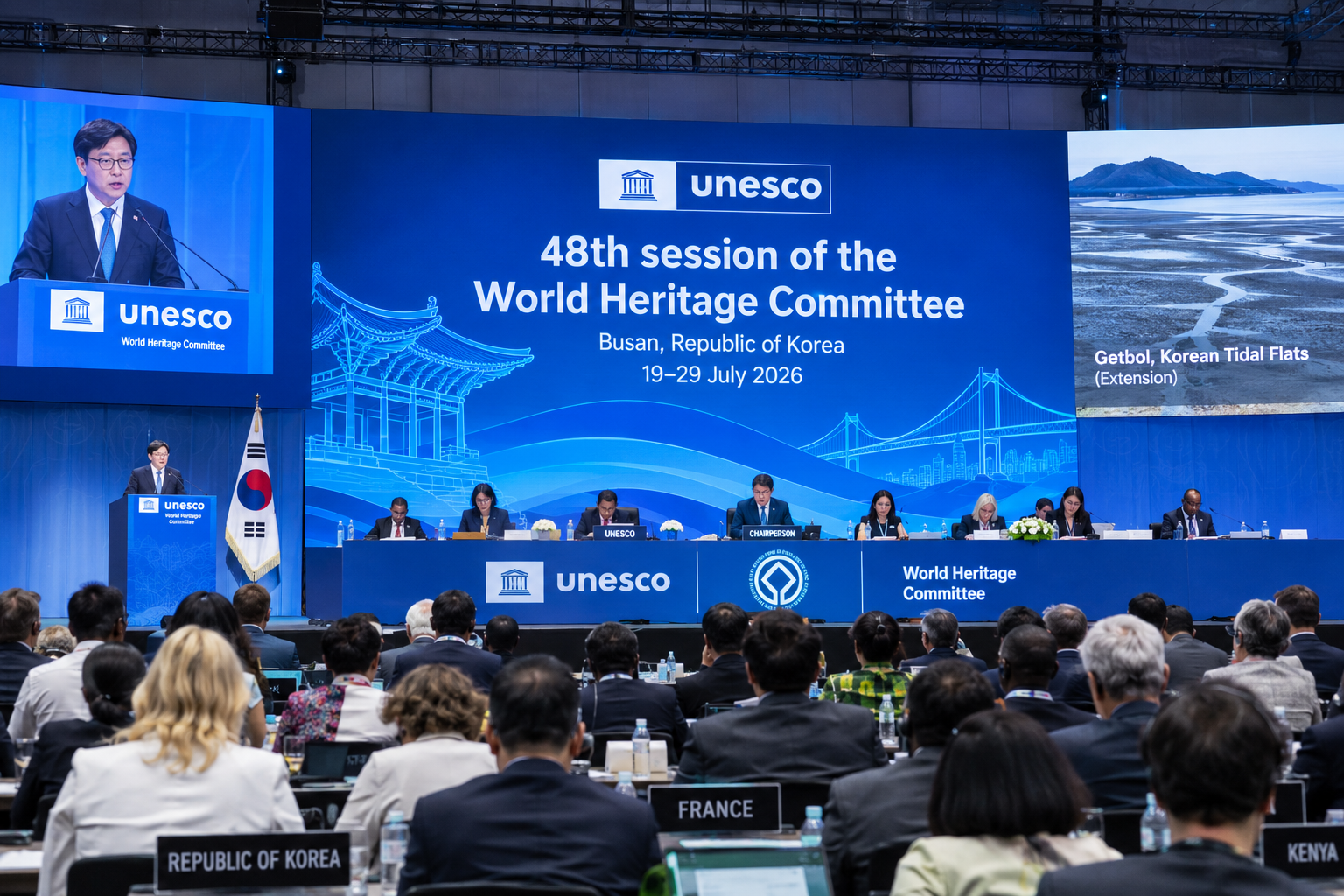
The Busan Declaration, emergency protection decisions, the Sado mines review, 25 new inscriptions, reforms to monitoring and interpretation, and the expansion of Korea’s tidal flats made the 48th UNESCO World Heritage Committee more than a showcase for Korean heritage. The session placed Korea inside the institutional process through which global heritage standards are negotiated.
For most of South Korea’s relationship with UNESCO World Heritage, achievement was measured through recognition.
Government agencies, scholars, local authorities, and civic groups worked to demonstrate that Korean palaces, temples, burial grounds, historic villages, archaeological sites, and natural landscapes possessed value extending beyond the country itself. Each successful inscription expanded Korea’s international cultural profile and provided another instrument for tourism, conservation, and public diplomacy.
The 48th session of the UNESCO World Heritage Committee, held at BEXCO in Busan from July 19 to 29, 2026, marked a different level of participation. It was the first time Korea had hosted the committee since joining the World Heritage Convention in 1988. Korean diplomat Lee Byong-hyun chaired the meeting, which brought together representatives of the committee’s 21 elected member states.
Korea was no longer appearing principally as a country seeking approval for its own nominations. It was hosting the intergovernmental body responsible for deciding which places enter the World Heritage List, examining whether existing properties are being protected, directing international assistance, reviewing the system’s finances, and revising the procedures through which the Convention operates.
By the end of the meeting, the committee had inscribed 25 new properties, approved two extensions and one renomination, added six properties to the List of World Heritage in Danger, removed one from that list, adopted a major strategy for vulnerable island states, and launched the next phase of global monitoring. The World Heritage List now contains 1,273 properties across 173 countries.
Busan did not give Korea the power to write UNESCO rules by itself. It did, however, move the country closer to the place where international heritage rules begin: the negotiation of principles, terminology, reporting requirements, conservation expectations, and institutional priorities.
The Meeting’s Agenda Extended Far Beyond New Inscriptions
New inscriptions generate the most recognizable headlines, but they represented only one part of the Busan agenda.
The committee received reports from the World Heritage Centre and its three advisory bodies—ICCROM, ICOMOS, and IUCN—and reviewed progress under the Strategy for World Heritage in Africa. It examined support for Small Island Developing States, implementation of the World Heritage Capacity-Building Strategy, the work of UNESCO-affiliated training and research centres, and follow-up to the Nairobi Outcome on heritage and authenticity.
It then moved through conservation reports for existing properties, nominations and extensions, boundary clarifications, retrospective statements defining properties’ Outstanding Universal Value, regional action plans, Periodic Reporting, proposed revisions to the Operational Guidelines, international-assistance requests, and the accounts and budget of the World Heritage Fund. The closing agenda included the bureau and provisional program for the committee’s 49th session.
This wider agenda is essential to understanding what the World Heritage Committee actually does.
The committee is not an international prize panel that places attractive landmarks on a prestigious list. It is also a supervisory and regulatory institution. It evaluates whether governments are fulfilling the obligations they accepted when their properties were inscribed and whether the World Heritage system possesses the personnel, money, evidence, and procedures needed to enforce those obligations.
The principal question in Busan was therefore not merely which sites would receive recognition. It was whether an increasingly large and politically exposed heritage system can protect what it has already recognized.
The Busan Declaration Was Korea’s Main Diplomatic Achievement
The clearest expression of Korea’s agenda-setting ambition came on July 20, when the committee adopted the Busan Declaration on World Heritage by consensus.
The declaration was prepared under Korean leadership with participation from experts representing the 21 committee members and UNESCO’s three advisory bodies. It calls for stronger cooperation among governments, advisory organizations, site managers, local communities, Indigenous peoples, young people, researchers, and civil society as heritage faces overlapping pressure from climate change, armed conflict, disasters, development, and technological transformation.
Its most ambitious proposal is to add Collaboration to the World Heritage Convention’s existing strategic objectives.
Those objectives are commonly described as the “5Cs”: Credibility, Conservation, Capacity-building, Communication, and Communities. The Busan Declaration argues that collaboration should become an additional strategic principle because modern heritage protection cannot be carried out by a single national ministry or a small group of technical experts.
National governments may hold legal authority, but local governments regulate nearby construction. Residents and Indigenous peoples possess knowledge, rights, and relationships connected to protected places. Scientists monitor environmental and structural change. Tourism agencies shape visitor pressure. Developers may control adjacent land, while site managers must balance all of those interests with the conservation requirements attached to World Heritage status.
Collaboration in this context is not simply a diplomatic virtue. It is an attempt to address the fragmented authority that allows many heritage threats to develop.
The declaration also calls for closer integration of cultural and natural heritage management, stronger professional capacity, more inclusive interpretation, and transparent and responsible use of digital technology. The Korean government described it as the first World Heritage declaration to place the responsibilities accompanying digital transformation so clearly within the community’s strategic debate.
The declaration does not automatically amend the Convention or formally create a sixth strategic objective. That would require additional institutional action.
Its significance is nevertheless substantial. International standards frequently begin as nonbinding language: a problem is identified, a shared term is proposed, states endorse the principle, and it gradually enters guidelines, training programs, funding criteria, monitoring systems, and professional practice.
Korea used Busan to place Collaboration at the beginning of that process.
Conservation, Not Inscription, Remained the System’s Central Test
The committee’s conservation workload was larger than its nomination agenda.
Busan’s program included 147 reports on the condition of existing World Heritage properties, 53 of them concerning sites already on the List of World Heritage in Danger. The cases addressed armed conflict, damage from disasters, urban and industrial development, tourism, ecological decline, inadequate legal safeguards, and weaknesses in management and monitoring.
This work receives less public attention than inscription celebrations, but it determines the credibility of the entire system.
World Heritage designation is not a permanent award granted without continuing conditions. States undertake to protect the attributes that give a property Outstanding Universal Value, maintain effective management systems, assess projects that may cause damage, and report major threats.
The committee can request corrective measures, monitoring missions, revised development plans, stronger buffer zones, improved visitor management, or changes in historical interpretation. In the most serious cases, it can place a property on the Danger List or consider whether it has lost the value for which it was inscribed.
Busan therefore placed Korea inside both sides of the World Heritage system: the prestige of recognition and the discipline of international scrutiny.
Six Sites Entered the Danger List
The meeting’s most urgent decisions concerned properties facing immediate or severe threats.
The committee added six sites to the List of World Heritage in Danger:
Mount Amel Castles and Tyre in Lebanon; the Boma–Badingilo Migratory Landscape in South Sudan; Sebastia in Palestine; the Historic Inner City of Paramaribo in Suriname; and the Ancient City of Tauric Chersonese and its Chora in Ukraine.
It removed the Historic Centre of Vienna from the Danger List, leaving 58 endangered World Heritage properties after the Busan session.
Three of the newly endangered properties—Boma–Badingilo, Mount Amel Castles, and Sebastia—were processed as emergency nominations. They were placed on the World Heritage List and the Danger List during the same session.
That combination can appear contradictory. A property receives the highest level of international recognition and is immediately declared endangered.
But emergency inscription is designed to mobilize attention and assistance before war, instability, environmental deterioration, or uncontrolled development causes irreversible loss. Danger listing can open access to additional technical and financial support and establish an internationally recognized framework for recovery and monitoring.
The decisions made clear that Busan was not simply adding monuments and landscapes to an expanding catalogue. The committee was confronting places where normal conservation systems had already broken down.
Twenty-Five Inscriptions Expanded the List—but Also Exposed Its Imbalances
The committee inscribed 25 new properties: 19 cultural, five natural, and one mixed. It also approved two extensions to existing properties and reconsidered Garamba National Park in the Democratic Republic of the Congo under additional criteria. Every inscription decision was adopted by consensus.
The session was particularly important for Comoros, São Tomé and Príncipe, and South Sudan, each of which received its first World Heritage property. Two of those countries are Small Island Developing States. After the decisions, the number of parties to the Convention without an inscribed property fell from 26 to 23.
These results supported UNESCO’s effort to make the List more geographically representative. Countries with long-established heritage administrations and extensive research funding remain better positioned to prepare nominations, commission specialist studies, produce management plans, and respond to advisory-body requests.
Busan did not remove that imbalance. Europe and North America still account for a disproportionately large share of the List. But the first inscriptions for three African countries represented measurable movement toward broader participation.
The nominations also revealed the continuing tension between technical evaluation and diplomatic negotiation.
Of the 33 dossiers examined, two were deferred and three referred for additional work. In five cases, the committee changed the recommendation placed before it by an advisory body: three proposed referrals became inscriptions, one proposed deferral became an inscription, and one recommendation against inscription became a referral.
The ability of elected states to depart from expert recommendations is part of the Convention’s intergovernmental structure. It also creates a persistent credibility problem.
Consensus may demonstrate successful diplomacy, but it cannot become a substitute for conservation evidence. If political negotiation repeatedly lowers the technical threshold for inscription, the List expands faster than the institutions responsible for protecting it.
Korea’s Tidal Flats Became the Host Country’s Most Visible Result
The most important decision involving Korea itself was the second-phase expansion of Getbol, Korean Tidal Flats.
The original property was inscribed in 2021. The Busan decision added the tidal flats of Yeosu, Goheung, Muan, and Seosan through a significant boundary modification approved under UNESCO’s biodiversity criterion.
The enlarged property represents a more complete range of Korea’s estuarine, open-coast, island-dominated, and semi-enclosed tidal-flat systems.
These environments support migratory birds along the East Asian–Australasian Flyway, as well as fish, shellfish, marine mammals, and organisms living within the sediment. They also depend on processes extending beyond visible coastlines: sediment movement, water quality, tidal flows, and ecological connections among feeding, resting, and breeding areas.
The decision gives Korea greater international recognition for its natural heritage. It also gives the country a direct opportunity to demonstrate whether the Busan Declaration’s principles can work in practice.
World Heritage status can bring research funding, monitoring, legal attention, and public awareness. It can also bring tourist infrastructure, local branding campaigns, higher land expectations, and pressure to convert recognition into commercial growth.
That tension is particularly acute for tidal flats. Their ecological value often depends on the absence of conventional development: undisturbed shorelines, functioning sediment systems, limited recreational disruption, and sufficient space for birds and marine organisms.
The challenge therefore shifts from inscription to management.
Korea will need to coordinate national agencies, multiple municipalities, fishing communities, residents, scientists, conservation organizations, and tourism authorities. The Getbol expansion is not merely another Korean success at UNESCO. It is an immediate test of whether the collaboration promoted in Busan can survive conflicts over development and local economic expectations.
The Sado Mines Decision Tested the Meaning of “Whole History”
The Busan session also reviewed one of the most politically sensitive World Heritage disputes between Korea and Japan: the interpretation of the Sado Island Gold Mines.
The property was inscribed in 2024 for the unmechanized gold-mining system developed primarily during Japan’s Edo period. Korea’s concern centered on a later period excluded from the property’s stated Outstanding Universal Value: the experiences of Korean workers mobilized to the mines during Japanese colonial rule.
Japan supported inscription with a commitment to present the property’s full history. The Busan review assessed how that commitment had been implemented.
UNESCO’s evaluation acknowledged progress in management, conservation planning, visitor management, and additional interpretation. But it found that the available evidence did not yet show clearly how the presentation at the site comprehensively addressed every period of mining exploitation.
The review noted that references to workers from the Korean Peninsula had been included at the Aikawa History Museum, but concluded that the wider interpretation remained heavily centered on Edo-period technology. It called for further clarification, continued consultation with the states concerned, stronger heritage-impact assessment, and opportunities for public participation when projects might affect the property. Japan must provide another conservation report by December 2027 for examination at the committee’s 50th session.
The decision did not settle the larger political dispute over forced labor, terminology, responsibility, or apology.
It did establish that inscription had not ended international oversight. Historical interpretation remained part of the property’s continuing management obligations.
Sado was therefore the most direct test of the Busan Declaration’s call for inclusive and responsible interpretation.
Heritage cannot be considered adequately protected simply because buildings, tunnels, archaeological remains, and landscapes are maintained. The account presented to visitors also matters. A site spanning celebrated technological history and colonial exploitation cannot meet the standard of whole-history interpretation if one period is made central and the other remains peripheral.
For Korea, the decision supported the argument that Japan’s commitments remain reviewable. It also creates a reciprocal obligation. A country advocating complete historical interpretation abroad must apply the same standard to difficult, marginalized, or politically uncomfortable histories within its own heritage system.
Small Island States Received One of the Meeting’s Most Concrete Strategies
Among Busan’s most substantial institutional outcomes was the adoption of the World Heritage Strategy for Small Island Developing States 2026–2034.
The strategy is backed by a proposed budget of US$13 million and was developed through consultation involving all 39 island states that are parties to the Convention, international experts, advisory bodies, and partner institutions. Its priorities include climate and environmental resilience, human and financial capacity, stronger governance, and greater participation by local communities.
The strategy responds to a structural problem within the World Heritage system.
Small island states may contain heritage of exceptional cultural or ecological importance, yet have limited administrative capacity, small technical teams, geographic isolation, and severe exposure to sea-level rise, storms, erosion, and other climate hazards.
Adding island properties to the World Heritage List without strengthening the institutions responsible for them would reproduce the inequalities the representation agenda is supposed to correct.
The Busan strategy therefore connects recognition to long-term support. It places communities, young people, and women at the center of implementation and treats heritage as part of climate adaptation and sustainable development rather than as a separate cultural sector.
The first inscriptions for Comoros and São Tomé and Príncipe gave the strategy immediate political relevance. Busan did not merely recognize properties from two island states. It adopted a framework intended to help them—and other island countries—meet the conservation obligations that recognition creates.
Africa, Authenticity, and Capacity-Building Became Part of the Governance Debate
The committee also reviewed progress under the Strategy for World Heritage in Africa.
The midterm report found advances in updated tentative lists, institutional participation, training, and the development of a larger pool of African heritage professionals. More than 4,000 stakeholders had participated in capacity-building activities, although uneven financing and the continent’s continued underrepresentation remained major concerns.
Busan also advanced follow-up to the Nairobi Outcome on Heritage and Authenticity, developed through a 2025 conference on African heritage.
The Nairobi framework challenges the assumption that authenticity must always be demonstrated through fixed physical fabric and relatively static monuments. It emphasizes living heritage, community-defined values, the relationship between tangible and intangible culture, and continuity through memory, knowledge systems, custodianship, and intergenerational practice.
This debate matters because the standards historically used to assess authenticity were shaped heavily by European monument-conservation traditions. Those standards do not always fit places where cultural meaning depends on rebuilding, ritual use, oral knowledge, seasonal practice, or continuous adaptation.
Busan did not complete the process of integrating the Nairobi principles into UNESCO’s rules. It moved the discussion toward training, nomination preparation, management, monitoring, and possible future revisions of the Operational Guidelines.
The committee also reviewed implementation of the World Heritage Capacity-Building Strategy 2025–2035 and the work of UNESCO-affiliated Category 2 centres. The strategy is intended to replace fragmented training projects with a more coordinated system involving the World Heritage Centre, advisory bodies, regional centres, site managers, institutions, and communities.
These agenda items are less visible than inscriptions, but they influence which countries and communities possess the expertise to navigate the system at all.
Indigenous Participation Advanced, but Institutional Reform Remains Incomplete
Indigenous involvement appeared throughout the Busan agenda: in the declaration, conservation management, nomination reform, capacity-building, and global reporting.
The committee considered a roadmap for developing stronger mechanisms through which Indigenous peoples could participate in the World Heritage Convention. The discussion moved toward preparing a more comprehensive proposal for the 49th session, developed with Indigenous representatives rather than designed solely by governments and heritage institutions.
This remains a work in progress.
The World Heritage system is formally organized around states. Yet many protected landscapes are inhabited, managed, or understood through Indigenous knowledge systems that predate the states making decisions about them.
Consultation after boundaries and management plans have already been drafted is not equivalent to participation in defining a property’s values, limits, interpretation, and future.
Busan did not resolve that institutional imbalance. It made the inadequacy of informal consultation harder to ignore.
Periodic Reporting and Procedural Reform Shaped the System’s Next Cycle
Busan launched the fourth cycle of Periodic Reporting, beginning with the Arab States and Africa.
Periodic Reporting is the mechanism through which countries provide UNESCO with information about legislation, administration, funding, staffing, management, conservation conditions, public education, community participation, and emerging risks.
The questionnaire was revised to clarify legal and regulatory issues and improve the way the system records the involvement of communities, Indigenous peoples, and other rights-holders.
This procedural work has little of the visibility of a new inscription, but it is essential.
Without regular reporting, UNESCO operates mainly through crisis response—intervening after a damaging construction project, conflict, ecological decline, or public controversy has already become severe. Periodic Reporting provides a wider picture of institutional weaknesses before they become emergencies.
The committee also reviewed regional action plans for Asia and the Pacific and for Latin America and the Caribbean, clarifications to property boundaries, retrospective Statements of Outstanding Universal Value, and revisions connected to Chapter V and Annex 7 of the Operational Guidelines.
Together, these decisions affect how properties are mapped, how the reasons for their inscription are formally recorded, how states assess their own performance, and what information UNESCO can use to compare conditions across regions.
These are rules in the administrative rather than legislative sense. They shape what governments must document, which risks become visible, and how conservation failure is identified.
Finance Revealed the Gap Between Ambition and Capacity
The committee also reviewed international-assistance requests, the final accounts of the World Heritage Fund for 2024–2025, and execution of its 2026–2027 budget.
The World Heritage Fund totals approximately US$7.3 million for the 2026–2027 biennium, with an additional US$400,000 allocated for emergency assistance. It finances advisory-body services, international assistance, monitoring, nomination evaluation, training, and other Convention activities.
The scale of that fund illustrates one of the system’s central weaknesses.
The World Heritage List contains more than 1,270 properties. Climate change, armed conflict, tourism, urban growth, and environmental degradation are increasing the number and complexity of conservation cases. Yet UNESCO’s core heritage institutions operate with limited staff and rely heavily on voluntary and earmarked contributions.
Declarations can call for collaboration, resilience, inclusive interpretation, and digital innovation. Those commitments require experts, local consultation, field missions, scientific monitoring, documentation, and long-term funding.
Busan did not solve the resource problem. It kept finance inside the conservation debate rather than treating it as an administrative issue unrelated to heritage protection.
Public Diplomacy Brought the Committee Beyond the Conference Hall
Korea also used the session to turn a specialized diplomatic meeting into a public cultural event.
K-Heritage House at BEXCO combined presentations of Korean World Heritage, intangible heritage, documentary heritage, crafts, food, performances, and immersive digital experiences. Attendance had exceeded 93,000 by July 25, four days before the session closed.
G-Dragon’s role as honorary ambassador moved the meeting into entertainment coverage and fan-driven social-media circulation. Korea’s wider collaborations between public heritage institutions, character franchises, digital media, and popular culture reflect a strategy of making heritage accessible to people who might never read a conservation report or follow revisions to UNESCO’s Operational Guidelines.
That strategy has clear benefits. Conservation requires public interest, and younger audiences may enter heritage through games, performance, fashion, celebrity, or immersive media rather than academic history.
It also carries a risk.
The easier heritage becomes to circulate as character imagery, digital spectacle, merchandise, or destination branding, the easier it becomes to separate a place’s visual identity from its difficult historical or ecological context.
Public outreach was therefore an important achievement of the host country, but not the central achievement of the committee.
The most consequential work took place in decisions about endangered sites, development controls, historical interpretation, community participation, monitoring, financial support, and institutional reform.
What Busan Actually Achieved
Busan’s achievements operated at several levels.
Korea secured consensus for a declaration placing collaboration, inclusive interpretation, integrated conservation, and digital responsibility within the future debate over World Heritage governance.
The committee added 25 properties to the World Heritage List and approved two extensions, including the enlargement of Korea’s tidal-flat property.
It used emergency procedures to recognize three severely threatened sites and placed six properties on the Danger List.
It required further work on Sado’s whole-history interpretation, confirming that historical presentation remains subject to post-inscription scrutiny.
It adopted a funded strategy for Small Island Developing States and continued efforts to improve Africa’s representation and institutional capacity.
It advanced work on authenticity, Indigenous participation, site-manager expertise, Periodic Reporting, international assistance, boundary documentation, and the financial machinery through which committee decisions must be implemented.
Finally, it handed the committee’s next session to Istanbul, Türkiye, in 2027.
None of this makes Korea a rule-maker with unilateral authority.
The World Heritage system remains intergovernmental. Its policies emerge through negotiation among committee members, states parties, UNESCO’s Secretariat, advisory bodies, experts, and communities.
But rules rarely begin as binding instructions.
They begin as shared concepts, declarations, reporting categories, interpretive expectations, professional guidance, and language that institutions gradually accept as legitimate.
Busan placed Korea more firmly inside that process.
The Harder Test Begins After the Meeting
The declaration will matter only if its principles influence what governments and institutions do after the delegates leave Busan.
The proposal to elevate Collaboration will need further negotiation. Indigenous participation will need mechanisms that share authority rather than merely improving consultation. Digital responsibility will need standards for evidence, transparency, consent, access, and long-term preservation. Climate adaptation will need to enter management plans and budgets.
Korea will also be judged against the principles it promoted.
The expanded tidal flats will test whether ecological protection can prevail over development and tourism pressure. Korea’s advocacy regarding Sado will test whether it applies equally complete interpretation to contested histories at home. Its call for collaboration will test whether residents and local communities gain meaningful influence. Its use of digital heritage and popular culture will test whether accessibility deepens understanding or merely expands visibility.
For decades, Korea’s central question at UNESCO was how to persuade the international community that Korean properties deserved World Heritage recognition.
Busan introduced a more demanding question: whether Korea can help improve the system granting that recognition—and accept the scrutiny that international leadership brings.
The 48th World Heritage Committee did not transform Korea into the author of global heritage law. It marked a clear transition from presenting Korean heritage to participating in the governance of heritage itself.
That is Busan’s more durable achievement.