July’s Korean bestseller charts moved from Yoo Si-min’s travel writing to a social-media-driven novel, while Keigo Higashino’s death produced an immediate wave of memorial reading
Korea’s July 2026 book market began with an established public intellectual writing about European cities and ended with two very different demonstrations of fiction’s commercial power.
Yoo Si-min’s 유럽 도시 기행 3 (European City Travels 3) entered Kyobo Book Centre’s overall chart at No. 1 in the second week of July and remained there the following week. By the final reporting period, however, Yoo Rae-hyuk’s previously published novel 수족관 (Aquarium) had completed a social-media-driven rise to the top of Kyobo’s chart.
At YES24, a separate late-month surge placed Keigo Higashino’s 투명한 나선 (A Transparent Spiral) at No. 1 after news of the Japanese mystery writer’s death reached Korean readers.
The result was a month shaped less by one dominant category than by several distinct routes to bestseller status. Author recognition, social-media circulation, summer reading, television exposure, philosophical self-improvement, and literary memorialization all influenced what Korean readers bought.
Retailers use different sales periods, customer bases, and ranking methodologies. Their charts should therefore be read alongside one another rather than combined into a supposedly unified national ranking.
July’s Closing Bestseller Chart
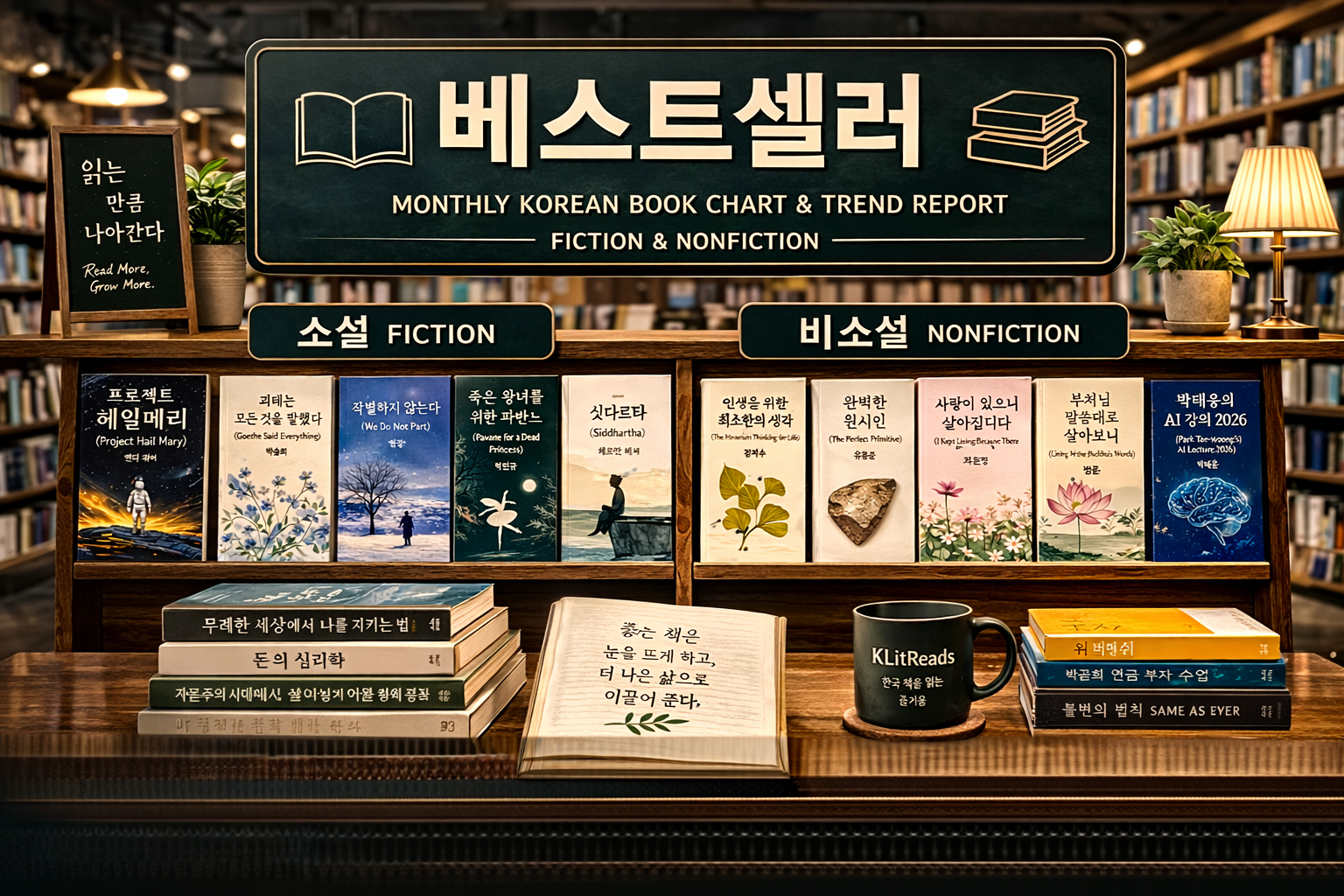
Kyobo Book Centre’s chart for the fourth week of July provided the clearest picture of how the month ended.
- 수족관 (Aquarium) — Yoo Rae-hyuk
- 유럽 도시 기행 3 (European City Travels 3) — Yoo Si-min
- 싯다르타 (Siddhartha) — Hermann Hesse
- 투명한 나선 (A Transparent Spiral) — Keigo Higashino
- 참 영원한 성자들의 크신 사랑 (The Great Love of the True Eternal Saints) — Kim Won-su
- 니체의 초월자 (Nietzsche’s Overman) — Friedrich Nietzsche
- 독서의 기술 (The Art of Reading) — Go Myung-hwan
- 코스모스 (Cosmos) — Carl Sagan
- 지푸라기 왕관을 쓴 여자 (The Woman Wearing a Straw Crown) — Park Sang-young
- 모순 (Contradictions) — Yang Gui-ja
The chart was based on Kyobo’s fourth-week sales period rather than a cumulative July ranking. It is presented as a closing snapshot of the market, not as a single authoritative list for every Korean retailer.
Aquarium Turned Social Visibility into a No. 1 Bestseller
The month’s most revealing success was not a new release.
Yoo Rae-hyuk’s Aquarium was first published in late 2023, but its commercial breakthrough arrived more than two years later. The novel climbed three places during Kyobo’s final July reporting period to reach No. 1, overtaking Yoo Si-min’s new travel book.
Kyobo attributed the rise principally to social-media word of mouth. Readers in their twenties were especially important, with women in their twenties accounting for 22.6 percent of purchasers. The summer vacation period also brought more student readers into bookstores.
The book had already been rising earlier in the month. During Kyobo’s second July reporting week, it moved up three places to No. 4. Coverage at the time highlighted its bright, summery cover as one reason it circulated widely on social media.
Its trajectory illustrates the expanding commercial life of Korea’s fiction backlist. A book no longer needs to achieve its largest sales immediately after publication. A distinctive visual identity, seasonal relevance, and concentrated recommendations from younger readers can restart its market life much later.
The rise also shows that social-media success does not require the scale of a television adaptation or celebrity endorsement. Repeated reader posts can create enough recognition for a novel to move from online discovery into nationwide bookstore charts.
Yoo Si-min Made Travel Writing Feel Substantial Again
Before Aquarium reached the top, Yoo Si-min’s European City Travels 3 was July’s most prominent new book.
It entered Kyobo’s chart at No. 1 and retained that position for two consecutive weeks. The strongest purchasing group was readers in their fifties, who represented 46.1 percent of buyers during its debut week.
The third volume covers Madrid, Barcelona, Lisbon, and Porto. Rather than offering a conventional itinerary, Yoo examines the cities through their streets, public spaces, museums, markets, religious buildings, histories, and contemporary inhabitants.
That approach matters in a market where much practical travel information has migrated to video platforms, social media, review sites, and map applications. A printed travel book now needs to offer something less replaceable than restaurant lists or transportation directions.
Yoo’s advantage is interpretive authorship. Readers are not merely buying information about four cities. They are buying his way of observing them.
The book’s performance suggests that Korean travel publishing remains commercially viable when it connects place with history, public life, and personal reflection. It also demonstrates the continuing strength of authors whose established readership can move immediately from announcement to purchase.
July Became a Strong Month for Fiction
Five of the ten books on Kyobo’s closing chart were novels: Aquarium, Siddhartha, A Transparent Spiral, The Woman Wearing a Straw Crown, and Contradictions.
These books represented very different publishing cycles.
Aquarium was a delayed social-media breakout. Siddhartha was a translated classic. A Transparent Spiral was a newly translated installment in a major mystery series. The Woman Wearing a Straw Crown was a new Korean literary release. Contradictions was a decades-old Korean novel sustained by a remarkable modern revival.
Their coexistence indicates that “fiction growth” in Korea is not limited to new literary releases. The category is drawing commercial strength from new books, rediscovered Korean novels, translated classics, genre franchises, and reader-led backlist revivals at the same time.
Summer timing likely assisted that development. Kyobo noted continued strength in fiction during the vacation period, when readers often look for immersive books rather than narrowly practical nonfiction.
Keigo Higashino’s Death Changed the Market in Days
Keigo Higashino died from colorectal cancer in the early hours of July 23, 2026, at age 68. His publisher, Kodansha, publicly announced his death on July 27 after a private family funeral.
The distinction between the date of death and the announcement date is important because the market response began after the news became public.
At YES24, A Transparent Spiral rose to No. 1 on the retailer’s fifth-week chart, covering sales from July 23 through July 29. Its weekly sales increased 326.5 percent from the preceding period. Readers in their forties represented 38.2 percent of purchases and those in their fifties represented another 30.2 percent.
At Kyobo, the same book entered the overall chart at No. 4 during the final week of July. The differing positions reflect retailer-specific sales patterns, but both charts registered the same development: Korean readers responded to Higashino’s death almost immediately.
A Transparent Spiral is the tenth novel in Higashino’s Galileo series, which began serialization in Japan in 1996. The book reveals previously concealed elements of physicist Yukawa Manabu’s past, giving it particular significance within the long-running franchise.
The age profile of its buyers is also notable. The strongest response came from readers in their forties and fifties, many of whom had followed Higashino’s Korean publication history for years. The sales increase was therefore more than curiosity surrounding a celebrity death. It represented the mobilization of an established long-term readership.
Higashino’s death turned the closing days of July into a period of memorial reading, but his Korean popularity was already deep enough to make that response possible.
Siddhartha and Contradictions Showed the Power of the Backlist
Hermann Hesse’s Siddhartha held third place on Kyobo’s chart during both the third and fourth reporting weeks of July. Yang Gui-ja’s Contradictions ranked ninth in the third week and tenth in the fourth.
Neither book belongs to the conventional frontlist cycle.
Siddhartha continues to be marketed and read at the intersection of classic literature, philosophy, and personal reflection. Its commercial resilience reflects the Korean market’s recurring interest in older texts that can be reframed around identity, direction, spiritual independence, and the question of how to live.
Contradictions, first published in 1998, represents a different form of revival. The novel has acquired a major new readership decades after its original publication, becoming one of the most persistent literary titles in Korea’s recent bestseller market.
The continued strength of these works shows why publishers can no longer treat the backlist as passive inventory. Older books can return to the commercial center through new editions, social recommendations, reading communities, celebrity references, or a renewed fit with contemporary concerns.
A catalog title may now have several distinct market lives.
Philosophy Continued to Blend with Self-Development
Friedrich Nietzsche’s Nietzsche’s Overman ranked sixth on Kyobo’s chart in both the third and fourth weeks of July. Siddhartha remained even higher.
These titles demonstrate how philosophy and classic literature are frequently positioned for Korean general readers. Rather than being presented solely as academic texts, they are framed as sources of personal direction.
Ideas such as self-overcoming, endurance, independence, purpose, and the creation of values overlap easily with the language of self-development. This allows classical writers to compete within a contemporary market focused on emotional resilience and life strategy.
The same tendency was visible in the performance of The Art of Reading, which debuted at No. 2 on Kyobo’s chart before settling at No. 7 in the final week. Its largest purchasing group during the debut period was readers in their forties, accounting for 42 percent of buyers.
The book does not present reading primarily as recreation. It links reading to personal advancement, judgment, and a method for reorganizing one’s life.
July’s nonfiction market therefore did not abandon self-improvement. It broadened the category by placing reading, philosophy, and classic literature inside it.
Cosmos Demonstrated Exceptional Long-Term Durability
Carl Sagan’s Cosmos ranked seventh during Kyobo’s third July reporting week and eighth in the fourth.
Its presence is especially striking because the current complete Korean edition has been available for more than two decades. The edition translated by the late Hong Seung-soo surpassed one million cumulative copies in Korea by the end of April 2026, according to Kyobo Book Centre.
The book’s continued chart visibility demonstrates that Korea’s science publishing market can sustain a small number of canonical works at an unusually high level. Cosmos functions not merely as a science book but as an established cultural reference, gift purchase, educational recommendation, and entry point into scientific reading.
Its durability also parallels the success of Siddhartha and Contradictions. All three show that familiar books can remain commercially powerful when each new generation encounters them as if they were current releases.
Television Still Produces Rapid Book-Sales Responses
While social media drove Aquarium, conventional broadcasting remained capable of producing immediate chart movement.
During Kyobo’s second July week, Jeon Gyeong-cheol’s 안녕, 피터팬 (Goodbye, Peter Pan) climbed 54 positions to reach No. 9 after a follow-up television story aired. Women accounted for more than 80 percent of purchases.
The episode demonstrates the difference between two media pathways.
Television can generate a sudden and concentrated sales spike by presenting a compelling human story to a mass audience. Social media may work more slowly, but it can repeatedly circulate a book until recognition accumulates across many individual recommendations.
Both mechanisms remained commercially important in July. The difference was speed and structure: broadcast exposure created an immediate surge, while social circulation gradually carried Aquarium to No. 1.
What July’s Charts Reveal
July’s Korean book market was governed by multiple forms of familiarity.
Readers recognized Yoo Si-min and followed him to a new volume. They rediscovered Aquarium after seeing it repeatedly online. They returned to Siddhartha, Cosmos, and Contradictions despite the age of those books. They bought The Art of Reading because an increasingly familiar public figure connected books with practical self-improvement. And after Keigo Higashino’s death was announced, they returned to an author whose novels had been part of Korean reading culture for decades.
The month’s strongest titles did not all succeed because they were new. They succeeded because readers had a reason to encounter them again.
That distinction is becoming central to Korean publishing. Release dates remain important, but they now compete with rediscovery dates: the moment a book begins circulating on social media, appears on television, receives a new edition, fits a seasonal mood, or becomes part of a public act of remembrance.
July’s charts consequently tell two stories at once.
The first is the familiar story of major authors and new releases. The second is a more dynamic account of books moving back into public view long after publication.
For Korean publishers, the implication is significant. The next bestseller may be a heavily promoted new title. It may also be a book already sitting in the catalog, waiting for readers to find a new reason to open it.