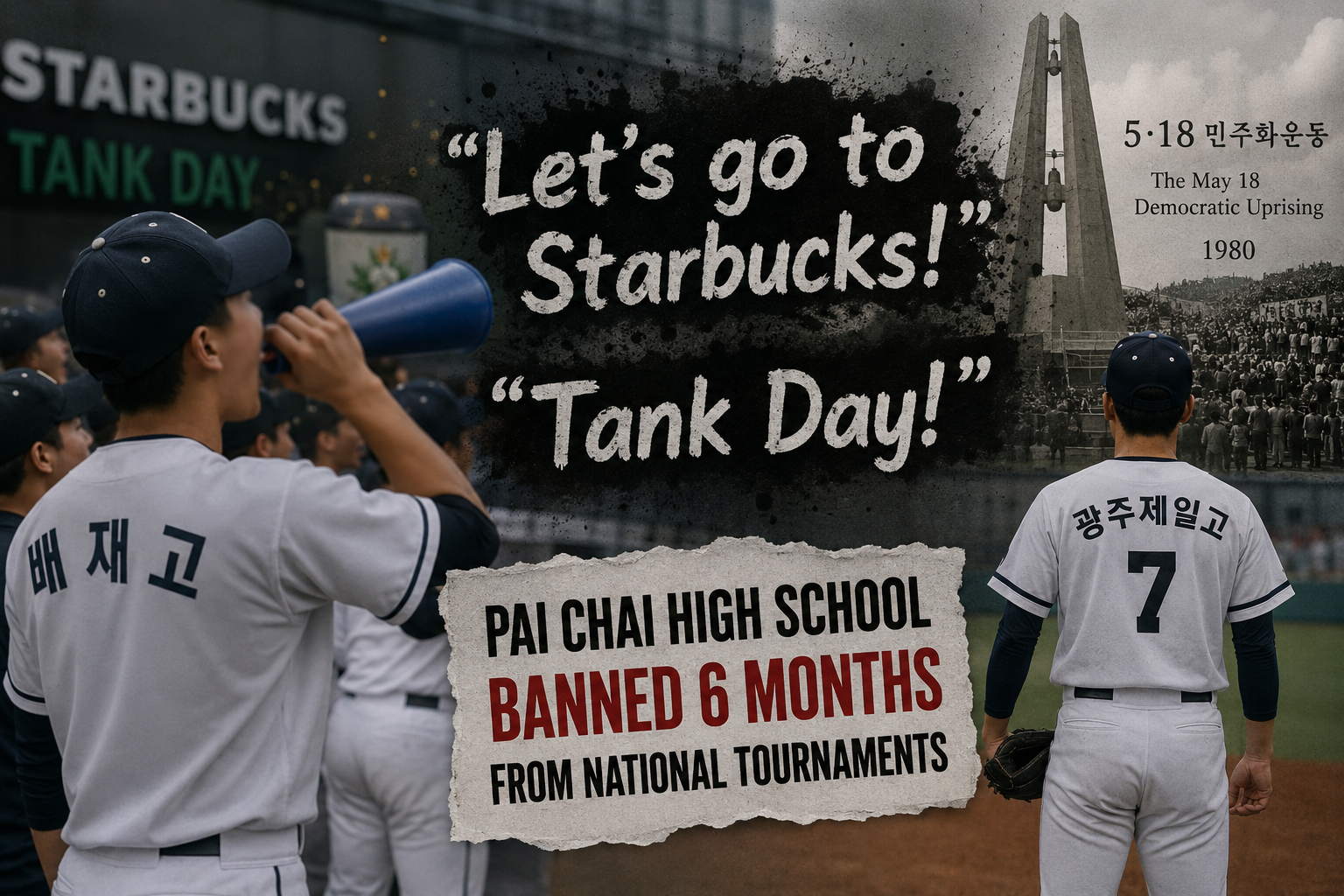
A high school baseball chant has become one of Korea’s clearest recent examples of how quickly online controversy can spill into offline behavior. Pai Chai High School’s baseball team was suspended from national tournament play for six months after players shouted “Let’s go to Starbucks!” and “Tank Day!” toward Gwangju Jeil High School during a national tournament game in Seoul. What might have looked, on the surface, like dugout trash talk was quickly read as something much more serious: a mocking reference to the memory of the 1980 Gwangju pro-democracy uprising.
The Korea Baseball Softball Association imposed the six-month ban on July 1 after reviewing the incident from Pai Chai’s game against Gwangju Jeil High School at the Blue Dragon Flag National High School Baseball Championship. Yonhap reported that the suspension took effect immediately, causing Pai Chai’s remaining tournament games to be forfeited, while separate disciplinary proceedings were expected for coaches and individual players.
The words at the center of the controversy were not random. They referred to Starbucks Korea’s recent “Tank Day” scandal, which erupted on May 18, the anniversary of the Gwangju uprising. The coffee chain’s promotion used “Tank Day” language for tumbler products, along with wording involving the sound “tak,” which critics connected both to the military suppression of Gwangju and to the 1987 torture death of student activist Park Jong-cheol. Starbucks Korea halted the promotion and apologized, while Shinsegae Group dismissed Starbucks Korea CEO Sohn Jeong-hyun over the backlash.
That context explains why the baseball chant spread so quickly through Korean news clips and social media. It was not heard simply as teenagers repeating a controversy they had seen online. It was heard as regional mockery aimed at a Gwangju school, using the vocabulary of a corporate scandal already tied to one of South Korea’s most painful democratic memories.
The Gwangju uprising remains central to modern Korean identity. UNESCO describes the May 18 Democratic Uprising as a pivotal event in South Korea’s democratization, and its documentary records were inscribed on the Memory of the World Register in 2011. That is why public references to tanks, state violence, or mockery of Gwangju do not land as neutral wordplay. They are received through a long memory of regional pain, military repression, democratic struggle, and contested historical interpretation.
The Pai Chai case compressed several Korean sensitivities into one public scene: school sports, youth conduct, regional identity, historical education, and online slang. In the dugout, the words may have functioned as taunting. In public, they became evidence of a broader failure: a failure of sportsmanship, a failure of historical awareness, and a failure to understand how quickly online references can become real-world harm once aimed at an actual community.
The Korea Times reported that the Seoul Metropolitan Office of Education said it would review the school’s follow-up measures and strengthen education for schools with athletic programs, including instruction on hate speech, disrespect toward opponents and communities, and distorted views of history. Education Minister Choi Kyo-jin also criticized the incident as conduct that denigrated the uprising and disparaged a region on a school sports field.
That official response matters. The punishment was not framed only as a sports sanction. It was framed as a civic education problem. The question became not just whether Pai Chai players violated the norms of competition, but whether school athletics had failed to teach the kind of social awareness expected from students representing their institutions in public.
The baseball association also treated the incident as institutional rather than merely individual. Kyunghyang Shinmun reported that the KBSA determined the chant ran counter to the spirit of sport and disrupted order at the venue. The association also planned separate disciplinary reviews for coaches and players, along with new guidance against inappropriate cheering at future tournaments.
This is where the story becomes larger than Pai Chai High School. The incident shows how quickly the symbolic vocabulary of one controversy can be reabsorbed into everyday behavior. A corporate promotion becomes a political scandal. A political scandal becomes a meme. A meme becomes a dugout chant. A dugout chant becomes a disciplinary case, a public apology, and a national conversation about history.
That cycle is now familiar in Korean public life. Social media does not simply amplify controversies after they happen. It supplies language, emotional framing, and shorthand references that people carry back into schools, workplaces, restaurants, stadiums, and neighborhoods. The boundary between online discourse and offline behavior has become thin enough that a phrase can move from comment sections to a baseball field in a matter of weeks.
The case also shows why youth conduct in school sports is judged so harshly when it becomes public. High school athletes are teenagers, but they also represent schools, regions, coaching systems, and elite sports pipelines. When their conduct becomes national news, the debate often moves quickly from individual immaturity to institutional responsibility.
That does not mean every student involved understood the full historical weight of the words. But the public reaction suggests that many Koreans see that lack of understanding as part of the problem. In a society where Gwangju remains a living memory rather than a closed chapter, ignorance can look like disrespect, especially when directed at a Gwangju school in a competitive setting.
The incident also reveals the continuing force of regional identity. Gwangju is not just another city in this story. It is a place whose name carries political and historical meaning. A chant that might have been dismissed as crude banter in another context became far more serious because it crossed that symbolic boundary. The target mattered as much as the words.
For schools and sports organizations, the lesson is not simply to ban offensive cheering. The deeper issue is that student-athletes now perform in a media environment where every chant, gesture, and clip can be detached from the field and judged by the wider public. Discipline will likely become faster and more visible because institutions know that local behavior can become national controversy within hours.
For Korean society, the Pai Chai ban is another reminder that historical memory is not confined to museums, anniversaries, or politics. It appears in advertising slogans, online jokes, school rivalries, and the casual vocabulary of young people. When that memory is handled carelessly, the reaction can be swift because the past is still active in the present.
The six-month ban may be remembered as a sports penalty. But the controversy around it points to something more enduring: in South Korea, public speech around Gwangju is never only speech. It is a test of historical respect, regional sensitivity, and the social consequences of turning collective trauma into mockery.