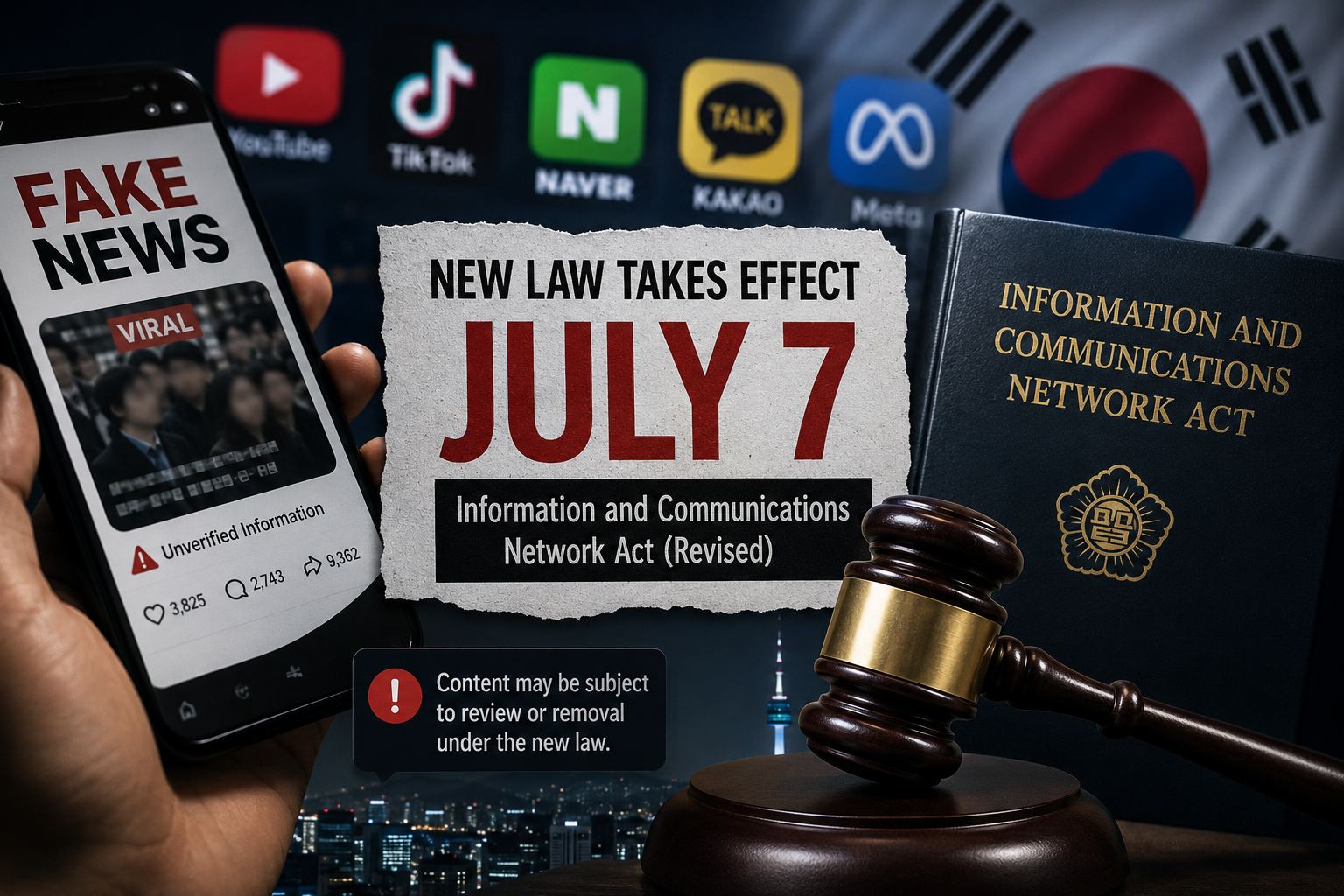
A revised online-speech law taking effect on July 7 is turning Korea’s everyday internet spaces—short-form video, community posts, app reviews, and platform complaint systems—into the center of a new moderation debate.
Korea’s next major social-media anxiety is not coming from a celebrity scandal, a political gaffe, or a viral fandom fight. It is coming from law.
On July 7, Korea’s revised Information and Communications Network Act takes effect, bringing the country’s so-called “fake news” rules into a new enforcement phase. The law has been discussed as an anti-disinformation measure, but its impact is likely to be felt far beyond formal politics or journalism.
That is why it has become one of the clearest platform issues of the week. The revised framework reaches the spaces where Korean internet culture actually happens: YouTube videos, TikTok clips, online communities, comment sections, app reviews, and posts that move quickly from private complaint to public accusation.
In Korea, a one-star review, a parenting-community post, a neighborhood rumor, or a viral short video can become a reputational weapon almost immediately. Businesses, schools, hospitals, public figures, creators, and ordinary users can all be pulled into online accusation cycles before facts are settled. The new law enters that environment with a promise of accountability, but also with a major unresolved question: who decides what is false, harmful, or unlawful quickly enough for platforms to act?
The most visible part of the law concerns high-traffic creators. English-language coverage from The Korea Times and SCMP has emphasized that creators with large audiences may face punitive damages if they deliberately spread unlawful or fabricated information that causes harm. Reports have pointed to thresholds such as more than 100,000 subscribers or high monthly viewership, making the law especially relevant to YouTube, TikTok, and other creator-driven platforms.
Large platforms are also under pressure. Digital Today reported that the final enforcement decree applies new self-regulatory obligations to major user-to-user information intermediary services, with the rules taking effect on July 7. Platforms with large daily user bases are expected to maintain systems for reporting, monitoring, and responding to problematic content.
That platform obligation is where the public anxiety becomes sharper. The issue is not only what courts may eventually decide. It is what platforms may do first.
If a platform faces greater regulatory risk for leaving disputed content online, it may become more willing to remove or restrict posts before legal questions are fully resolved. That could affect political commentary, consumer reviews, creator commentary, local-community accusations, and public-interest criticism. For users, the fear is not just punishment after a court case. It is faster takedowns, more aggressive complaint systems, and a more cautious moderation culture.
Supporters of the law argue that Korea has a real problem with fabricated content and online reputational attacks. False claims can spread widely before correction, and online mobs can damage individuals and businesses with little accountability. In that sense, the law reflects a familiar demand: platforms and creators should not be able to profit from viral falsehoods while victims absorb the damage.
Critics see a different danger. Once “fake news” becomes a legal and platform category, powerful complainants may use it to pressure platforms against criticism. A business criticized in a review, a public figure targeted by commentary, or an institution named in a community post may have stronger incentives to file complaints. Platforms, meanwhile, may not want to become judges of truth, motive, and harm.
This tension is especially important in Korea because online reputation is already intensely platform-driven. Search visibility, community discussion, short-form video, and review culture can shape public perception with unusual speed. A single accusation can migrate from a forum to YouTube commentary to social media screenshots within hours. The new law does not create that culture, but it changes the risk calculation around it.
The final enforcement details also matter. Earlier discussion around the law created a broad impression that many everyday digital spaces, including open marketplaces and review-heavy services, could be directly pulled into the platform-obligation framework. Korean legal coverage has since indicated that the final enforcement-decree scope is narrower in some respects than earlier drafts, especially around certain search and marketplace services. Still, the broader cultural effect remains: users and platforms are now preparing for a more legally sensitive internet.
That is why July 7 is being watched as a platform moment, not just a legal date. Creators may become more cautious about commentary. Communities may change moderation rules. Platforms may make complaint channels more visible. Users may think twice before posting accusations, reviews, or rumors that cannot be clearly supported.
The strongest version of the law’s argument is that Korea needs tools against malicious falsehoods that can destroy reputations at platform speed. The strongest concern is that those same tools could make platforms more defensive, more opaque, and more likely to silence contested speech.
Next week’s question is not simply whether Korea has a fake-news problem. It is whether the new system can target deliberate harm without turning everyday online criticism into something easier to suppress.
For Korea’s internet users, that is the real anxiety: not only what counts as fake news, but who gets to decide before the post disappears.