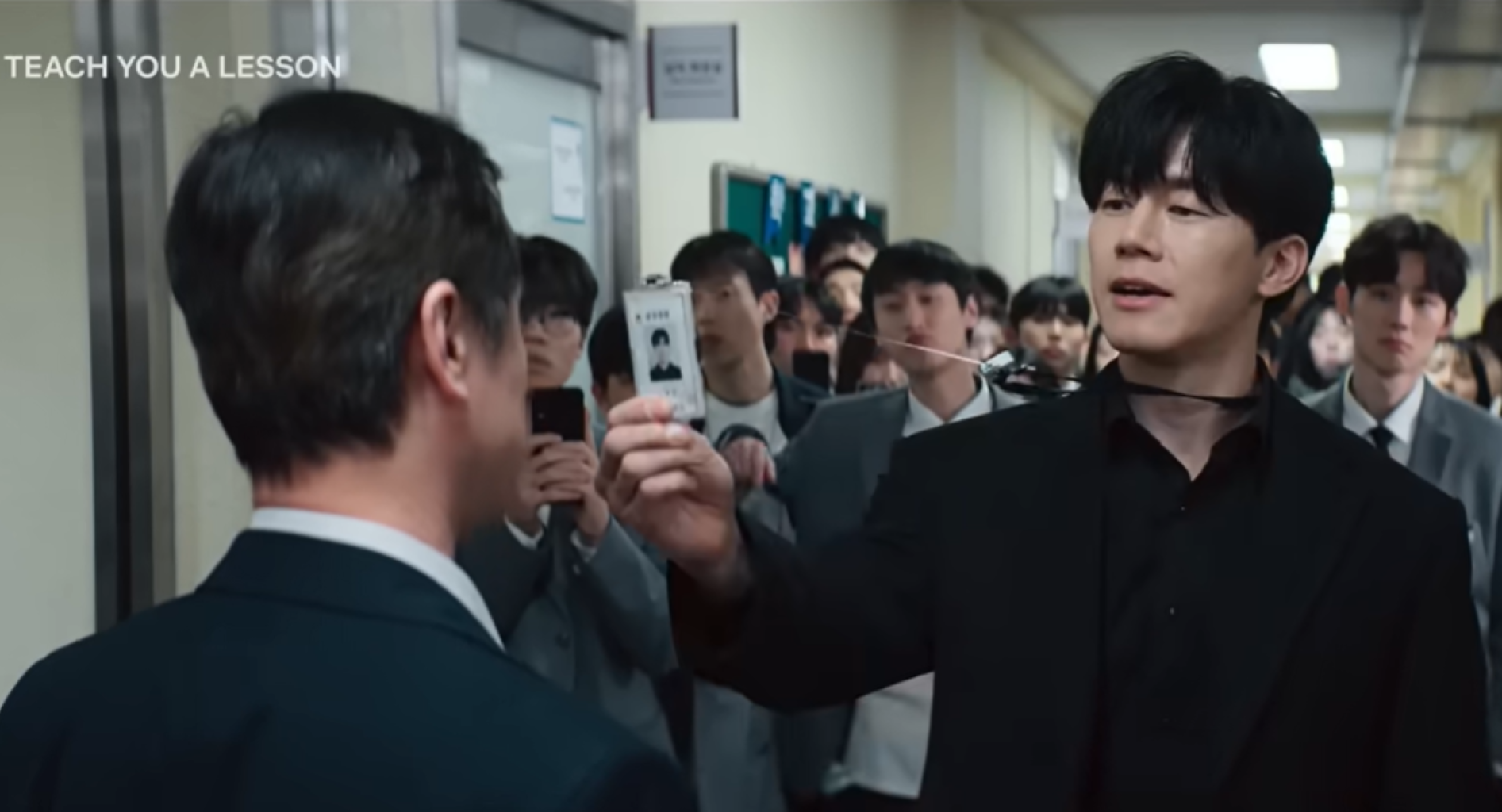
Netflix’s Teach You a Lesson did not arrive quietly.
Released globally on June 5, 2026, the Korean limited series quickly became one of the most watched non-English shows on Netflix. Within its first tracking week, it reached No. 1 on Netflix’s global non-English TV chart, drawing 6.4 million views and 68.7 million hours watched. By June 9, it was also appearing strongly across country-level Netflix charts, including major Asian markets and several regions beyond Asia.
But the series is not being discussed only because it is popular. It is being discussed because viewers around the world are arguing over what kind of story it is: a satisfying anti-bullying fantasy, a provocative social drama, or a troubling glamorization of violence in schools.
That tension is exactly what makes Teach You a Lesson one of the most interesting Korean dramas of the year.
Based on the Naver webtoon Get Schooled, originally titled 참교육 in Korean, the drama follows a fictional government bureau created to intervene when schools collapse under bullying, abuse, corruption, and fear. The Korean title can be translated as “true education” or “proper discipline,” though the phrase also carries a sharper modern meaning: giving someone the lesson they deserve. Netflix’s English title, Teach You a Lesson, leans into that double meaning.
The result is a drama that is both easy to binge and difficult to discuss calmly.
A School Drama Built Like an Action Series
At the center of Teach You a Lesson is Na Hwa-jin, played by Kim Moo-yul, an inspector dispatched to schools where ordinary systems have failed. He is not a traditional teacher, counselor, or bureaucrat. He enters each case more like an institutional enforcer: calm, physically capable, and willing to confront students, parents, administrators, and criminals with methods that go far beyond normal school discipline.
The agency he works for exists in a fictionalized version of South Korea where the collapse of respect in schools has become a national emergency. Teachers are humiliated, students are bullied, parents abuse power, and administrators often choose self-preservation over justice. When the bureau arrives, it does not simply investigate. It intervenes.
That premise gives the show its immediate appeal. Each episode presents a broken school environment, identifies the person or group abusing power, then lets Hwa-jin and his team turn the situation around. The structure is familiar, but the setting gives it emotional force. Instead of police officers chasing criminals or prosecutors exposing corruption, the heroes walk into classrooms, hallways, parent meetings, and private academies.
The battlefield is education.
That is why the drama feels different from a standard revenge thriller. Teach You a Lesson is not only about punishing villains. It is about the fear that schools — places meant to protect young people — have become places where the vulnerable are abandoned.
Why Viewers Are Responding So Strongly
The strongest positive reaction to Teach You a Lesson is catharsis.
For many viewers, the series offers a fantasy they rarely see in real life: bullies are confronted, powerful parents are exposed, teachers are defended, and victims are finally believed. The drama understands the anger that builds when institutions move too slowly or fail to protect the people who need them most.
This is especially important in the global K-drama landscape. Korean dramas about school violence have traveled widely in recent years, from The Glory to Weak Hero Class. International viewers are now familiar with the emotional grammar of these stories: the isolated victim, the protected bully, the indifferent authority figure, and the long wait for justice.
Teach You a Lesson changes the formula by making justice immediate. Hwa-jin does not wait years for revenge. He enters the school and acts.
That is thrilling for some viewers. It is also exactly what makes the series uncomfortable.
Online reaction has praised Kim Moo-yul’s performance in particular. His Na Hwa-jin is not loud or reckless. He is controlled. He studies the room, lets others underestimate him, then takes command with a combination of intimidation, intelligence, and physical force. Viewers who enjoy antihero characters have responded to that confidence. He is written as the adult who refuses to be manipulated, bribed, shamed, or frightened.
Lee Sung-min adds authority as Choi Gang-seok, the political figure behind the bureau. Jin Ki-joo brings sharper energy as Im Han-rim, while Pyo Ji-hoon gives the team a lighter rhythm as Bong Geun-dae. Together, they make the bureau feel like a fantasy institution: the version of government viewers might imagine when they are tired of apologies, committees, and delayed consequences.
The Controversy Did Not Begin With Netflix
The debate around Teach You a Lesson began long before the drama premiered.
Its source material, Get Schooled, was already controversial. The webtoon attracted criticism for its violent disciplinary fantasy and later faced major international backlash over offensive racial content. Its English-language release on WEBTOON was discontinued after that controversy, and the title has remained one of the most debated Korean webtoon properties among global readers.
That history matters because the Netflix drama cannot fully separate itself from the webtoon’s reputation. Viewers who know the source material are not watching the series as a neutral school action drama. They are watching to see whether the adaptation softens, revises, or repeats the original’s problems.
The Netflix version appears to understand that burden. The drama emphasizes victims more clearly than institutional authority alone. It repeatedly frames the bureau as an agency that is not automatically on the side of teachers, students, or parents, but on the side of those being harmed. That adjustment gives the series a more defensible moral center.
Still, the basic premise remains provocative: a state-backed team uses force and intimidation to restore order in schools.
That is the line viewers keep returning to. Is the show criticizing broken systems, or is it inviting audiences to enjoy the fantasy of force as a solution?
The answer depends on the episode, and often on the viewer.
A Korean Social Issue With Global Reach
In South Korea, Teach You a Lesson lands inside a much larger conversation about education, teacher authority, school violence, parental pressure, and youth crime.
The country has spent years debating the pressure placed on students, the power of parents, the vulnerability of teachers, and the difficulty of responding to bullying before it becomes irreversible. These are not abstract themes. They are recurring public concerns, and the drama uses them as emotional fuel.
That is one reason the show can feel so intense to Korean viewers. The cases may be exaggerated, but the anxieties underneath them are recognizable: teachers afraid to discipline students, parents who treat schools as customer-service centers, students who weaponize status or social media, and administrators who hide problems to protect reputations.
For some Korean viewers, the show is a fantasy of overdue correction. It says what many people may feel but would not say publicly: that the system has become too weak to protect the innocent.
For others, especially those concerned about real-world education policy, that fantasy is dangerous. A drama that makes physical punishment look stylish can blur the difference between emotional satisfaction and ethical judgment. It may expose real frustration, but it also risks suggesting that schools can be repaired by fear.
That is why Teach You a Lesson feels less like a simple entertainment product and more like a national argument in drama form.
How International Viewers Are Reading the Drama
Outside Korea, the response has been just as intense, but not always for the same reasons.
In many Asian markets, the drama’s themes are immediately legible. Exam pressure, school hierarchy, parental ambition, bullying, and the shame attached to academic failure are familiar concerns across the region. Viewers in countries such as Japan, India, Indonesia, the Philippines, Thailand, Taiwan, Vietnam, and Malaysia helped push the show high on Netflix country charts shortly after release.
In these conversations, the appeal often centers on emotional justice. Viewers respond to the satisfaction of seeing bullies lose their power and victims gain protection. The show’s action-thriller style makes that satisfaction easy to access, even for audiences unfamiliar with the original webtoon.
In English-language viewer spaces, reaction has been more divided. Many viewers praise the show’s pace, performances, and anti-bullying message. They describe it as addictive, intense, and satisfying. At the same time, others question whether the series goes too far in turning discipline into spectacle. Some viewers also approach the drama with caution because of the original webtoon’s controversy.
That split is important. Teach You a Lesson is not traveling globally as a soft-power comfort drama. It is traveling as a provocation. It asks international audiences to confront a question that is not limited to Korea: what should happen when schools fail to protect victims?
The show’s answer is thrilling on screen. Whether it is morally convincing is another matter.
Why the Drama Works as Entertainment
As a piece of television, Teach You a Lesson knows exactly how to keep viewers watching.
The cases are direct. The villains are easy to hate. The victims are placed in situations that invite emotional investment. The bureau’s interventions are staged with the rhythm of an action drama: entrance, confrontation, reversal, punishment, release.
That formula can be blunt, but it is effective. Each episode gives viewers a clear emotional arc. The world begins unjust. The team arrives. The balance of power shifts.
Kim Moo-yul’s performance is essential to that effect. He gives Na Hwa-jin a stillness that makes the character more compelling than a simple tough-guy hero. Hwa-jin does not need to shout to dominate a scene. His silence often does more work than his threats. The performance makes him feel like someone who has already calculated the moral and physical terrain before anyone else realizes a confrontation has begun.
The supporting cast also helps the drama avoid becoming a one-man show. Im Han-rim’s more volatile presence adds unpredictability. Bong Geun-dae’s technical and comic elements soften the bureau’s severity. Choi Gang-seok gives the agency political weight, reminding viewers that this is not just a revenge team but a fictional public institution with national consequences.
The result is a drama that moves quickly, even when its moral questions are heavy.
Where the Drama Becomes Uneven
The weakness of Teach You a Lesson is also tied to its strength.
Because the drama is so committed to catharsis, it sometimes simplifies the social problems it introduces. Bullying, teacher burnout, abusive parenting, youth crime, online harassment, and academic pressure are complex issues. They do not disappear after one confrontation, one exposure, or one physical defeat.
The show knows this, but it does not always have time to explore it. Its action structure pushes each case toward a dramatic payoff. That makes the episodes satisfying, but it can also make the solutions feel too easy.
This is where criticism of the series is most persuasive. Teach You a Lesson raises serious questions about institutional failure, but its most memorable scenes often involve punishment rather than repair. It is more interested in the moment when power changes hands than in the slower process of rebuilding trust.
That does not make the drama ineffective. It makes it conflicted.
The series wants to be a social critique and a crowd-pleasing action show at the same time. Sometimes those goals support each other. Sometimes they collide.
Why This Debate Matters Beyond One Drama
The reaction to Teach You a Lesson reveals something important about the current global appetite for Korean storytelling.
Audiences are not only looking for romance, fantasy, or polished genre entertainment. They are also drawn to Korean dramas that dramatize social pressure: school violence, workplace hierarchy, class resentment, institutional corruption, and the loneliness of people trapped inside rigid systems.
This is one reason webtoon adaptations have become so powerful. Webtoons often begin with a strong premise and a sharp emotional hook. They are built around serialized momentum. They know how to make readers return. When adapted well, that structure can translate naturally into streaming television.
But Teach You a Lesson also shows the risk of adapting controversial webtoons for a global audience. Source material does not arrive cleanly. Its past travels with it. International viewers now know how to trace a drama back to its original platform, its reader debates, and its publication history. A streaming adaptation cannot assume that controversy will stay behind.
In this case, the controversy may even be part of the show’s visibility. Viewers are watching not only to be entertained, but to decide where they stand.
Final Take
Teach You a Lesson is fast, forceful, and impossible to discuss without touching a nerve.
As entertainment, it is highly watchable. It has a strong central performance, a clear episodic structure, and the kind of moral momentum that makes viewers want to continue. It understands the appeal of seeing bullies and abusers lose control.
As social commentary, it is more complicated. The drama gives voice to real frustration with broken institutions, but it often turns that frustration into a fantasy of punishment. That fantasy can feel satisfying, especially when victims have been ignored. It can also feel troubling when the show makes force look like the cleanest answer.
That contradiction is the real reason Teach You a Lesson has become a global conversation. Viewers are not simply asking whether the drama is good. They are asking why it feels so satisfying — and whether that satisfaction should make them uncomfortable.
In a year crowded with Korean dramas, Teach You a Lesson stands out because it does not ask to be quietly enjoyed. It asks to be argued over.




Leave a Reply