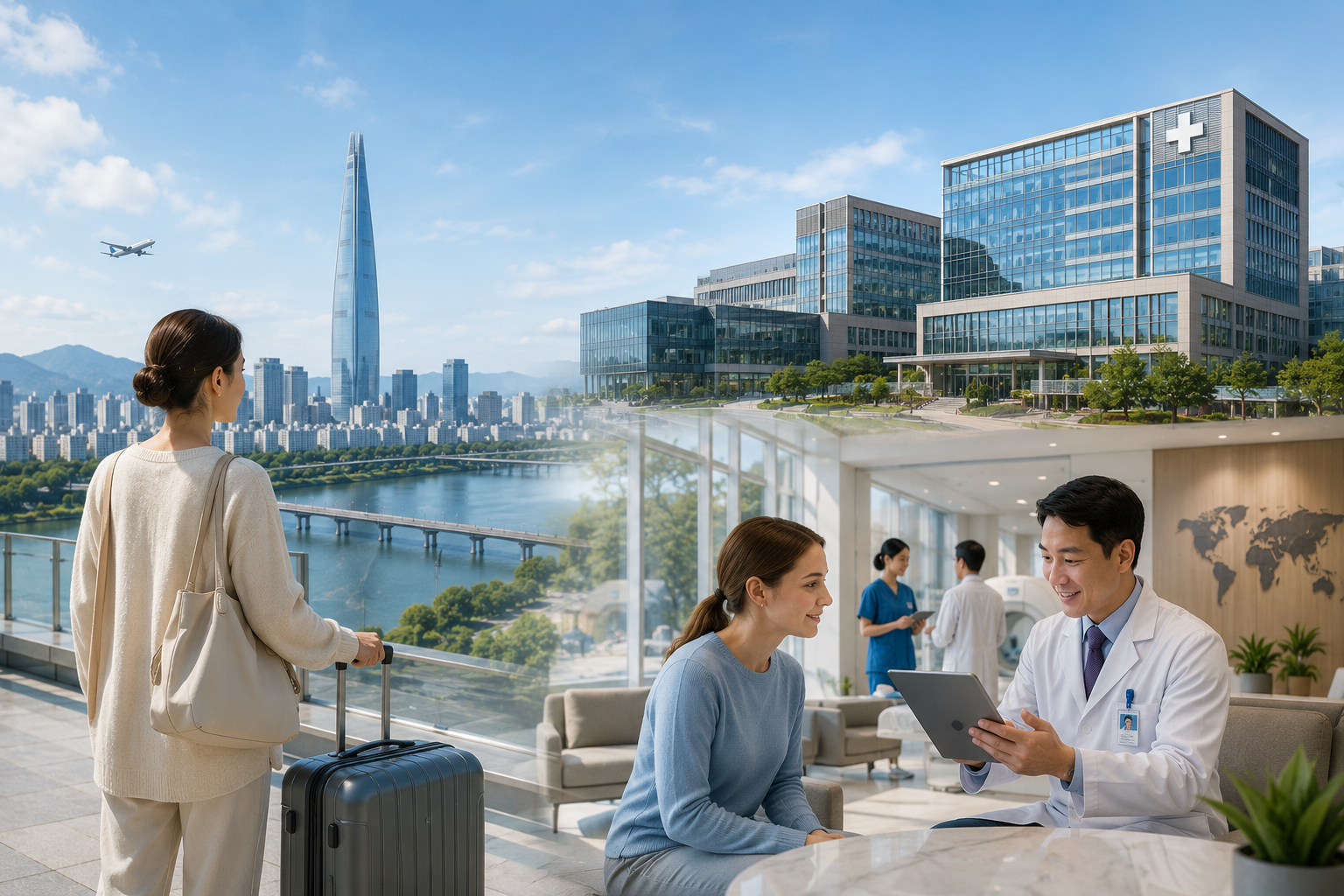
South Korea’s medical tourism industry has crossed a symbolic threshold: the country is now in the “2 million foreign patient” era.
That number matters because it changes how the industry should be understood. For years, Korean medical tourism was often treated as a side story to tourism, K-beauty, plastic surgery, or elite hospital care. In 2025, however, foreign patients became a large-scale service economy in their own right. According to government data, more than 2 million foreign patients visited Korea in 2025, the first time the country has passed that mark since it began formally tracking foreign-patient attraction in 2009.
A new industry briefing held in Seoul by the Korea Health Industry Development Institute, often known as KHIDI, shows that policymakers and medical institutions now see the next stage differently. The question is no longer simply how Korea can attract more patients. The more important question is how Korea can convert rapid growth into a sustainable, higher-value, better-regulated medical tourism ecosystem.
What Happened at the Seoul Briefing
On June 5, KHIDI held a foreign-patient attraction briefing in Seoul at the Severance Building near Yonsei University. The event brought together about 150 people from foreign-patient medical institutions, patient-attraction agencies, local governments, and related organizations.
The timing was deliberate. Korea had just passed 2 million foreign patients for the first time. The briefing was framed around how the industry should grow from here.
The topics reveal the direction of travel. Speakers discussed government support based on long-term patient data, telemedicine systems for foreign patients, high-value business models, medical-dispute prevention, branding, and regional medical-tourism clusters. In other words, the conversation was not only about marketing Korea abroad. It was about building a more mature industry structure.
One presentation focused on using data accumulated since 2009 to design more targeted support policies by country and medical specialty. Another discussed how telemedicine can help foreign patients before they enter Korea and after they return home. A cosmetic-surgery clinic presentation warned against a low-price, high-volume “factory” model and argued that the industry needs to compete through service quality and differentiated patient experience.
That warning may be the most important part of the story.
The Numbers Behind the Boom
The 2025 data show explosive growth. Korea recorded about 2.01 million foreign patients in 2025, with total patient visits reaching about 2.72 million. Since 2009, cumulative foreign patients have reached about 7.06 million.
The post-pandemic rebound has been especially dramatic. Foreign-patient numbers fell sharply during COVID-19, dropping to about 120,000 in 2020. They then recovered to about 610,000 in 2023, about 1.17 million in 2024, and more than 2 million in 2025. That means the market has nearly doubled year after year for three consecutive years.
By nationality, China and Japan dominate. Together, they accounted for more than 60 percent of all foreign patients in 2025. Taiwan, the United States, and Thailand followed. The rapid increase from China and Taiwan was especially notable, driven by beauty-medical demand, travel recovery, aviation capacity, and Korea’s broader appeal as a culture and shopping destination.
By medical specialty, the picture is even clearer. Dermatology was the leading category by far, accounting for roughly 1.31 million patients, or about 62.9 percent of all foreign-patient treatment. Plastic surgery followed at about 11.2 percent, then internal medicine and checkup centers.
This means Korea’s medical tourism boom is strongly linked to beauty-related procedures, especially skin treatment. The medical tourism economy is not just about hospitals. It is tied to the international image of Korean skin care, Korean cosmetics, Korean celebrities, and the idea of Korea as a place where beauty trends begin.
K-Beauty Has Become Medical Infrastructure
Korea’s advantage is not only that it has capable hospitals and clinics. Many countries have capable hospitals and clinics. Korea’s advantage is that its medical services are attached to a much larger cultural ecosystem.
K-beauty creates demand before the patient even searches for a clinic. Korean dramas, idols, influencers, cosmetics, skin-care routines, beauty YouTube channels, and social media all help shape the global fantasy of Korean skin, Korean aesthetics, and Korean self-care. For many visitors, a dermatology appointment in Seoul is not an isolated medical act. It is part of a larger Korea trip: shopping, food, cafes, cosmetics, fashion, entertainment, and personal transformation.
That gives Korea a major advantage over purely clinical medical-tourism destinations. The patient is also a tourist, consumer, and fan of Korean culture.
But this advantage creates risk. When a medical service becomes too closely tied to trend culture, it can also become vulnerable to over-commercialization. Low-price packages, aggressive brokers, poor aftercare, language barriers, and inconsistent service quality could quickly damage Korea’s reputation if the industry grows faster than its safeguards.
Seoul Is Winning, but the Regional Gap Is Still Large
The 2025 data also show a striking regional imbalance. Seoul attracted about 87.2 percent of all foreign patients. This is understandable. Seoul has the highest concentration of registered foreign-patient medical institutions, international transport access, hotels, shopping districts, interpreters, and recognizable medical brands.
For visitors from Japan, China, Taiwan, Southeast Asia, and the United States, Seoul is the easiest destination to understand and navigate. It is also where Korean beauty medicine is most visible.
But the concentration creates two policy problems.
First, the economic benefits of medical tourism are unevenly distributed. If most patients stay in Seoul, then regional hospitals, hotels, transport providers, and local tourism operators receive only a small share of the boom.
Second, Seoul’s dominance reinforces the beauty-clinic structure of the market. Korea has strong medical assets outside cosmetic dermatology, including cancer care, fertility treatment, dentistry, rehabilitation, health checkups, Korean medicine, and complex hospital care. But many of these require longer stays, stronger referral systems, more translation support, and deeper trust-building than a short beauty-medical visit.
The government has been trying to develop regional medical-tourism clusters, linking hospitals with tourism, wellness, and local business networks. The Seoul briefing’s discussion of a Myeongdong medical-tourism network points to how these clusters may work in practice: healthcare, shopping, hotels, local merchants, and tourism infrastructure operating as one coordinated service zone.
The harder challenge is whether similar models can work outside Seoul.
Telemedicine Could Change the Patient Journey
One of the most important structural changes is the formalization of telemedicine for foreign patients.
Foreign medical tourists face a unique problem. They often come to Korea for a short time, receive treatment, and then leave the country. But good healthcare does not end at the clinic door. Patients may need pre-arrival consultation, follow-up care, recovery guidance, prescription coordination, or help managing complications after returning home.
That is especially important for higher-value care. A quick skin treatment can be managed with a short appointment. But surgery, fertility treatment, complex dental care, cancer care, and chronic disease management require continuity. Without reliable pre- and post-care, Korea’s medical tourism industry will remain tilted toward procedures that can be completed quickly.
The new legal framework for foreign-patient telemedicine is therefore not just a convenience measure. It could become the infrastructure that allows Korea to move beyond one-time beauty visits and into longer-term global healthcare relationships.
For patients, the appeal is obvious: they can consult before flying, reduce uncertainty, plan treatment more efficiently, and receive follow-up after leaving Korea. For providers, telemedicine creates a way to build trust earlier and retain patients after their trip. For Korea’s industry strategy, it supports the transition from volume-based tourism to relationship-based healthcare.
The Industry’s Biggest Risk: The “Factory Model”
Some reports highlighted a concern raised during the briefing: the danger of price-driven, “factory-style” patient attraction.
This is a familiar risk in fast-growing service industries. When demand rises quickly, providers can be tempted to compete mainly on speed, price, and volume. That can work temporarily, especially in beauty medicine, where consumers may compare clinics through social media and package deals. But it can weaken long-term trust.
Medical tourism depends on confidence. A foreign patient is choosing care in a different language, legal system, and cultural environment. If something goes wrong, the patient may not know how to complain, mediate, or seek compensation. That makes trust even more important than in ordinary tourism.
Korea’s long-term medical tourism brand cannot be built only on “fast,” “cheap,” or “trendy.” It must be built on safety, transparency, multilingual communication, aftercare, medical-dispute response, and consistent patient experience.
This is where Korea has a chance to differentiate itself. The country already has a powerful cultural brand. The next stage is to match that brand with a healthcare-service standard that international patients can trust.
Why the Economic Impact Is So Large
Medical tourists spend money differently from ordinary tourists. They do not only pay for flights and hotels. They pay for consultations, procedures, recovery care, companions, translation, shopping, restaurants, local transportation, and sometimes extended accommodation.
Government-linked analysis estimated that foreign patients and their companions generated about 12.5 trillion won in medical-tourism spending in 2025, including about 3.3 trillion won in medical spending. The estimated domestic production impact was about 22.8 trillion won.
That scale explains why medical tourism is now being treated as a strategic industry. It supports clinics and hospitals, but also hotels, airlines, beauty retailers, pharmacies, wellness services, duty-free shops, interpreters, platform companies, and local commercial districts.
This is why Myeongdong matters. It is not simply a shopping neighborhood. It is a possible model for how medical services, beauty retail, tourism, and urban commerce can reinforce one another.
What Korea Needs Next
Korea has already won the volume race. Passing 2 million foreign patients is proof that the country has become one of Asia’s most visible medical tourism destinations. But the next stage will be harder.
First, Korea needs stronger quality control. Medical tourists should be able to identify trustworthy institutions, understand prices, receive clear consent information, and know what happens if there is a dispute.
Second, Korea needs better multilingual patient navigation. Translation is not enough. Foreign patients need culturally competent guidance before, during, and after treatment.
Third, the industry needs to reduce overdependence on Seoul and beauty medicine. Dermatology and plastic surgery will remain important, but sustainable growth requires broader medical categories and stronger regional participation.
Fourth, Korea needs to integrate telemedicine carefully. Done well, it can improve safety and continuity of care. Done poorly, it could create confusion around responsibility, licensing, prescriptions, and follow-up.
Fifth, Korea should protect the connection between K-beauty and medical credibility. The same soft-power engine that attracts patients can also amplify negative stories if patients feel rushed, misled, or poorly cared for.
The Bottom Line
South Korea’s medical tourism industry has entered a new phase. The 2 million foreign-patient milestone shows that Korea’s mix of healthcare, beauty culture, tourism infrastructure, and global soft power is working.
But the industry’s future will not be decided by visitor numbers alone.
The real test is whether Korea can move from a high-volume beauty-medical boom to a high-value healthcare ecosystem. That means better aftercare, stronger patient protection, more transparent service standards, smarter use of telemedicine, and regional medical-tourism models that spread benefits beyond Seoul.
Korea has already become a place where foreign visitors come to shop, eat, watch, and experience culture. Increasingly, it is also becoming a place where they come to be treated, restored, and transformed.
The opportunity is enormous. So is the responsibility.



Leave a Reply