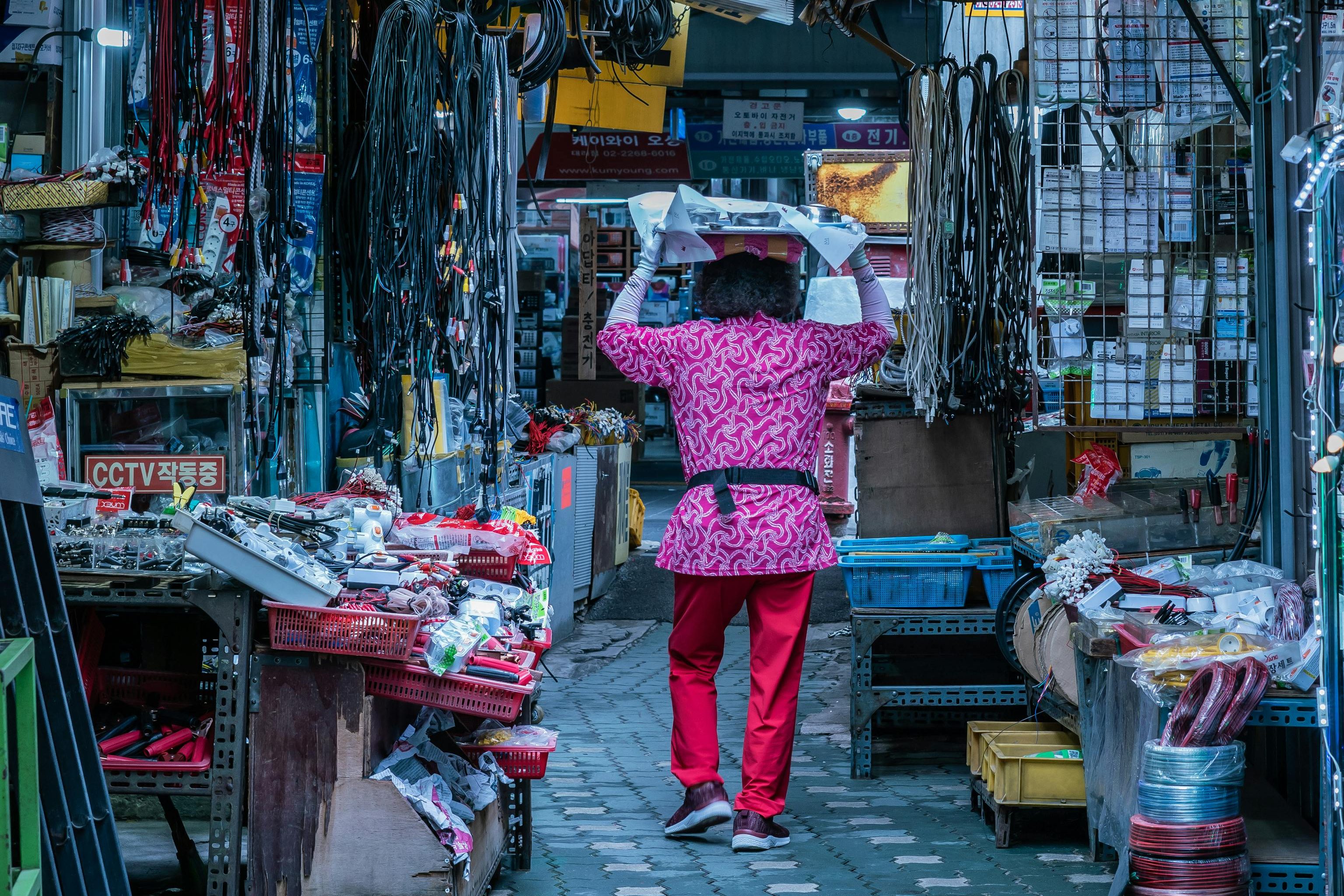
In Korea right now, work is doing something strange in the timeline.
On one end, late-career employment is stretching forward: in 2025, the employment rate for 55–64-year-olds hit 70.5%, the first time that cohort crossed 70% since the series began in 1983.
On the other end, early adulthood is stalling. More young people—especially those in their 20s—are slipping into a Statistical Korea category that feels less like economics and more like mood: “쉬었음,” often translated as taking a break or just resting. It doesn’t simply mean unemployed. It means not working and not actively job-hunting, for reasons that don’t include school, illness, childcare, or household duties.
So Korea can post a record-high late-career employment rate and still feel like a country where twenty-somethings are… absent. Not from life, necessarily—but from the expected life-script.
And that’s the weekend-magazine truth of it: this isn’t just a labor story. It’s a culture story about what a “normal life” is supposed to look like—and what happens when the timeline breaks.
The new Korea timeline: work begins later, ends later, and feels shakier throughout
If you grew up on the classic Korean sequence—study hard → survive the entrance exam funnel → secure a first job → climb—then today’s numbers read like a plot twist.
Older Koreans are working longer.
But the milestone hides a common reality: many people still hit a kind of retirement cliff around 60 and then re-enter the market in a second act—often with less pay, less status, and less security than before. The “peak wage” debate (wages tapering downward with age) lives here, too: an attempt to reconcile seniority pay traditions with longer working lives—sometimes at the cost of older workers’ income.
Younger Koreans aren’t just unemployed.
They’re increasingly detached from the formal labor market in ways that don’t always register in the unemployment rate—because unemployment requires you to be actively searching.
That’s why “resting” has become the lightning word: it suggests not a temporary gap, but a quiet suspension of forward motion.
What “just resting” looks like in real life
“Resting” is a statistical category, but culturally it has a texture.
It can look like:
- living at home again and keeping days small,
- pausing job applications after months of no replies,
- studying for exams that may or may not convert into a job,
- cycling between short-term gigs and long breaks,
- or simply opting out of precarious work that feels like a dead end.
And this is where Korea’s youth story refuses simple moral framing.
Some of this “resting” is strategic—a rational decision to avoid low-quality work after investing years in education. Some of it is protective—burnout, discouragement, or mental health strain after repeated failure in a hyper-competitive entry market.
When the label expands, it starts to feel less like “a personal choice” and more like a social weather system.
Meanwhile, the late-career boom is real—but not always a victory lap
If you’re reading the 70.5% figure as a celebration of energetic new seniors, you’re not wrong—partly.
Korea’s older workforce is healthier than past cohorts, and the country is aging fast. It needs people who can and want to work longer.
But a big part of “working longer” in Korea is not the glossy version (late-career fulfillment). It’s the pragmatic version (income continuity). Reporting and research have repeatedly pointed to the way older workers are often pushed into lower-paid, more precarious roles even as participation rises.
And the government’s role matters. Korea has expanded senior employment programs and supported roles that keep older adults economically active—good for participation, but also a sign that the state is now actively shaping the age profile of “employment.”
So the late-career rise is both:
- a sign of adaptation, and
- an indicator that retirement, as a stable end-state, is fading.
The feeling underneath the data: two generations living in different Koreas
This is where the weekend-magazine lens matters: the split isn’t only in jobs. It’s in meaning.
For many older Koreans, work is a continuation of responsibility.
The house, the savings gap, the expectation of supporting children longer than planned, the reality that “retirement” often means reemployment.
For many younger Koreans, work is a gatekeeping ritual.
It’s not “get a job.” It’s “get a good first job”—one that feels like it justifies the years spent studying, the private education costs, the résumé choreography, the social pressure.
And when the gate feels too narrow, the system produces a strange outcome: young people who are not visibly “unemployed,” but not participating either.
A country can be working harder and moving slower at the same time.
Why this mismatch is getting worse, not better
Even if Korea’s overall employment numbers look okay, the distribution of opportunity matters.
A few structural forces amplify the two-speed effect:
- Entry-level hiring is the easiest thing for firms to pause. When uncertainty rises, companies don’t always lay people off; they just stop opening doors for first-timers.
- Job growth can concentrate in roles that don’t fit youth expectations or credentials. That doesn’t mean those jobs are “bad.” It means the match is broken.
- Demographics distort the mood. A shrinking youth population can make it feel like “there should be plenty of jobs,” yet the competition for specific stable tracks (large firms, public sector) remains brutal.
And in Korea, job quality is not a soft concept. It is tied to long-term security: income trajectories, housing prospects, marriage and family plans, even self-worth in a résumé society.
The cultural question Korea is really asking: when does adulthood start now?
For decades, Korea ran on a collective schedule:
- school → test → university → first job → stability.
Now the schedule is bending:
- stability is delayed,
- retirement is delayed,
- and the middle is increasingly uncertain.
That’s why this story keeps resurfacing in conversation, not just policy. It’s not about laziness or virtue. It’s about time—about how long life takes now, and what the country expects of you at each stage.
If the 70.5% milestone is to mean progress rather than pressure, Korea will need to build two things at once:
- Late-career jobs that aren’t a downgrade (so longer working lives don’t equal longer insecurity).
- A credible first rung for younger workers—paid training paths, junior hiring tracks, and entry routes that don’t demand years of unpaid endurance.
Because right now, the most revealing statistic may not be 70.5%.
It’s the quiet fact that in one of the world’s most work-structured societies, a growing number of young people are being counted as “resting”—not because they’re resting, but because the system doesn’t know what to call this new kind of pause.
And maybe neither do we.


Leave a Reply