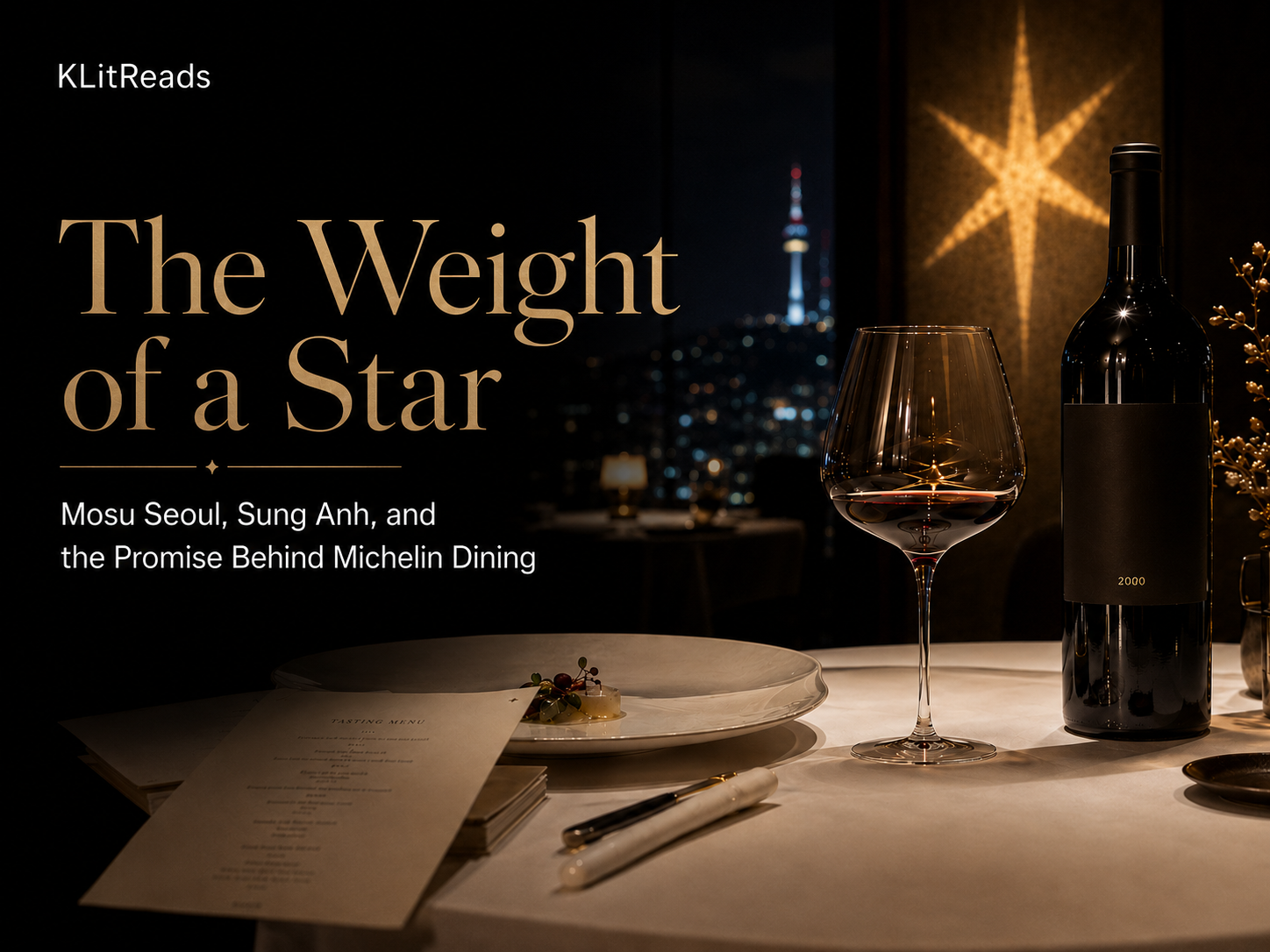
A Michelin restaurant does not sell food alone. It sells trust.
That trust lives in details most guests never see: the cellar record, the service briefing, the pairing list, the sommelier’s hand, the label facing the table, the chef’s authority behind every element of the meal. At a restaurant like Mosu Seoul, those details are not background operations. They are part of the promise.
That is why the recent wine controversy surrounding Sung Anh, also widely known in Korean media as Ahn Sung-jae — 안성재, the Korean spelling of his name — has become more than a dispute over one bottle. It has become a public test of what a Michelin-level restaurant owes its guests when trust is broken.
According to Korea JoongAng Daily, the controversy began after a customer claimed that during a Mosu Seoul wine-pairing course, they were supposed to receive a Château Léoville Barton 2000 but were instead served the 2005 vintage, reportedly a less expensive bottle by more than 100,000 won. The customer said they noticed a difference in aroma and taste, asked staff to confirm the wine, and was told by the sommelier that a different wine from the course listing had been served.
Mosu Seoul later issued an apology, saying it had failed to provide accurate guidance during wine-pairing service and that its follow-up explanation was insufficient. The restaurant said the entire Mosu team, including Chef Sung Anh, took the matter seriously and would review service procedures to prevent a similar incident.
But the apology did not end the issue. It changed the question.
The question was no longer only whether the wrong vintage had been poured. It became whether a restaurant carrying Michelin prestige responded with the clarity, humility, and operational seriousness that such prestige demands.
A wine pairing is a promise
A wine pairing in fine dining is not simply a beverage choice. It is part of the structure of the meal.
Guests pay for the confidence that the restaurant has chosen a specific wine for a specific dish at a specific moment. They trust that the printed pairing, the server’s explanation, and the glass in front of them all refer to the same thing. In everyday dining, a mistaken pour may be treated as an ordinary service error. In Michelin dining, the standard is higher because the restaurant asks for a higher level of trust.
The guest cannot see the kitchen. The guest cannot inspect the cellar. The guest cannot know how bottles are stored, moved, opened, or poured. That imbalance is why fine dining depends on ritual: presenting the bottle, confirming the vintage, explaining substitutions, and correcting mistakes immediately. These gestures are not decorative. They are safeguards.
When that chain breaks, the damage is not limited to the price difference between two bottles. The deeper damage is the loss of confidence that the restaurant’s invisible systems are as precise as its visible artistry.
Why the apology became part of the controversy
Mosu Seoul’s statement expressed regret, but several reports noted that the public response remained critical because the apology was seen as too vague. Korea JoongAng Daily reported that the restaurant apologized for failing to provide accurate information and for an insufficient follow-up explanation, while Chosun Ilbo’s English edition reported that the customer later said they received a direct apology and a complimentary meal invitation, which they declined.
This is where crisis language matters.
When a failure is concrete, an apology that sounds abstract can deepen public mistrust. A customer alleged that one vintage was expected and another was served. If the restaurant describes that as a matter of “guidance” or “communication” without fully explaining the operational failure, readers may hear evasion even where regret is sincere.
A serious apology for a luxury-service failure usually needs four elements: what happened, why it happened, how the guest was remedied, and what will change. Without those elements, the apology may be emotionally correct but institutionally incomplete.
For a restaurant like Mosu, “we are sorry” is necessary. It is not sufficient.
Michelin prestige magnifies responsibility
Mosu Seoul is listed by the Michelin Guide as a two-star restaurant, and Michelin’s own recent feature notes that Mosu Seoul had previously been promoted to three stars for the 2023 and 2024 editions before returning after its closure period. The same Michelin article describes Sung Anh’s career path from Mosu San Francisco to Seoul and the restaurant’s return in March 2025.
That prestige is important. A Michelin star is not merely a compliment to flavor. In the public imagination, it signals discipline: trained staff, reliable systems, ingredient integrity, service control, and leadership capable of sustaining excellence under pressure.
This is why the Mosu controversy resonated beyond one table. The public was not only asking whether a mistake happened. It was asking whether the restaurant’s internal standards matched the symbolic authority of its stars.
A Michelin restaurant benefits from the aura of being exceptional. When something goes wrong, it must also accept the burden of exceptional accountability.
WineKing and the shift in public perception
The controversy escalated further after WineKing, a Korean wine YouTuber, uploaded criticism of the incident. Maeil Business Newspaper reported that WineKing argued the case could amount to “wine fraud,” while TenAsia reported that he claimed the matter should not be treated as a simple mistake and raised questions about whether another guest who ordered the same wine by the bottle may also have been affected. These were WineKing’s claims and interpretations, not legally established findings.
Still, his intervention changed the frame.
Before that, the issue could be understood as a dispute between one customer and one restaurant. After the video, it became a larger conversation about the transparency of wine service in elite restaurants: Who controls the bottle? When is the vintage verified? What does the guest see? What happens when wine is moved out of sight?
That shift matters because public trust in fine dining increasingly depends not only on critics, guides, and awards, but also on diners, specialists, video commentators, and social-media audiences who compare notes in real time.
In that environment, timing becomes part of the message. An apology that arrives after public escalation may still be sincere, but audiences often read it as pressure-driven. For a restaurant built on precision, even the timing of accountability is judged as part of the service.
The real issue is not perfection. It is accountability.
No restaurant is immune to error. Even the best kitchens and dining rooms are human systems, and human systems fail. The public should allow room for mistakes, correction, and growth.
But luxury dining cannot ask for grace while withholding clarity.
The responsibility of a Michelin restaurant is not to pretend that errors never happen. It is to show that when they do happen, the restaurant has the honesty to explain them, the discipline to correct them, and the humility to learn from them.
For Mosu Seoul, a stronger response would not need to be dramatic. It would need to be specific.
The restaurant could explain how wine-service verification will change. It could clarify whether every bottle and vintage will be shown before pouring. It could state how substitutions will be communicated and approved. It could outline how staff will respond when a guest questions a pour. It could make clear that a different wine will never be served without explicit explanation and consent.
That kind of response would not weaken Mosu’s prestige. It would protect it.
The promise behind the glass
Sung Anh’s career has helped shape the global image of contemporary Korean fine dining. Mosu’s rise, closure, relocation, and return have made it one of Seoul’s most closely watched restaurants. Its influence is real. Its achievement is real.
But influence makes accountability more necessary, not less.
A restaurant at Mosu’s level does not only represent itself. It represents a broader promise about Korean fine dining: that it can be creative without being careless, luxurious without being opaque, and prestigious without becoming untouchable.
The Mosu wine controversy is therefore not just about a bottle. It is about the fragile contract between a restaurant and the people who trust it. It is about the moment when beauty must be matched by transparency. It is about whether the standards that earn stars are also strong enough to withstand scrutiny.
A Michelin star may recognize excellence. Responsibility is what preserves it.
For Mosu Seoul, the next chapter will not be written by apology alone. It will be written by the systems that follow — and by whether guests believe that the restaurant’s promise now extends beyond the plate, beyond the glass, and into trust.


Leave a Reply