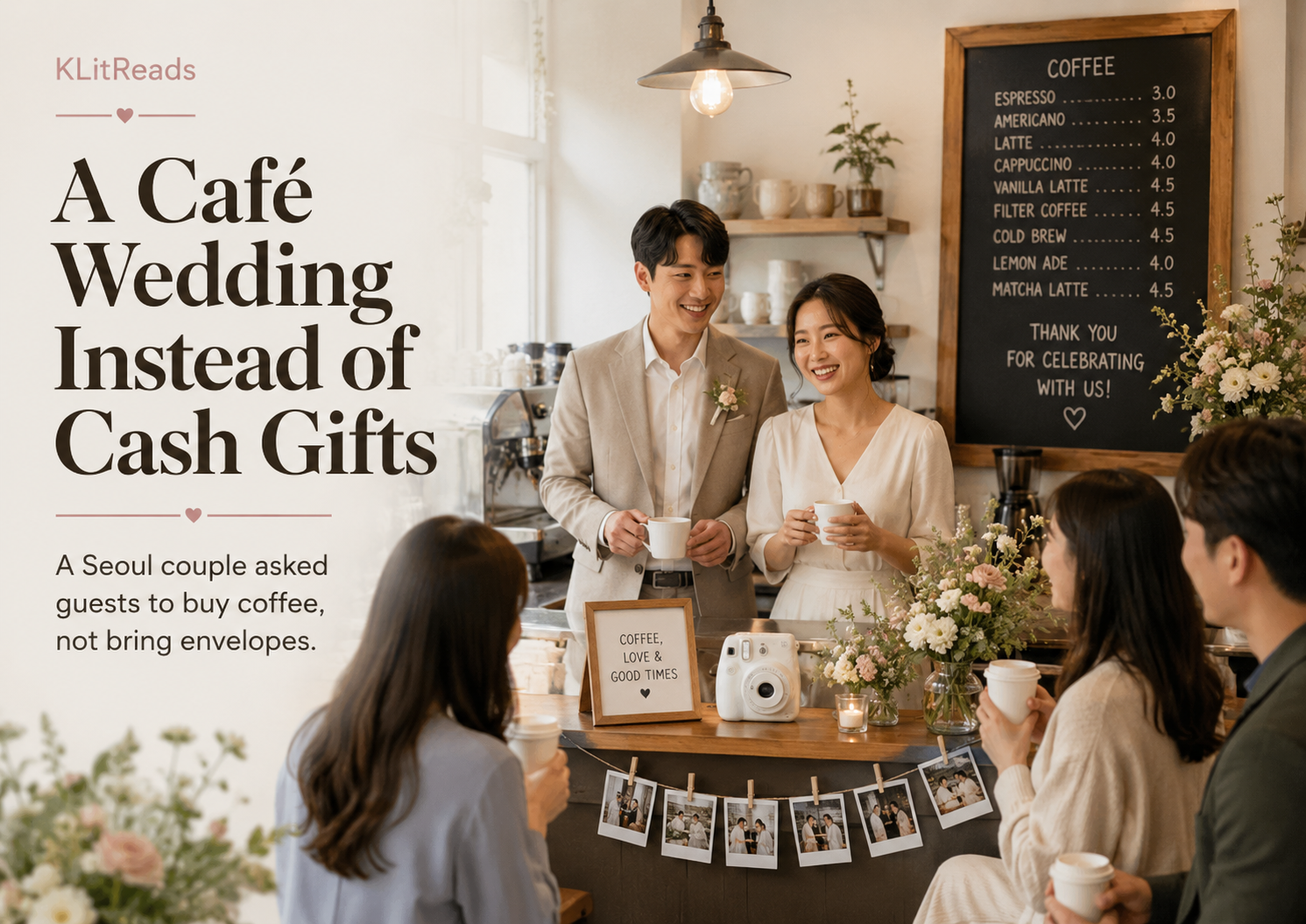
A Seoul couple has gone viral for holding the kind of wedding many guests secretly dream of attending: no formal ceremony, no banquet meal, and no pressure to bring a cash envelope.
The wedding took place from April 24 to 27 at a café near Dongmyo Station in Jongno-gu, Seoul. The couple, who own the café, opened the space to guests over four days instead of compressing everything into a standard wedding hall schedule. There was no officiant and no fixed ceremony order. Guests simply came by, ordered coffee, talked with the couple, and took a Polaroid photo together.
The most talked-about detail was the gift rule. The couple did not serve a full wedding meal, so they did not accept traditional cash wedding gifts. The only “gift” was the price of a coffee: about 5,000 won, or roughly the cost of a regular café drink in Seoul.
That choice struck a nerve because cash gifts are deeply embedded in Korean wedding culture. They help couples offset wedding costs, but they also create pressure for guests, who often have to calculate how much to give based on closeness, workplace hierarchy, and whether a meal is included. The groom said the couple wanted to remove unnecessary formality and receive only genuine congratulations.
The wedding was also dramatically cheaper than a conventional event. The couple’s four-day celebration cost about 4 million won in total. They also skipped the usual studio-photo, dress, and makeup package, replacing it with ordinary clothes and spending about 400,000 won on that part of the process.
The timing helps explain why the story spread. According to Korea Consumer Agency data cited by The Korea Economic Daily, the national average cost for wedding services reached 21.39 million won in February 2026, up 2.3 percent from December 2025. Course-style wedding meals averaged 119,000 won per person.
Against that backdrop, the café wedding read less like a cute personal choice and more like a quiet rejection of the standard wedding industry. Instead of a short, highly staged event built around venue schedules and guest counts, the couple created something slower and more flexible. Friends could visit when they were free. The couple could actually talk to people. The event felt closer to an open house than a performance.
The reaction on Dmitory was mostly positive. Commenters called the idea appealing and interesting, with one noting that the format seemed focused purely on receiving congratulations rather than managing wedding obligations.
Still, this model will not work for everyone. The couple had a major advantage: they owned the venue. A rented café wedding would bring practical questions about capacity, staffing, food rules, time limits, and family expectations. Korea’s wedding culture is also not only about the couple; it often reflects parents, relatives, social networks, and workplace relationships.
That is why the story matters. It does not suggest that Korea’s wedding halls are about to disappear. It shows that more young couples are questioning what parts of the ceremony are meaningful and what parts are simply expensive habit.
The café wedding’s viral appeal came from one simple swap: coffee instead of cash gifts.
But the bigger question is harder to dismiss. If a wedding is supposed to gather people who genuinely want to celebrate, how much of the old format is still necessary?



Leave a Reply