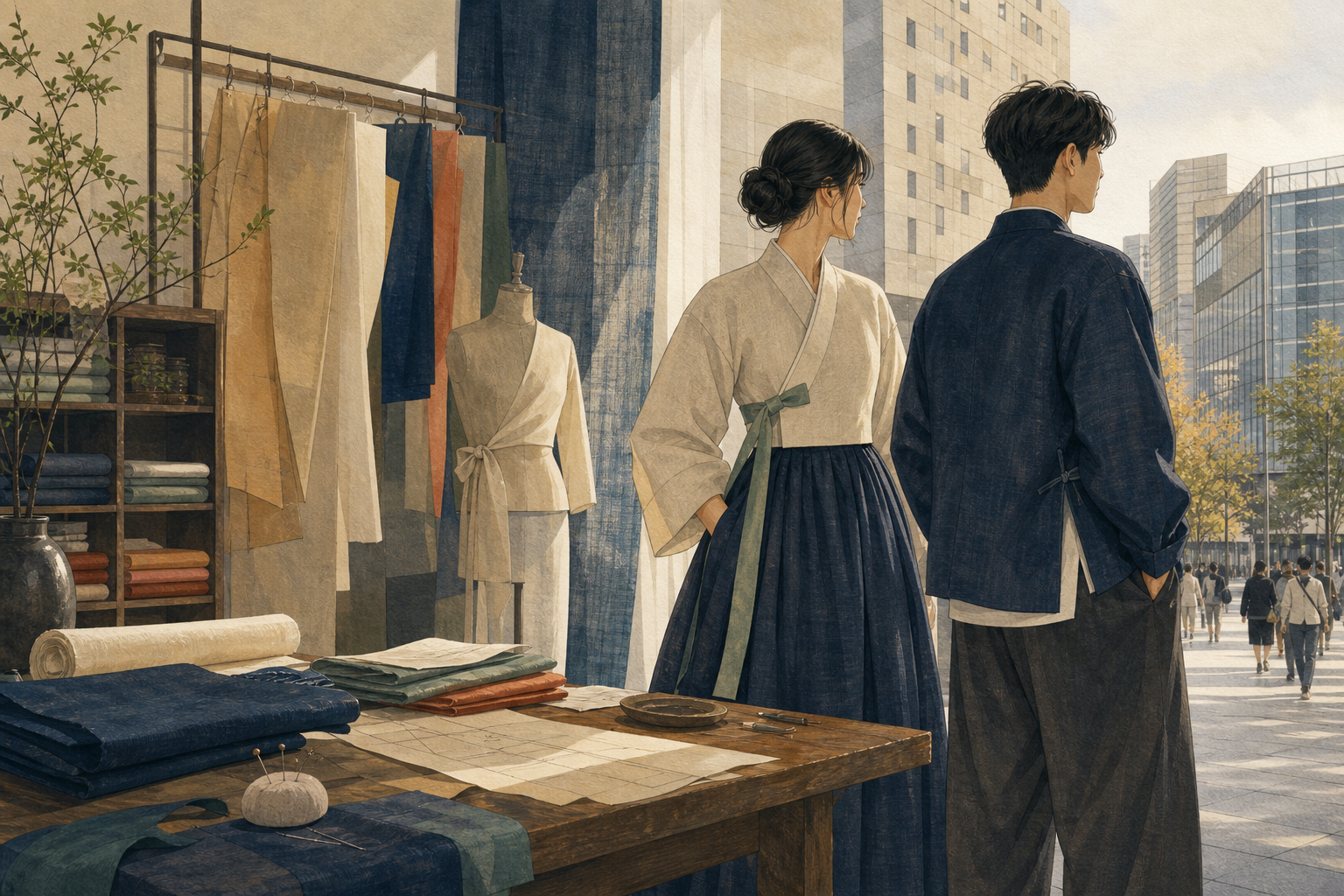
At Seoul’s Dongdaemun Design Plaza this past weekend, hanbok was not presented as one garment with one correct silhouette. It appeared as wedding clothing, children’s wear, accessories, long jackets, loose shirts and pieces that could pass through a subway turnstile without announcing themselves as ceremonial dress.
That range was the point of 한복상점 (Hanbok Expo), which ran Aug. 13-16 under the theme “A Market That Makes Hanbok.” The Culture Ministry and the Korea Craft and Design Foundation described it as South Korea’s only dedicated hanbok fair. Now in its ninth year, it gathered about 150 brands with sales booths, exhibitions, lessons, styling events and spaces where visitors could arrive in their own hanbok.
The expo arrived at an unusual moment. Hanbok may be more globally recognizable than at any time in recent history. It is a recurring image in Korean historical dramas, idol performances, palace tourism and government-backed fashion campaigns. Yet recognition is not the same as use. For many Koreans, hanbok remains clothing for a wedding, a first birthday or a rented afternoon near a palace—not something selected from a wardrobe on an ordinary Tuesday.
The fair’s real subject, then, was not whether hanbok can attract attention. It was whether a cultural symbol can become clothes again.
The market behind the finished garment
The expo’s central exhibition focused on Gwangjang Market, better known to many visitors today for mung-bean pancakes, twisted doughnuts and crowded food alleys. That tourist image can obscure the market’s older role in Seoul’s clothing economy.
Gwangjang opened in 1905 as the country’s first privately financed permanent market, according to the expo’s official history. Fabric became one of its foundations. Over time, textile sellers, cutters, sewers, embroiderers and gold-leaf specialists formed an interdependent production network for hanbok.
The exhibition traced that network through the stages and occasions of a life: a newborn’s first clothes, holiday dress, wedding garments and burial robes. Six hanbok and textile businesses participated alongside demonstrations of sewing, embroidery and decorative work.
This is the part of hanbok that a finished photograph usually removes. A garment may be credited to one label, but it can carry the labor of several small workshops and suppliers. The expo called the system an ecosystem. That description is more useful than the familiar language of revival because it identifies what must survive for the clothing to survive: not only designs, but also fabric knowledge, specialist labor, retail relationships and customers with a reason to buy.
A comeback that can be counted
The fair itself has expanded rapidly. A 2026 study in The Korean Fashion and Textile Research Journal reported that the first expo, held in 2018, drew 5,095 visitors, 39 participating businesses and 247 million won (about $167,000) in sales. By 2024, attendance had reached 45,845, with 112 businesses and 1.9 billion won (about $1.3 million) in sales.
The 2026 event pushed the number of participating brands higher. Its official sales directory listed 139 vendors, while promotional material described roughly 150 brands across the fair. The organizers had not released final attendance or sales totals as of Monday, so the latest edition should not yet be called a record.
What was clear was how the event defined participation. The program included a “mapsi” styling contest—a celebration of personal dress—and free admission for people who arrived in hanbok. Visitors could learn how to wear the clothing properly, have a portrait made or watch wedding styling. The fair treated wearing as an act of interpretation rather than passive observation.
That approach matches the way younger consumers have already loosened the category. Modern hanbok labels retain elements such as the wrap, the goreum ribbon, a curved sleeve or the long line of a jeogori jacket while changing fabric, fastenings and fit. The result may resemble a blouse, overshirt, dress or coat before it reads as national attire.
The transformation is visible. The retail system beneath it is less settled.
The problem between a photograph and a purchase
The government’s 2022 Hanbok Industry Survey estimated that the sector had 3,608 businesses, 4,844 workers and 142 billion won (about $96 million) in annual sales, using 2020 industry data. That makes hanbok culturally prominent but commercially small. The same survey found a business landscape dominated by independent operators rather than large manufacturers.
Small scale is not a flaw in a craft industry. It can preserve regional techniques and make close collaboration possible. It can also make standardized sizing, detailed online listings, returns and national distribution harder to sustain.
Researchers Yun Won-jeong and Jang Jeong-ah examined that problem in the study published this year. They collected 186 women’s long-jeogori products from 30 modern hanbok brands that had participated in the expo and were selling online in May 2025.
The products showed how far designers had moved from a single ceremonial template. About 44% were classified as a basic long-jeogori form, while 38% used a shirt-like form. Smaller groups resembled blouses or T-shirts. Most retained the goreum, but some used buttons, and more than 80% omitted the contrasting white collar strip known as a dongjeong. The study found designers favoring wearable, roomy shapes: 62.4% used a basic fit and 37.6% a loose fit.
The difficulty appeared in the product information. Small, medium and large were the most common sizes, but brands did not consistently provide the same measurements. Only three of the 30 brands listed collar width, even though the collar is a defining structural feature. The researchers concluded that inconsistent measurement details made it difficult for shoppers to predict fit online.
It is a modest retail problem with a large cultural consequence. A garment can circulate widely as an image while remaining difficult to purchase with confidence. If modern hanbok is to move beyond special events and enthusiasts, it needs the ordinary infrastructure consumers expect from clothing: reliable measurements, understandable care instructions, predictable delivery and pieces that work with garments they already own.
What K-pop can do—and what it cannot
The government’s 한복웨이브 (Hanbok Wave) program approaches the same problem from the other end: visibility first. This year, Stray Kids member Felix will work with five small and midsize hanbok companies. Each selected business is eligible for as much as 50 million won (about $34,000) to develop 10 looks, including traditional hanbok, everyday clothing and art wear.
The finished designs are scheduled to appear in a Felix fashion pictorial and promotional displays in Seoul, New York, Paris and Milan. Previous editions featured Olympic champion Kim Yuna, singer and actor Suzy, actor Kim Tae-ri and actor Park Bo-gum.
It is an effective formula because a K-pop star gives a small label an audience it could not buy on its own. The 2026 selection also has a neat cross-cultural logic: Felix was born and raised in Australia and works in a Korean group with a global fan base. His image can present hanbok as contemporary fashion rather than historical costume.
But celebrity visibility cannot solve the entire wardrobe problem. A look created for a billboard is not automatically a product that can be ordered in several sizes, repaired locally or worn to work. The value of Hanbok Wave will depend partly on what remains after the pictorial: sellable designs, stronger brands and customers who can imagine the clothes without the celebrity inside them.
Heritage does not require a frozen silhouette
South Korea’s heritage policy offers a useful way to think about that change. In 2022, the government designated “hanbok saenghwal,” or hanbok lifestyle, as a National Intangible Cultural Heritage. The designation did not protect one ideal garment. It covered the knowledge and practices of making, wearing and enjoying hanbok according to different occasions.
That distinction matters. Clothing survives by changing with bodies, work and social life. The loose pants and layered jackets seen in one era do not invalidate the shorter jackets or different proportions of another. A shirt-like long jeogori can depart from ceremonial construction and still carry a recognizable relationship to Korean dress.
The question is not whether every modern piece is traditional enough. It is whether adaptation remains connected to the knowledge, labor and cultural vocabulary that make hanbok more than a decorative reference.
The 2026 expo made that argument through its layout. Gwangjang Market’s workshops sat beside contemporary sales booths. Lessons on proper dress shared space with personal styling. The fair placed preservation and alteration in the same room.
Hanbok does not need to replace the T-shirt or become mandatory holiday wear to be alive. It needs more occasions between the palace rental and the wedding hall. It needs designers who can simplify without flattening, craftspeople whose labor can support a livelihood and retailers that make unfamiliar construction legible to a customer.
The most promising garments at a hanbok fair are not necessarily the ones that produce the grandest photograph. They are the ones a visitor can imagine wearing again after the photograph is taken.