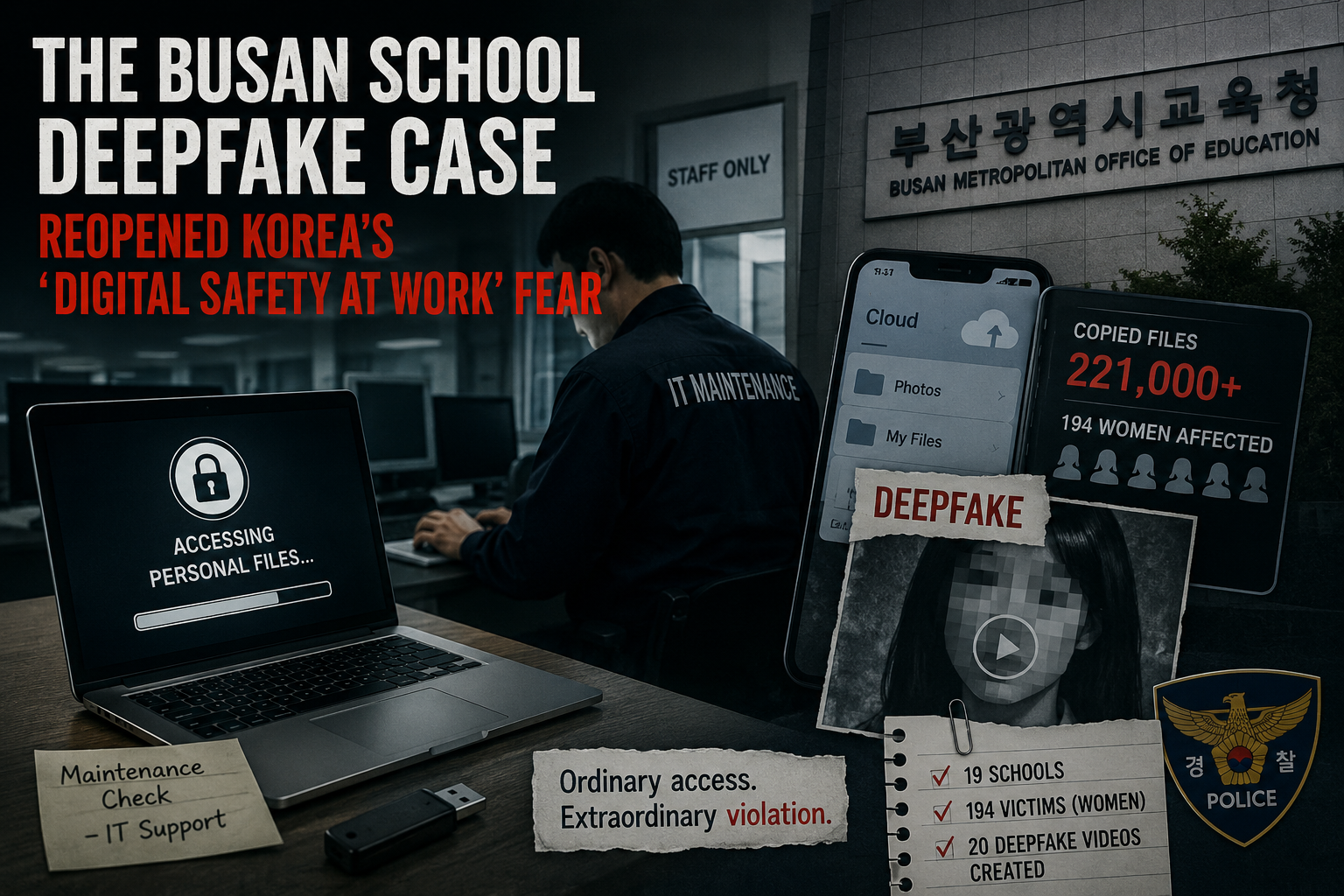
A Busan school deepfake case spread widely in Korea because it did not feel like a distant cybercrime story. It began with something ordinary: a school computer needed maintenance, an outside worker came in to fix it, and staff members trusted that access would be limited to the job.
According to police, a man in his 30s who worked for an outside company managing school computer equipment was accused of copying personal photos and videos from staff computers at 19 schools and kindergartens in Busan. The alleged crimes took place from July 2021 to September 2025, and 194 women were identified as victims. Police said he used some of the stolen material to create 20 sexually explicit deepfake videos.
The case became especially frightening because of how ordinary the access was. The suspect allegedly entered logged-in cloud accounts, including Google Photos and Naver MyBox, while staff members were away from their desks, then saved personal files to a USB drive. Police said more than 221,000 files were copied, and the case came to light after a school employee found the USB device.
That detail changed the emotional shape of the story. This was not only about deepfake technology. It was about workplace trust. The person accused was not a stranger hacking from far away; he was someone allowed into school-linked workplaces to maintain computers. For many readers, the fear was not simply “What if my image is posted online?” but “What if someone who handles my device can quietly take my private files?”
Police said they had not found evidence that the fabricated videos were distributed online. But that did not make the case feel harmless. The violation had already happened at the point of extraction: private images were allegedly copied, stored, and turned into sexual material without consent.
The case also landed inside a broader Korean anxiety about digital sex crimes. South Korea has already faced repeated shocks involving illegal filming, image-based abuse, Telegram-linked exploitation, and sexual deepfakes made from ordinary photos. In that context, the Busan case was received not as an isolated incident, but as another reminder that women’s everyday digital traces can be turned into material for abuse.
That is why online reaction focused on more than punishment. The larger question was whether routine digital life is safe when so much of it depends on access granted to other people: repair workers, IT contractors, cloud services, school systems, and workplace devices. If a school employee cannot safely leave a computer during maintenance, then digital safety is not just about strong passwords or suspicious links. It is also about supervision, account separation, and basic institutional safeguards.
The workplace angle made the story especially relatable. Many people have handed a laptop, phone, tablet, or office computer to someone else for repair. Many stay logged in to cloud accounts for convenience. Many mix personal and work files across devices without thinking much about it. The Busan case made those habits feel newly risky.
It also exposed a gap in how institutions often think about cybersecurity. Employees are usually warned not to click unknown links or download suspicious files. But fewer workplaces give clear guidance for repair situations: logging out of cloud accounts, removing personal files, supervising outside maintenance, blocking USB copying, and separating personal photos from work devices.
For schools and public institutions, the lesson is concrete. Outside IT maintenance should be treated as a controlled access event, not a casual service visit. Devices should not be left unattended while logged in. Cloud accounts should be logged out before repair. USB use should be restricted where possible. Staff should know exactly what to do before handing over a computer.
The deeper fear behind the Busan case is that digital sex crimes do not always begin in obviously dangerous online spaces. They can begin at a desk, during a routine inspection, through a trusted role. Artificial intelligence may create the fake image, but the raw material can come from ordinary workplace exposure.
That is why the story spread beyond crime coverage. It compressed several fears into one case: gendered digital exploitation, weak institutional safeguards, AI-enabled abuse, and the collapse of trust in everyday service interactions. The nightmare was not futuristic. It was painfully ordinary: someone comes to fix the computer, and the private life inside it is no longer private.



Leave a Reply