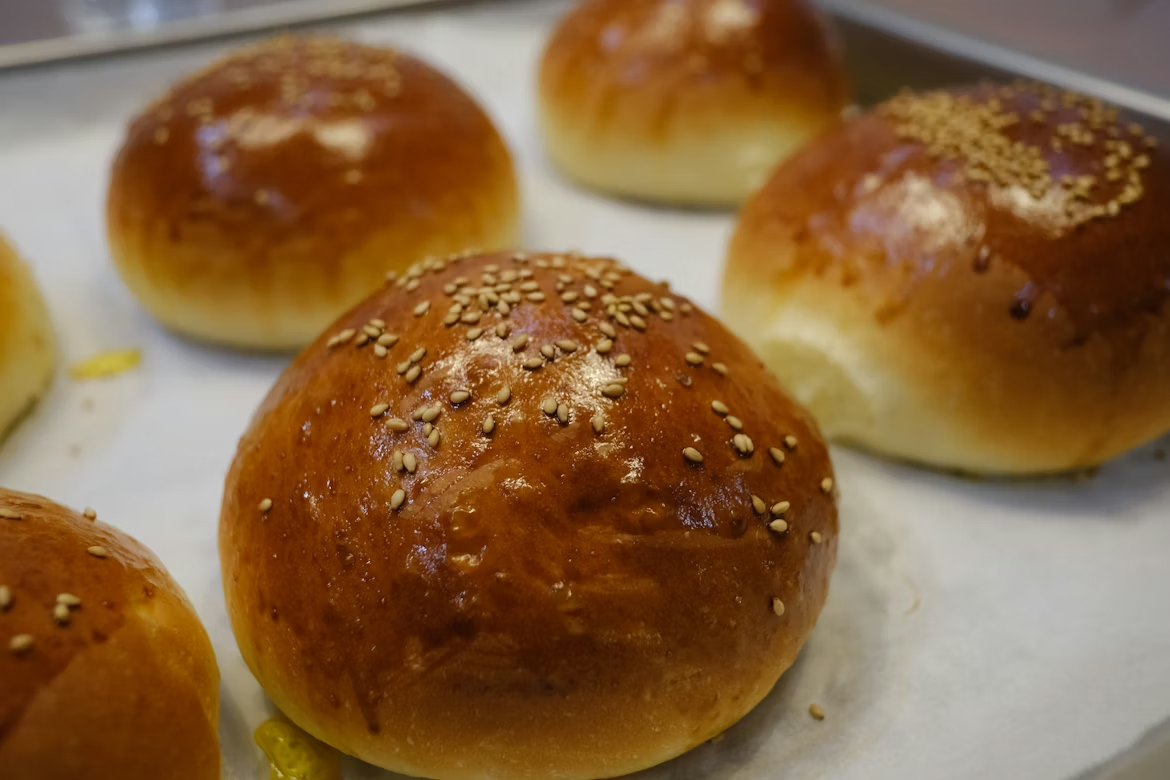
South Korea’s cost-of-living conversation has entered a new phase—one where the loudest consumer headlines aren’t about what’s trendy, but what’s cheap.
It starts with numbers that read like typos: “$0.75 bread” (₩1,000). “$7.50 for four burgers” (₩10,000). And now, in one of the most politically sensitive everyday categories, “$0.07 sanitary pads” (₩99–₩100) per pad.
These aren’t just promotions. They’re a public-facing signal that price anxiety is now a mainstream storyline—and that Korea’s biggest retailers are responding with aggressive, headline-ready tags that double as marketing and message: we’re on your side.
The “ultra-low price” headline is a symptom of fatigue
Consumers don’t experience inflation as a single statistic. They experience it as a daily series of “wait—how much?” moments: at the bakery counter, at lunch, at the convenience store. Even when overall inflation cools, everyday categories remain emotionally hot because they’re frequent and unavoidable.
That’s why retailers are leaning into extreme reference prices—simple, shareable figures engineered to cut through distrust. A $0.75 item doesn’t just feel affordable; it feels like a rebuttal to the broader sense that basics have gotten out of hand.
Why pads joined the price war—and why it matters
Food is a classic battleground, but the sanitary pad market turning into a price-war headline is more revealing: it suggests cost pressure has reached categories that are not discretionary and not easily substituted without social consequences.
In recent weeks, South Korean retailers have rolled out sweeping pad promotions and price cuts after the president publicly criticized pad prices, triggering fast-moving competition across channels.
The most eye-catching move came from Coupang’s private-label line: pads priced around $0.07 each (₩99 for medium, ₩105 for large), with the company saying it would absorb losses from the reductions.
Then came the escalation effect: Korea’s dollar shop Daiso moved to introduce ₩100 pads (about $0.07)—another “impossible” price point built for headlines and high-volume retail.
When a market starts treating essentials like pads as a price-war billboard, it’s no longer only about discounting. It’s about social pressure, political sensitivity, and retail power converging around one idea: basic goods must look affordable—publicly.
The flour-to-bread chain: upstream cuts, downstream pressure
Now connect the dots to food.
In late February, CJ CheilJedang announced additional flour price cuts—about 5% on average—following earlier reductions, bringing cumulative cuts in some categories close to 10% since the start of the year.
That matters because flour is a symbolic upstream input: when flour gets cheaper, consumers and policymakers increasingly expect that bread and snack prices should follow.
And the downstream response has started to arrive. Paris Baguette announced price reductions on 11 bread and cake items, with cuts ranging from ₩100 to ₩1,000 (about $0.07 to $0.75) per item, set to begin in mid-March.
At the same time, broader reporting tied bakery price moves to government investigations into alleged price collusion among flour and sugar producers—adding a policy spotlight that makes “price-down” announcements even more urgent for brands that don’t want to look unresponsive.
This is how the current cycle works:
input-price narratives → public pressure → retail headline pricing → competitors forced to respond.
What these discounts really do: reset what “normal” feels like
Ultra-low price items are rarely the full story of profitability. Big players can treat them as loss leaders, subsidizing thin margins with scale, private-label sourcing, and cross-category basket economics.
But the cultural effect is bigger than the accounting: repeated headlines about $0.75 bread and $0.07 pads reset expectations for what basics “should” cost. That creates a rough environment for small merchants—local bakeries, neighborhood shops—whose costs don’t bend to headline pricing.
In the short term, consumers win deals. In the medium term, the market learns a new habit: it starts shopping for essentials as if a “floor price” exists everywhere—and punishes anyone who can’t match it.
The real takeaway: this isn’t just discounting—it’s a consumer mood index
Korea’s ultra-low price competition is often framed as cheerful bargain culture. But when the most clickable consumer stories are built around cheap staples and aggressively reduced necessities, it’s usually a sign of something more durable:
- households are more price-sensitive,
- retailers are more combative, and
- “value” has become not a preference, but a public benchmark.
Today’s $0.75 bread (₩1,000) and $0.07 pads (₩99–₩100) aren’t just deals. They’re a snapshot of how a consumer economy behaves when trust in everyday pricing has fractured—and when brands believe the fastest way to earn loyalty is not a slogan, but a number.




Leave a Reply