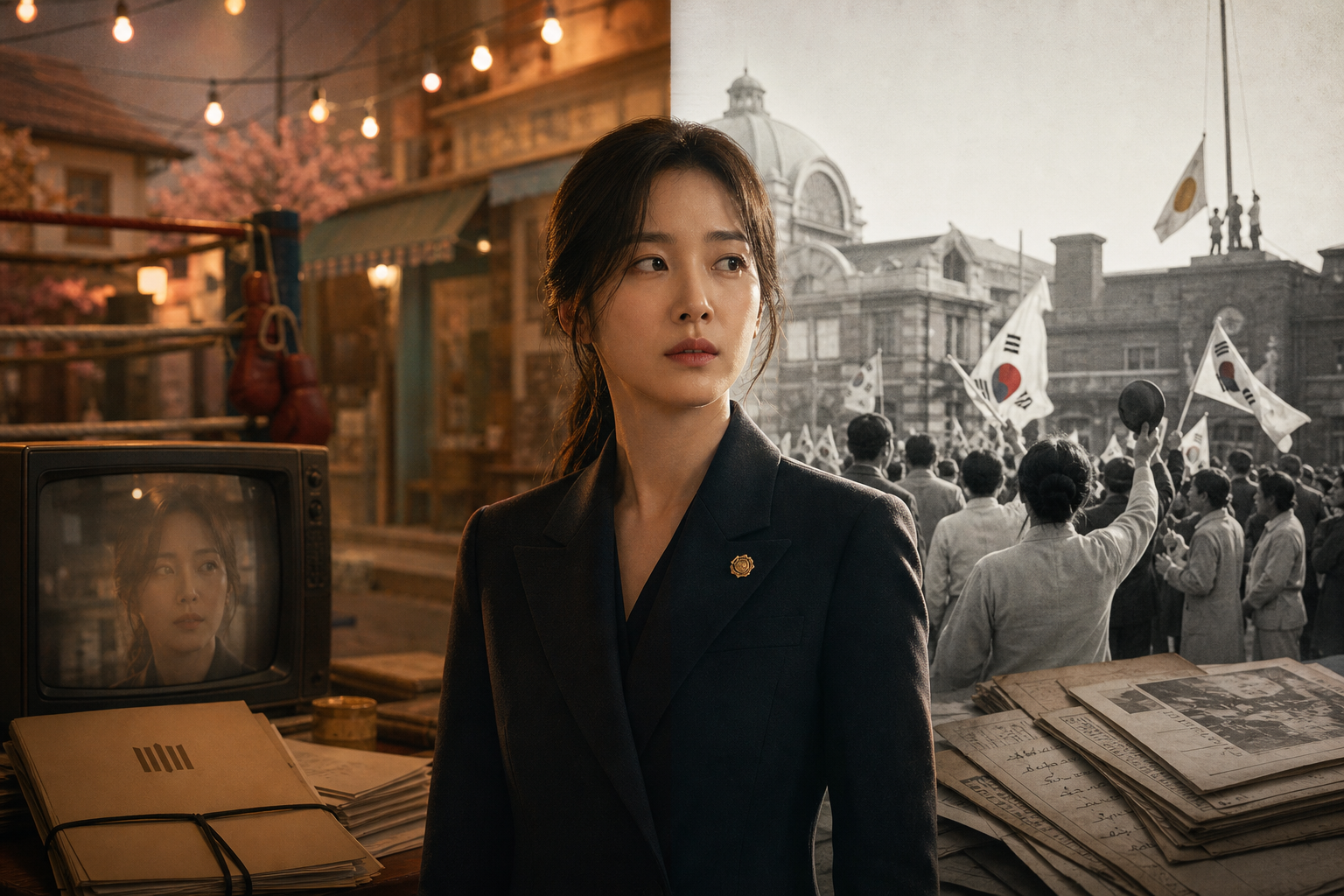
Netflix released “Our Sticky Love” on Aug. 7 with the polished machinery of a summer Korean romantic comedy. Jung Hae In played a small-town boxing coach. Ha Young played a prosecutor who loses her memory and wakes to find him claiming to be her boyfriend. The series promised an easy mixture of amnesia, cohabitation and romantic confusion.
Within days, the story surrounding its leading actress had changed genres.
In promotional appearances, Ha Young had described a family of medical professionals stretching back four generations. She said her great-grandfather opened an early Western-style clinic in Seoul and treated Emperor Gojong. It was the kind of family anecdote entertainment programs prize: concise, distinguished and easy to attach to an actor who had recently played a trauma-center nurse in another Netflix hit.
Then historical records entered the frame.
A report identified the great-grandfather as physician Ahn Sang-ho and connected him to the Daejeong Sileop Chinmokhoe, an organization founded in 1916 that the Academy of Korean Studies classifies as pro-Japanese. Ha Young’s agency initially rejected the allegation. It reversed course after finding Ahn on the organization’s founding council list and apologized for its hurried response. Ha Young followed with a handwritten apology, saying she had known only fragments of the family history she had presented with pride.
The controversy also reached the drama’s publicity campaign. Korean entertainment media reported that an Aug. 14 round-table interview involving Ha Young and Jung was canceled and that a promotional video featuring Ha Young was made private. Netflix has not removed “Our Sticky Love,” and there is no verified report that Ha Young was cut from the completed series or removed from another production. What changed was the promotional space around her—the interviews, clips and easy biographical storytelling used to sell a star.
That is what makes the episode more than a celebrity scandal. A story created for the K-content publicity cycle collided with an argument South Korea has carried since 1945: who prospered under Japanese rule, what survived liberation and why the state waited so long to examine it.
The family anecdote that changed meaning
Ha Young had spoken about her medical background before “Our Sticky Love.” During promotion for Netflix’s “The Trauma Code: Heroes on Call” in 2025, she said she was grateful for and proud of her family history. The medical connection suited the work. She played a senior nurse, and the series’ director said her familiarity with hospital life had helped her performance.
The later report did not dispute that Ahn practiced medicine. It changed the historical setting around that achievement.
The Academy of Korean Studies describes the Daejeong Sileop Chinmokhoe as a pro-Japanese organization that promoted accommodation with colonial rule and the ideology of Japanese-Korean integration. Historian Lee Jun-sik told “Sports Kyunghyang” that service on its council amounted to collaboration, even though Ahn does not appear in the “Dictionary of Pro-Japanese Collaborators.”
The distinction is important. The dictionary is an extensive civil-society reference, not a court register containing every person associated with the colonial system. Its silence does not erase other records. At the same time, a historically responsible account should identify the conduct the evidence supports rather than turn an organizational listing into a claim about every aspect of a person’s life.
Another record, preserved by the National Institute of Korean History, adds social context. A 1918 article in the colonial newspaper “Maeil Sinbo” presented Ahn, his Japanese wife and their household as closely integrated into the Japanese community. Social proximity by itself is not a legal finding. Ahn’s documented council role is the more substantial evidence.
Online feedback focused heavily on the distance between the polished family anecdote and the archive beneath it. One widely circulated discussion of the report drew about 49,000 views and more than 350 comments by Aug. 17. Another exceeded 72,000 views and received about 880 recommendations. These figures are snapshots, not opinion polls, but the recurring themes were clear: anger at the agency’s initial denial, frustration with inherited prestige and demands for renewed scrutiny of wealth connected to colonial collaboration.
The response also exposed a recurring feature of Korean celebrity culture. Public figures are expected to offer intimate family stories as part of their marketable identity. Those stories can confer authenticity, education and class status. But once a private genealogy is used as public prestige, audiences may test it against the historical record. In Ha Young’s case, the promotional anecdote became the entry point to a much larger national memory.
The reckoning that collapsed after liberation
South Korea did try to punish colonial collaborators. The attempt was brief, contested and ultimately broken from within.
The National Assembly enacted the Anti-National Activities Punishment Act in September 1948. It created criminal penalties, civil-rights restrictions and property confiscation for defined acts of collaboration. A special investigative body, commonly called the Banmin Special Committee, began identifying and arresting suspects.
The numbers show both the ambition and the failure. The National Institute of Korean History says the committee identified about 7,000 potential offenders. It handled 688 cases, referred 599 to special prosecutors and produced 293 indictments. Only 78 defendants received judgments before the process collapsed. Ten received prison sentences or more severe punishment.
It would be inaccurate to say that nobody was punished. It would be equally inaccurate to call the effort a completed purge.
The new republic depended on police officers, administrators and other officials who had worked under Japanese rule. The U.S. military government had favored administrative continuity and anti-communist stability. President Rhee Syngman opposed investigations that threatened the police and members of his political coalition.
The conflict became visible after investigators arrested senior police official Roh Deok-sul. Rhee demanded his release. On June 6, 1949, police raided the committee’s office, assaulted or detained staff members and crippled its work. An official historical account says Rhee publicly acknowledged ordering the raid. The special bodies were dissolved that October.
The raid left a durable image: police working for the post-liberation state shutting down the people assigned to investigate collaboration. The failure was not simply that too few cases reached court. It was that parts of the new state protected the institutional continuity the investigation threatened.
That choice carried into public life. People who had gained credentials, networks or property under colonial rule could retain them, while many independence activists and their families waited decades for recognition or support. The record was never uniform—working under colonial rule could involve coercion, survival, ambition or ideological commitment in different proportions—but the destruction of the investigative process prevented those differences from being examined consistently.
The result is still visible in contemporary arguments. A celebrity’s family story can become a proxy trial for a case the first republic never finished.
When descendants recovered valuable land
The unsettled history later moved into civil court. Beginning in the 1990s, descendants of prominent collaborators filed “ancestral land-finding” suits against the state or registered owners. Some won.
In 1997, a great-grandson of Lee Wan-yong, one of the officials most closely associated with Japan’s annexation of Korea, prevailed in litigation over property that had belonged to Lee. Contemporary reporting said the descendant recovered land in Seoul and Gyeonggi province valued at more than 10 billion won (about $7 million). The property included roughly 2,314 square meters (700 pyeong) in Seoul’s Seodaemun area.
Other families pursued similar claims. When a government property commission began work in 2006, it opened investigations into two properties that Lee’s descendants had obtained through successful suits, as well as two properties recovered by descendants of Lee Jae-geuk and Min Yeong-hwi, according to an official government briefing.
The courts were not giving collaborators new land as a reward. They were applying the property law available at the time. In litigation involving a descendant of Lee Jae-geuk, an appellate court said the state needed a constitutional and statutory basis to deny recognizable property rights. Public anger could not substitute for a law.
Legally, the reasoning was conventional. Culturally, the result was incendiary. Colonial land records could help collaborators’ descendants recover valuable property, while independence activists’ families often had neither equivalent documents nor an effective route to reclaim what had been lost.
Those cases helped create pressure for the 2005 special law that authorized the state to recover property acquired as a reward for defined collaboration.
Property recovery, then a 16-year gap
The later law did not seize everything owned by the descendant of a collaborator. It targeted specific property linked to defined collaboration and protected good-faith third parties. A separate commission investigated the assets from July 2006 to July 2010.
The Ministry of Justice says the commission recovered property worth about 237.3 billion won (about $165 million). Proceeds from recovered assets were directed to a fund supporting independence activists and their families.
The courts also acquired a new legal framework. In 2012, the Supreme Court upheld retroactive state reversion under the special law. It ruled that qualifying collaboration-derived property was treated as state-owned from the time it was acquired and that collaborators or their heirs could not gain title through adverse possession. Affected parties could still show that a particular asset was not acquired as a reward for collaboration.
Then the commission disappeared. Its mandate ended in 2010, leaving South Korea without an equivalent investigative body for 16 years. Litigation and administrative work continued, but there was no standing commission with the same power to investigate newly identified assets.
That gap is one reason the issue has returned in 2026.
The National Assembly passed a new property-recovery act on May 7. It was promulgated June 2 and takes effect Dec. 2. The law restores the investigative commission, permits recovery of proceeds when qualifying property has been sold and includes rewards for useful reports. The Ministry of Justice is preparing the commission for its launch.
As of this article’s publication, the new commission is not operating. The law has returned; the investigations have not yet begun.
There is also no evidence in the material reviewed for this article that Ha Young, her immediate family or property connected to them is part of a recovery case. The law matters here because the controversy revived public discussion of colonial wealth—not because a legal claim against the actress has been established.
What the entertainment story reveals
The controversy around Ha Young sits at the intersection of three things Korean popular culture often packages separately: celebrity biography, national history and class inheritance.
Her own conduct belongs to the first category. She publicly repeated an admiring family story without its full historical context. Her agency denied the allegation before checking the relevant record. Both later corrected themselves and apologized.
Ahn Sang-ho’s record belongs to the second. It should be judged through documents, organizational activity and the historical meaning of his position—not through the fame of a descendant.
The survival of collaboration-derived property belongs to the third. It is a question for investigation and law, not assumption. South Korea’s recovery statutes concern traceable assets, not every possession held by every descendant.
Keeping those categories distinct does not weaken the historical argument. It makes it harder to evade. Ha Young’s celebrity cannot establish a property case, but neither can celebrity publicity turn a partial family legend into the whole record.
“Our Sticky Love” remains on Netflix, where its fictional amnesiac heroine must reconstruct a missing past. The parallel is unusually neat. The public controversy surrounding its star is also about what happens when memory returns—but national memory is less accommodating than a romantic comedy. It does not resolve in 12 episodes, and it does not end when the promotional cycle moves on.
South Korea is preparing, once again, to investigate property left by collaboration. More than eight decades after liberation, that is not evidence of an old issue being revived for entertainment. It is evidence that the old issue never fully ended.