A free Korean Film Academy program has moved short films, scripts and storyboards into an airport concourse. The useful experiment is not the location alone, but who can enter without buying a ticket.
Airports are designed to move people through controlled space. At Gimhae International Airport, a month-long film program is asking the building to do something slower.
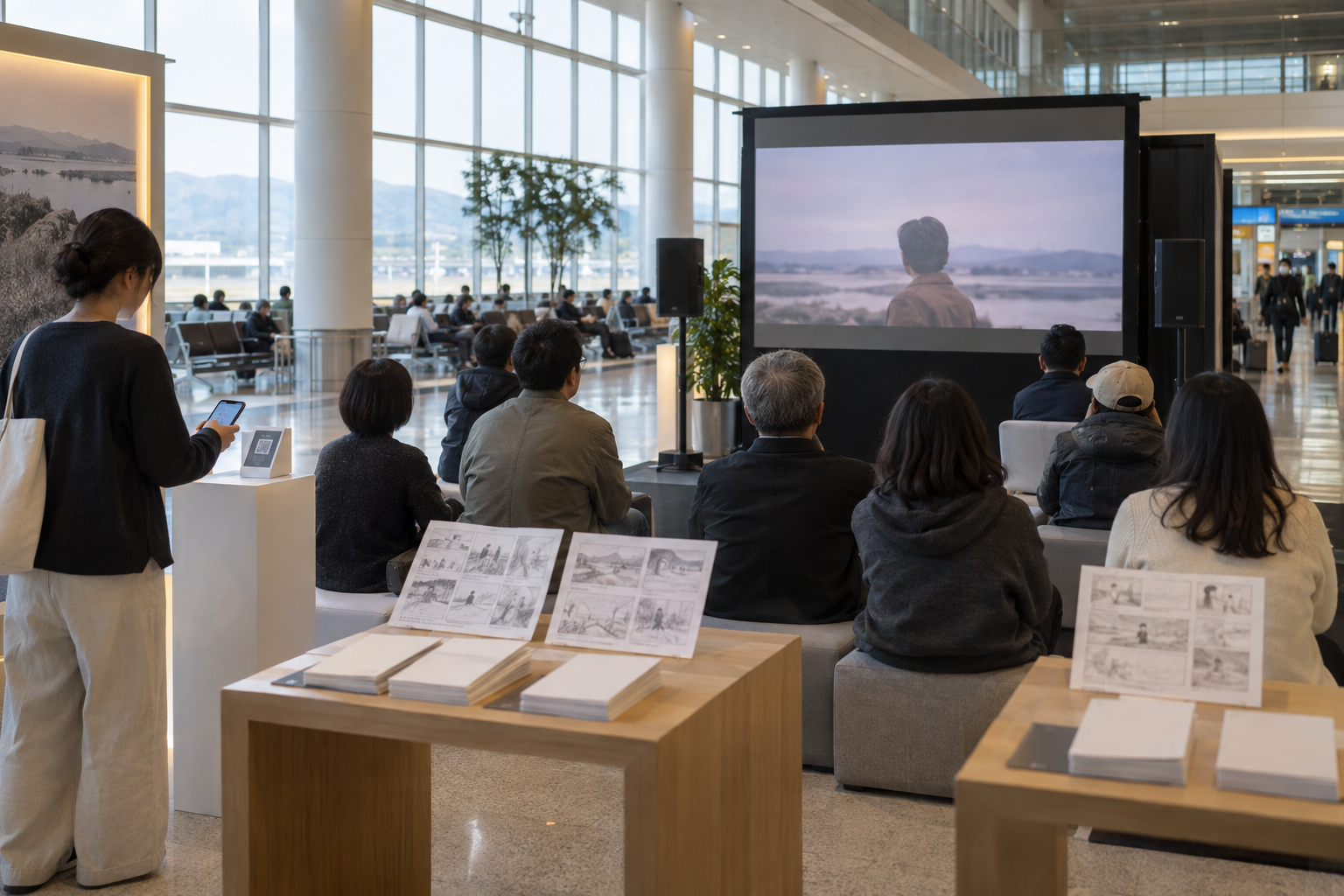
From September 22 through October 19, the Korean Academy of Film Arts is operating 공항시네마클럽 (Airport Cinema Club) in the domestic terminal’s third-floor public waiting area. The Film Promotion Committee says the program includes 25 short films by graduates ranging from Bong Joon Ho, Choi Dong-hoon, Jang Joon-hwan and Lee Ok-seop to newer directors whose work has circulated at international festivals.
The important detail is access. The installation is outside the passenger-only zone. A boarding pass is not required, and admission is free.
That turns what could have been an anniversary retrospective into a small test of cultural infrastructure. Instead of asking audiences to travel to a cinematheque, festival or campus, the program places Korean film history inside a transport hub and allows the public to encounter it without committing to a conventional screening.
The ten-minute cinema fits the building
The central strand is called the “10-Minute Cinema.” Short work is an obvious fit for a place structured by waiting, interruption and uncertain attention. A traveler may have time for one film rather than a feature. An airport worker or nearby resident can enter without organizing an evening around a showtime.
This is not the same experience as a dark auditorium. Sound, foot traffic and flight routines compete with the screen. But the compromise is part of the experiment. Film reaches people who did not begin their day by choosing a film.
The program also refuses to treat the screen as the whole medium. A “Cinema Warehouse” displays art books and scripts, while “Cinema Cards” let visitors continue watching on a phone. Those formats expose the work around a finished image: writing, visual development and the movement between a public installation and a personal device.
An anniversary becomes a public archive
KAFA is marking 20 years of its feature-film program, although the academy itself dates to 1984. Its anniversary has already produced a much larger overseas retrospective in Brazil, with 20 features and 25 shorts shown through screenings and online programs.
The Gimhae version is smaller and locally specific. It uses the airport’s connection to Busan and the approach of the 31st Busan International Film Festival, but it does not require festival accreditation or travel. Early work by established directors sits beside films by emerging graduates, making the school’s history visible as a continuum rather than a collection of famous names.
That distinction matters. Retrospectives can flatten institutions into their most successful alumni. A public archive is more useful when it shows that careers begin with experiments, modest production conditions and work that may never receive commercial distribution.
The airport is more than borrowed floor space
The installation is part of Korea Airports Corporation’s effort to use airports as regional cultural bases. That language can sound decorative: an exhibition is placed in a terminal, passengers take photographs, and the building’s main purpose continues unchanged.
Airport Cinema Club has a stronger claim because its location changes the audience. The public concourse means the program can serve travelers, airport staff and people who arrive specifically for the films. Its value is not measured only by whether it entertains passengers.
This is especially relevant outside Seoul. National cultural institutions often tour work to regional venues, but transport hubs can connect those programs to people already moving through a city. Gimhae’s domestic terminal sits inside the wider cultural geography of Busan, where an international film festival and a large production and exhibition ecosystem already exist.
The airport does not replace cinemas or festivals. It can function as a threshold: a place where a short encounter points toward the institutions beyond it.
Public access still needs curation
Placing culture in a high-traffic site does not automatically make it accessible. Screens can become background noise. Phone extensions can become marketing devices. A display of scripts can be illegible without explanation.
The practical questions are therefore curatorial. Are the films captioned clearly? Can a visitor understand why a student short matters without already knowing the director? Does the program give equal visibility to recent filmmakers, or do famous alumni absorb the attention? Can people with disabilities use the screening and mobile formats comfortably?
These details determine whether a public installation broadens participation or merely changes scenery.
A useful definition of public cinema
Public cinema is often discussed through subsidies, ticket prices and the survival of theaters. Gimhae adds another dimension: where film can be encountered and what a visitor must possess before entering.
Here, the answer is unusually light. No ticket, membership or festival pass is required. The films are short enough to fit an airport wait, but the surrounding scripts and storyboards ask visitors to see filmmaking as a process rather than disposable content.
The project is temporary. Its larger value will depend on what follows: whether airports continue to work with local cultural institutions, whether the screenings become part of a regional circuit and whether the public area remains genuinely open.
For one month, however, Gimhae is demonstrating a clear principle. A cultural venue does not always need to begin with a building devoted to culture. It can begin by changing the terms of entry to a place people already use.