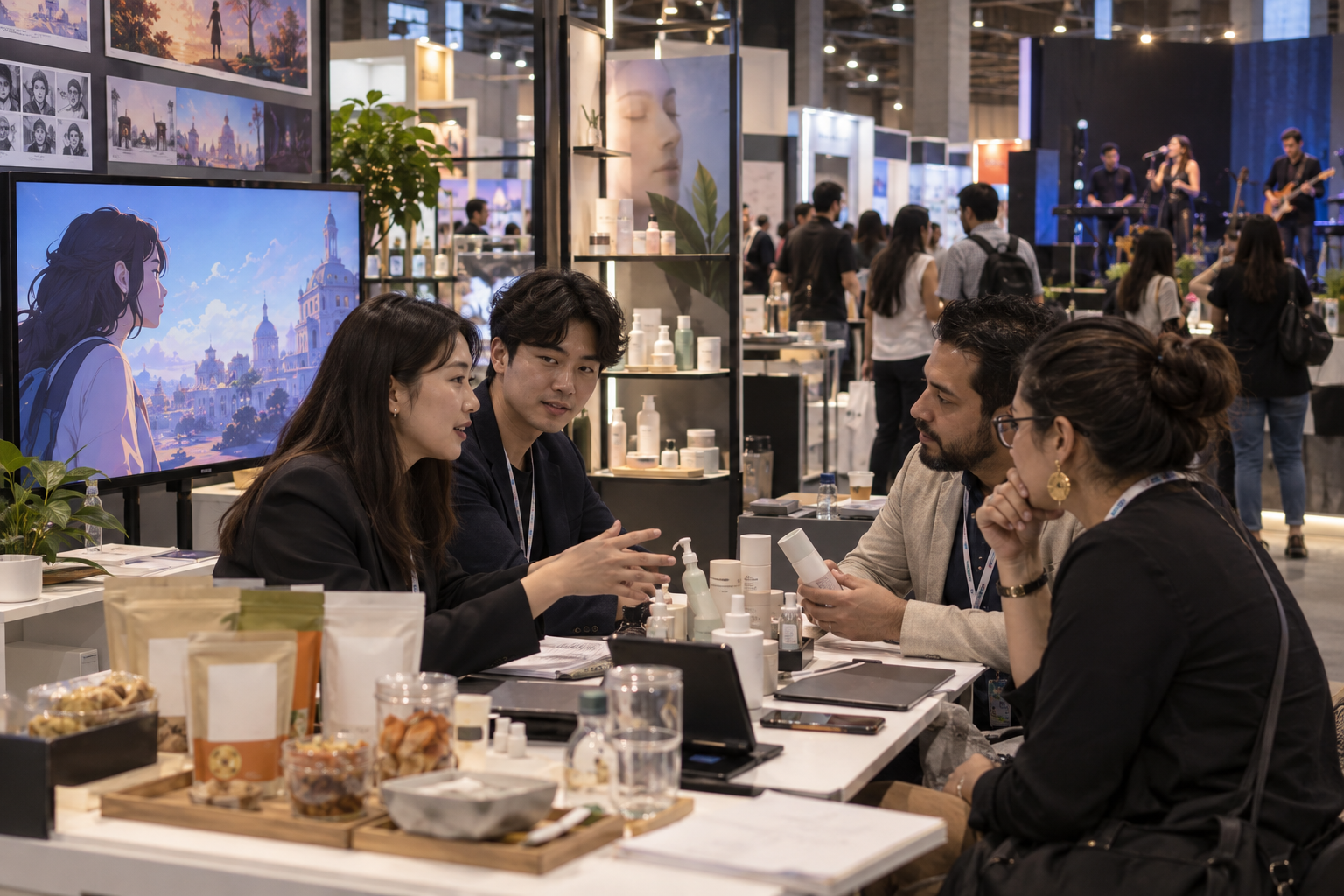
The Mexico City fair put content, food, beauty and consumer technology into one trade-and-fan event. Its scale shows how Korean export policy now tries to convert cultural attention across categories.
Korean cultural exports are usually counted in separate columns. Music, screen content, food, cosmetics and consumer goods have different regulators, trade groups and business models. In Mexico City, the 2026 Korea Expo tried to place them in one system.
Held from September 24 through 27, the event brought together six Korean ministries and their agencies. The program combined two days of business consultations with a public exhibition at the World Trade Center Mexico City and a K-pop concert. The government said 120 Korean companies and institutions were matched with 258 local buyers; a separate KOTRA program linked 62 Korean companies with more than 120 buyers from seven countries.
This is more than a large national pavilion. The organizing idea is that attention generated by music and screen culture can reduce the distance between unfamiliar Korean products and a new customer—and that food, beauty and technology can in turn make “K-culture” part of daily consumption.
Mexico is being treated as a regional gateway
The choice of Mexico reflects scale and geography. Government and KOCCA materials describe the country as the world’s 14th-largest content market and project average annual growth of 6.4 percent through 2029. Mexico also connects North American production and distribution networks to the wider Latin American market.
Korean companies already have evidence of demand beyond entertainment. Official figures cited for the fair showed first-half exports to Latin America rising 28.1 percent across five major consumer-goods categories. K-food exports to the region rose 19.5 percent, while cosmetics exports by Korean small and medium-sized companies to Mexico increased 131.9 percent.
Those rates do not prove that one category caused another to grow. They do explain why six ministries were willing to share one event. The government is betting that the same consumer may watch a Korean series, follow a music group, try a packaged food and recognize a skincare label—but the commercial work needed to complete each purchase remains different.
The fair joined fandom to procurement
The public exhibition offered a familiar range of attractions: food tasting, beauty demonstrations, technology-assisted product recommendations, content experiences and a concert. Participating companies included large Korean consumer brands, while smaller firms used the exhibition and consultation program to meet buyers.
The business side gives the model more substance than a promotional festival. Organizers reported 34 agreements worth $12.5 million after the first day of consultations. That is an event-stage figure, not proof of completed exports. Agreements can vary in form, and announced values may not become booked revenue.
Still, the number reveals the intended conversion path. Public enthusiasm creates traffic and recognition; scheduled buyer meetings are supposed to convert that interest into distribution, licensing or retail commitments.
The event therefore treats fandom as market infrastructure. A random-play dance or concert is not presented as separate from the export floor. It attracts and measures an audience that companies hope to reach through products and content rights.
Cross-category policy has practical advantages
Small content and consumer companies face many of the same obstacles abroad: finding credible partners, adapting language and packaging, understanding local rules, financing promotion and sustaining inventory after an initial event.
A combined fair can lower search costs. A local buyer who arrives for cosmetics may also see food products or digital content. A Korean company can meet government trade agencies and potential distributors in one trip. Shared promotion can produce a larger public event than any small firm could finance alone.
The model also gives Korean agencies a reason to coordinate. Content, agriculture, industry, health, fisheries and small-business policy often operate through separate export programs. A common market event can expose gaps between them, including conflicting eligibility rules or support that ends before a contract is fulfilled.
“K-culture” can become too broad
The same breadth creates risk. When every Korean product is presented as culture, the term can lose analytical value. A drama license, a bag of snacks and a diagnostic beauty device do not travel through the same supply chain or face the same regulation.
There is also a danger that cultural visibility will be treated as a substitute for local market work. Popularity does not guarantee shelf space, competitive pricing, Spanish-language customer service or durable distribution. A fair can introduce companies, but repeat orders depend on partners and operations after the booths close.
The strongest evaluation would therefore separate outputs. Content deals should be tracked as licensing and rights agreements. Consumer goods need shipment, retail and reorder data. Concert attendance and booth traffic are promotional signals, not export revenue.
The next test is what remains in Mexico
The Mexico expo shows how Korean export policy is changing. Rather than promoting a television program or food product alone, it organizes a market around the relationships among attention, lifestyle and purchase.
That is a plausible response to the way audiences encounter Korean culture. A viewer’s interest rarely stays inside a single ministry’s category. But public policy still has to distinguish enthusiasm from business capacity.
The event will matter if local distributors continue to place orders, Korean small companies can afford follow-up, content rights are licensed on sustainable terms and Mexican partners gain a durable role beyond hosting a four-day showcase.
The scale of the fair demonstrates demand. Its afterlife will show whether a cross-category cultural brand can become an export system.