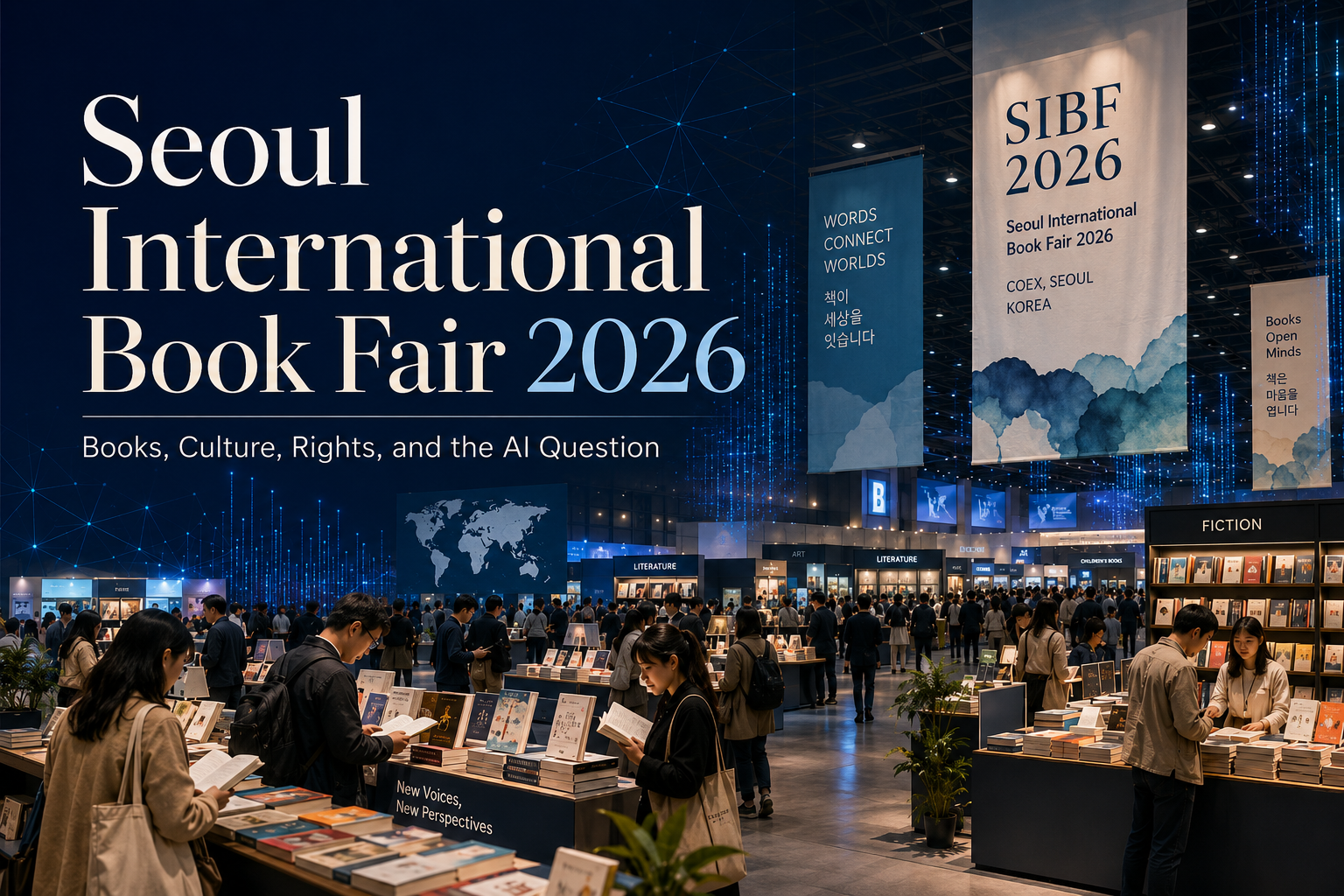
The Seoul International Book Fair closed on June 28 after five days at COEX, but the more important story was not simply that Korea’s largest book festival returned at scale. It was that the 2026 fair made a larger argument about what books are becoming in Korea: not only objects to buy, but cultural experiences, exportable intellectual property, public gathering points, and a way to defend human questioning in an age increasingly shaped by artificial intelligence.
Held from June 24 to 28 at COEX Halls A and B1 in Seoul, the 68th edition of the fair brought together 538 participating companies from 18 countries, including 361 domestic and 177 international exhibitors. Its program included 416 exhibitions, lectures, seminars, side events, and on-site programs, with 326 writers and speakers from Korea and abroad.
Those numbers confirmed the fair’s status at the center of Korea’s publishing calendar. But the real significance of this year’s edition came from how that scale was used. Seoul International Book Fair 2026 was not framed only as a place to sell books. It was framed as a place to ask what books are still for.
This year’s theme, “Human Declaration: Homo duduri,” placed the fair inside one of the publishing industry’s most urgent debates: what remains distinctly human when machines can write, summarize, recommend, translate, search, and answer?
The Korean title, “Human Declaration,” was paired with “Homo duduri,” a coined phrase built around “duduri,” an old Korean word associated with a blacksmith-like mythical figure and the archetype of the dokkaebi, a Korean goblin or spirit figure often linked to transformation and supernatural force. The fair’s interpretation turned that image into a metaphor for the AI age. A human being is not valuable because they can process information faster than a machine. A human being is valuable because they can enter uncertainty, ask better questions, and forge meaning from pressure.
That framing made SIBF 2026 more than a celebration of books. It became a public staging ground for Korea’s current publishing dilemma: how to keep books culturally powerful when attention is fragmented, digital platforms control discovery, AI changes the cost and meaning of text production, and readers increasingly expect publishing to offer an experience as well as a product.
A Book Fair Built Around the Question of Being Human
The fair’s central exhibition, “Human Declaration: Homo duduri: 2×2=5,” gave the AI question a literary and philosophical shape. Rather than treating AI only as a technology issue, the program placed it inside a longer tradition of human uncertainty. Classic works such as “Notes from Underground,” “Walden,” and “Thus Spoke Zarathustra” appeared as part of the theme exhibition, linking the present AI debate to older questions about freedom, solitude, morality, irrationality, and the limits of knowledge.
That curatorial choice mattered. It pushed the fair away from the familiar binary of “AI versus books.” Instead, SIBF treated AI as another form of fire: dangerous, useful, transformative, and dependent on the human hands that use it. In that sense, the fair’s position was neither anti-technology nor blindly optimistic. Its strongest message was that books still matter because they preserve the practice of deep questioning.
The theme also reflected a real industry problem. Publishing now faces AI not only as a subject to discuss, but as a production tool, a rights challenge, a copyright threat, a discovery mechanism, and a new competitor for readers’ time. The fair’s seminars and lectures addressed this through panels on creativity, copyright, ethics, fact-checking, artistic identity, and the changing boundaries between human and machine-made work.
For Korea, this discussion has extra weight. The country’s publishing market sits close to several of the world’s most active digital-storytelling ecosystems: webtoons, webnovels, streaming adaptations, fandom-driven discovery, and platform-based reading. Korean publishers are therefore not encountering AI in isolation. They are encountering it alongside a broader shift in how stories are created, packaged, recommended, licensed, and adapted.
That made the “Human Declaration” theme unusually well matched to the moment. The fair was asking not only whether AI can write. It was asking whether readers, writers, publishers, and rights professionals can still define the value of human attention.
France as Guest of Honor: Cultural Diplomacy Through Books
France’s role as guest of honor added an international frame to the fair. The guest-of-honor program, presented under the idea of “Reading France,” marked the 140th anniversary of diplomatic relations between Korea and France. French contemporary literature, children’s books, picture books, humanities titles, philosophy, and publishing institutions were placed at the center of the international program.
The guest list carried both literary and public-recognition value. Bernard Werber, whose novels have long had an unusually strong readership in Korea, was one of the most visible names. His presence reflected a specific feature of Korean reading culture: certain foreign authors become not just translated writers, but long-term cultural presences. Werber is one of the clearest examples. His popularity in Korea made him a natural symbolic figure for a fair concerned with imagination, science, civilization, and the future of humanity.
Other French participants, including children’s literature author Marie-Aude Murail, picture-book artist Anne Laval, and philosopher Pascal Bruckner, widened the program beyond literary fiction. That breadth was important because Korea’s publishing relationship with France is not only about prestige literature. It includes picture books, comics and graphic storytelling, philosophy, food writing, design, education, and the broader cultural role of books.
The France program also highlighted how international book fairs function as soft-power events. A guest-of-honor pavilion is not merely a booth. It is a cultural statement. It tells local readers which country’s books deserve attention, and it tells visiting publishers how that country wants to be read. In Seoul, France arrived not only as a literary nation but as a partner in a conversation about what reading culture can mean after AI.
The Rights Market Behind the Public Festival
For general visitors, Seoul International Book Fair is a place to browse, queue, buy books, meet authors, and discover publishers. For the industry, it is also a rights market. That second identity is central to understanding why the fair matters beyond Korea.
The 2026 Rights Center operated from June 24 to 26, creating a professional space for publishers, literary agents, and rights professionals to hold copyright import and export consultations. International participation included publishers and organizations from countries such as France, Germany, Canada, Taiwan, Singapore, the United States, Chile, and Thailand. A fellowship program also brought publishing professionals from multiple countries into direct contact with Korea’s publishing community.
This rights-market function is becoming more important as Korean content continues to travel across formats. International interest in Korean stories is no longer limited to literary fiction. It now includes children’s books, illustrated books, genre fiction, essays, lifestyle books, food writing, webtoon-adjacent storytelling, and intellectual property that can move from print to digital platforms, comics, streaming series, merchandise, and fan communities.
This is where Seoul has a distinct advantage. Frankfurt remains the global rights marketplace. Bologna remains essential for children’s publishing. London and Beijing each occupy different trade positions. Seoul’s role is more specific: it sits inside a culture where books are increasingly connected to the wider Korean content economy. A Korean story can begin as a novel, move into a webtoon, become a drama, generate merchandise, and circulate internationally through fan translation, official licensing, social media, and streaming platforms.
That does not mean every Korean book becomes exportable IP. Most do not. But it does mean international publishers and agents now look at Korea with a broader scouting lens. They are not only asking which books can be translated. They are also asking which stories, authors, aesthetics, and publishing brands can travel.
The 2026 fair’s rights activity showed that Seoul is still building its trade identity, but the direction is clear. Korea’s book industry is no longer only trying to be discovered by the world. It is learning how to present itself as a rights-exporting market with its own reader signals, visual culture, genre strengths, and adaptation pipeline.
The Public Side: Books as Experience
The most visible story from the fair floor was the public energy around books. Advance tickets sold out, and the fair opened amid expectations of around 150,000 visitors. Korean press coverage also emphasized long lines, crowded halls, and the way publishers competed not only with titles but with booth concepts.
That detail may sound minor, but it points to one of the biggest changes in Korean book culture. The book fair is no longer just a retail event. It is also a form of cultural participation.
Publishers increasingly treat booths as temporary worlds. Blue Forest drew attention with a laundromat-like concept built around the idea of cleansing or refreshing the mind through books. Borim Publishing presented a “Book Makase” concept, combining “book” with “omakase,” the Japanese dining format in which a chef selects the course for the guest. In this case, staff dressed in chef-style uniforms and recommended books to readers as if serving a curated literary meal.
These concept booths are not merely decorative. They show how publishing is borrowing the language of pop-up stores, fandom retail, lifestyle branding, and social-media-ready space design. In Korea, where offline pop-ups have become a major tool for fashion, beauty, entertainment, food, and character brands, publishers are adapting the same logic to books.
That shift can make traditionalists uncomfortable. A book fair built around merchandise, limited editions, booth design, and photo-worthy concepts may seem far from the quiet ideal of reading. But the more useful question is why readers respond to it.
For younger readers especially, books now compete inside a cultural field shaped by visual identity, collectible objects, online sharing, and fandom rituals. A fair gives books something digital discovery often lacks: physical presence. Readers can touch the object, hear the author, watch other readers gather, compare publisher identities, and turn book buying into a memory attached to a place.
This does not reduce books to merchandise. Rather, it shows that the social life of books is changing. The book remains the core object, but the surrounding experience has become part of how readers assign value.
The “Text-Hip” Moment Is Not Just a Trend
Korean media often describes the current coolness of reading through the phrase “text-hip,” meaning that text and books have acquired a fashionable cultural charge. The term can be too neat, but the fair showed why it continues to circulate.
The crowds at SIBF 2026 were not simply evidence that people still buy books. They suggested that reading has become visible again. Book purchases, author talks, tote bags, special editions, booth photos, and fair-going itself can all become part of a reader’s public identity. For publishers, this is both an opportunity and a warning.
The opportunity is obvious: books can reclaim cultural attention through design, events, and community. The warning is that attention can be shallow if the experience does not lead back to reading. The strongest publishers at a fair like SIBF are not simply the ones with the most attractive booths. They are the ones that use the booth to clarify their editorial identity.
In that sense, the best fair experiences work like a live version of a publisher’s catalog. They tell readers what the publisher believes in, what kind of books it makes, and why its books belong together. For independent publishers, art-book makers, children’s publishers, genre specialists, and literary houses, this can be especially powerful. A strong booth can make a small publisher legible to readers who might otherwise never encounter it through algorithmic retail.
This is one reason the fair’s Book Village section matters. With more than 110 independent publishers participating, Book Village placed smaller and more design-conscious publishing cultures inside the same event as larger houses and international exhibitors. This year’s Asian independent-publishing presence also widened that section beyond Korea, bringing in organizations linked to Taiwan, Japan, and Singapore. That mix is crucial to the fair’s identity. It allows SIBF to function as both a mainstream book festival and a discovery platform for more experimental publishing.
Reader Communities Are Part of the Story
The fair’s cultural meaning also extends beyond COEX. Online communities, social platforms, and reader forums have become part of how book events are interpreted in Korea. Posts about lines, booth recommendations, celebrity appearances, limited editions, author events, and shopping strategy turn the fair into a shared cultural topic even for people who do not attend.
This community layer is important because it shows how books enter everyday conversation. A trade report can measure exhibitors, programs, and rights meetings. A visitor guide can list times and ticket prices. But online reader discussion shows what people actually find worth sharing: which booths felt fresh, which books sold out, which authors drew attention, which goods were desirable, and whether the fair felt worth the trip.
For Korean publishing, this is valuable data in cultural form. It reveals not only demand, but desire. Readers are not only asking, “What should I buy?” They are asking, “Where should I go?” “What should I line up for?” “Which publisher feels interesting?” “What does this event say about the kind of reader I am?”
That is why the community response should not be treated as a side note. It is part of the fair’s ecosystem. The strongest sign of a living book culture is not only sales. It is conversation.
Awards, Limited Editions, and the Fair as Publishing Stage
SIBF 2026 also functioned as a stage for publishers to launch, frame, and reintroduce books. The fair’s “Best Book of Korea” program selects 40 books annually across four broad values: beauty, fun, pleasure, and wisdom. These categories point to a broad understanding of book value: design, picture-book pleasure, literary and narrative entertainment, and scholarly or intellectual contribution.
The fair also featured limited-edition books, new releases tied to the event, author talks, and programs designed to draw attention to overlooked titles. This matters because one of publishing’s hardest problems is not producing books but making them visible. A fair concentrates attention. It gives publishers a reason to repackage a title, invite a reader to a conversation, or create a physical moment around a book that might otherwise disappear inside online retail.
In Korea’s current market, where bestseller visibility can be heavily shaped by platform rankings, celebrity attention, and social-media bursts, a fair offers an alternative form of discovery. It does not eliminate commercial hierarchy, but it lets more kinds of books compete for attention through curation, space, and direct reader encounter.
What SIBF 2026 Says About Korean Publishing Now
The 2026 Seoul International Book Fair revealed a Korean publishing industry moving in several directions at once.
First, it is trying to defend the cultural value of books in the AI age without pretending technology can be ignored. The “Human Declaration” theme acknowledged AI as a force already inside publishing and culture, but argued that the human role lies in questioning, judgment, imagination, ethics, and interpretation.
Second, the industry is treating the fair as a rights platform. International participation, the Rights Center, and fellowship programming all point to a Korean publishing market that wants to be more active in export conversations. The opportunity is especially strong because Korean books sit near a larger content ecosystem already familiar to global audiences.
Third, the public fair is becoming more experiential. Booths, goods, special editions, author encounters, and social-media circulation are no longer peripheral. They are part of how books compete for attention in contemporary Korea.
Fourth, reader communities now help determine the afterlife of a cultural event. The fair does not end when COEX closes. It continues through reviews, photos, recommendations, online discussion, and the circulation of impressions across communities.
Finally, SIBF 2026 showed that Korean reading culture is not moving backward into nostalgia. It is moving forward into hybridity. Books are being asked to do many things at once: remain serious, become visible, travel internationally, generate IP, hold ethical questions about AI, and create offline experiences strong enough to pull readers away from screens.
That is a heavy burden for publishing. But it is also a sign of life.
The fair’s central metaphor, the blacksmith-like “duduri,” works because it does not imagine culture as something pure and untouched. It imagines culture as something forged under heat. At COEX, the fire came from AI, market pressure, global rights ambition, reader fandom, and the constant competition for attention. Seoul International Book Fair 2026 suggested that Korea’s book culture is not trying to escape that fire. It is learning how to work inside it.