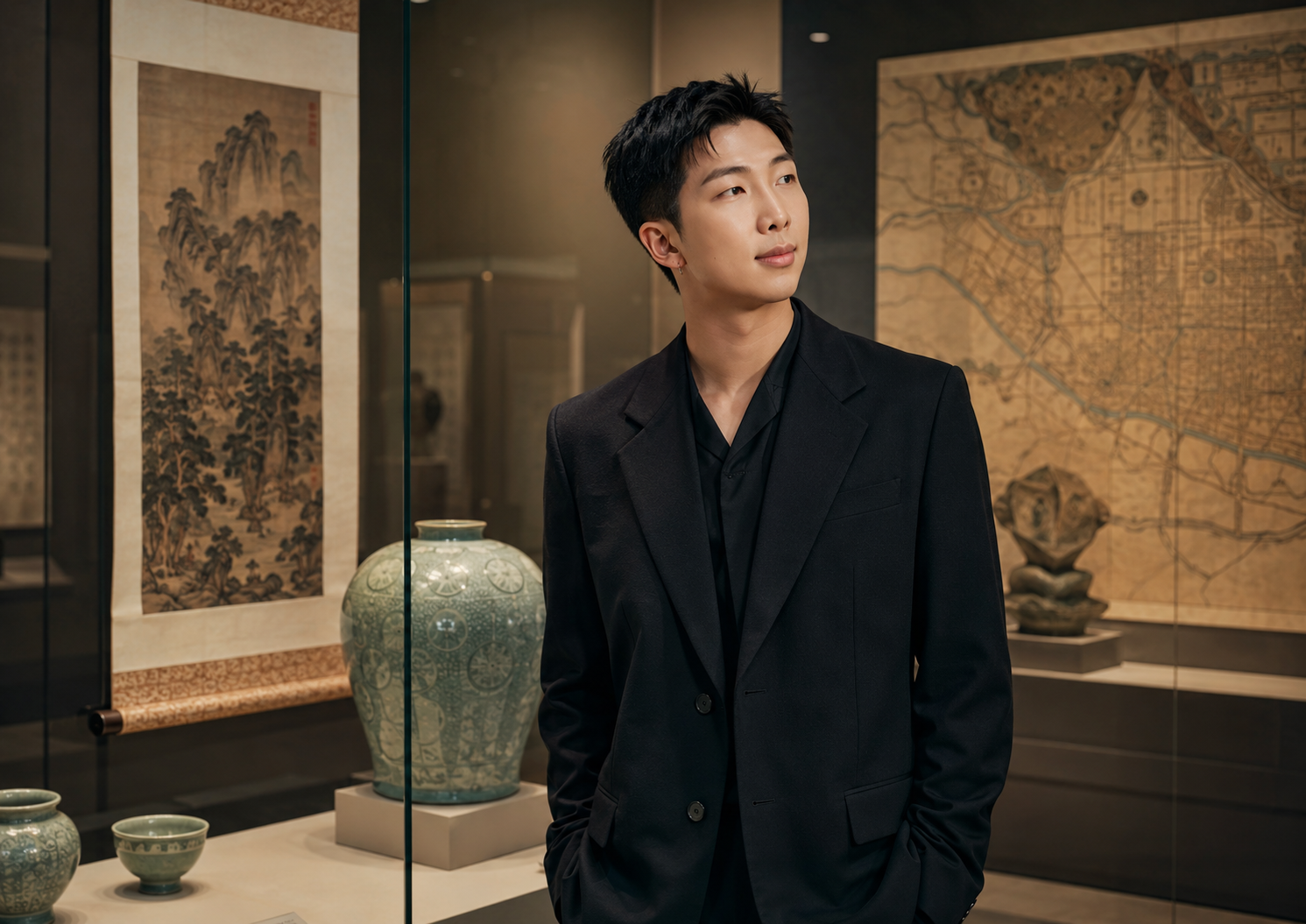
BTS leader RM’s appointment as global public-relations ambassador for the National Museum of Korea is not just another celebrity title. It is a sign of how Korean cultural institutions are learning to use pop-cultural attention to deepen global interest in heritage, museums, and historical memory.
The National Museum of Korea appointed RM, whose real name is Kim Nam-joon, on June 19 at the museum in central Seoul. The museum said he will help promote Korean cultural heritage to audiences in Korea and abroad. That mandate places him at an increasingly important intersection: K-pop visibility, cultural diplomacy, museum strategy, and Korea’s effort to turn global curiosity into lasting cultural understanding.
The appointment works because RM is not being attached to heritage from the outside. For years, his public image has included museums, art collecting, Korean painting, and cultural preservation. He has become one of the rare pop figures whose fan culture regularly crosses into galleries, exhibitions, bookstores, and heritage spaces.
That makes the museum’s decision more meaningful than a routine promotional partnership. RM is not simply lending fame to a national institution. He is becoming the public face of a broader Korean strategy: connecting the global language of contemporary pop culture with the older cultural forms that shaped Korea’s identity.
From Entertainment Export to Cultural Interpretation
For much of the past two decades, the Korean Wave has been measured through entertainment: idol groups, dramas, film, beauty, food, fashion, and tourism. Those industries remain central to Korea’s global image. But the next stage of cultural influence is more complex. It is not only about making Korean culture visible. It is about helping global audiences understand what they are seeing.
That is where museums matter.
A hit song, drama, or viral performance can introduce Korea to millions of people. A museum can explain the historical depth behind the country’s visual language, symbols, materials, aesthetics, and stories. The challenge is that museums do not always speak easily to younger international audiences. K-pop, by contrast, already has their attention.
RM’s role offers a bridge between those worlds. His global audience may arrive through BTS, but many have already followed him into a wider cultural field: modern art, Korean old paintings, architecture, literature, and museum visits. In that sense, he represents a model of soft power that is not limited to spectacle. It is built around curiosity.
Why RM Is a Credible Choice
Celebrity ambassadorships can feel thin when the connection between the figure and the institution is purely promotional. RM’s case is different because his relationship with art and heritage is already well established.
He is widely known as an art collector, and his personal collection will be featured in “RM x SFMOMA: Between You and Me,” an upcoming San Francisco Museum of Modern Art exhibition running from October 2026 to February 2027. The exhibition will bring together about 200 works from RM’s collection and SFMOMA’s holdings, placing modern and contemporary Korean art in conversation with works from around the world.
His support for heritage preservation has also been concrete. RM donated 100 million won in both 2021 and 2022 to the Overseas Korean Cultural Heritage Foundation to support Korean cultural assets abroad. That record matters because the National Museum of Korea is not only seeking attention. It is seeking credibility in how Korean heritage is introduced globally.
The museum’s ceremonial gift to RM also carried symbolic weight. It presented him with a miniature hanging scroll based on Daedongyeojido, the “Territorial Map of the Great East,” a major nineteenth-century map of Korea made from woodblocks in 1861 by cartographer Kim Jeong-ho. The gift was more than a souvenir. It positioned RM as a guide, someone tasked with helping global audiences locate Korean heritage on a wider cultural map.
A Museum Already in the Global Spotlight
The appointment also comes as the National Museum of Korea is enjoying unusual international momentum. The museum recorded more than 6.5 million visitors in 2025, ranking third globally in visitor numbers after the Louvre and the Vatican Museums. That surge reflects more than local attendance. It shows how Korean heritage is becoming part of the country’s broader cultural draw.
Korea’s museums are increasingly benefiting from the same forces that drive interest in Korean food, film, music, fashion, and travel. International visitors are not encountering heritage as a separate category from contemporary culture. They are moving between them: from a concert to a palace, from a drama location to a museum shop, from a pop idol’s recommendation to an exhibition hall.
This is where RM’s appointment becomes strategically useful. The museum already has authority and collections. RM brings attention and emotional access. The important question is whether the institution can convert that attention into deeper engagement.
The Promise and the Risk
The promise of this partnership is clear. A figure like RM can help museums reach audiences that would otherwise see national heritage as distant, formal, or difficult to approach. He can make cultural objects feel less sealed off from contemporary life. He can also help show that Korean identity is not split between old and new, but built through an ongoing conversation between tradition and reinvention.
The risk is also clear. Heritage institutions must avoid turning artifacts into fan-service props. A painting, map, sculpture, ceramic vessel, or royal document should not matter only because a celebrity stands next to it. The strongest version of this ambassadorship will use RM’s reach to open the door, then let curators, scholars, educators, and the objects themselves carry the meaning.
That balance will determine whether the role becomes real cultural diplomacy or only a successful publicity moment.
What Success Would Look Like
A meaningful ambassador program would go beyond photo calls. It could include multilingual digital content, short-form museum explainers, global campaigns around specific artifacts, international exhibition partnerships, accessible introductions to Korean art history, and programming designed for first-time museum visitors.
It would also be valuable if RM’s role helps spotlight less familiar parts of Korean heritage. The most useful cultural diplomacy does not only repeat famous symbols. It expands the public’s sense of what Korea contains: regional histories, craft traditions, conservation work, Buddhist art, cartography, calligraphy, folk painting, court culture, and the movement of Korean objects across the world.
The appointment therefore belongs in a wider Culture & Society conversation. Korea’s cultural influence is maturing. The country no longer has to choose between pop culture and heritage, or between fandom and scholarship. Its institutions are increasingly trying to make those worlds speak to each other.
RM’s role at the National Museum of Korea shows that K-pop soft power is no longer only about music charts, concerts, or tourism campaigns. It is also becoming a pathway into museums, archives, and historical interpretation.
For the National Museum of Korea, RM is not simply a famous ambassador. He is a bridge between attention and understanding. In the next phase of Korea’s global cultural presence, that bridge may matter as much as the spotlight itself.