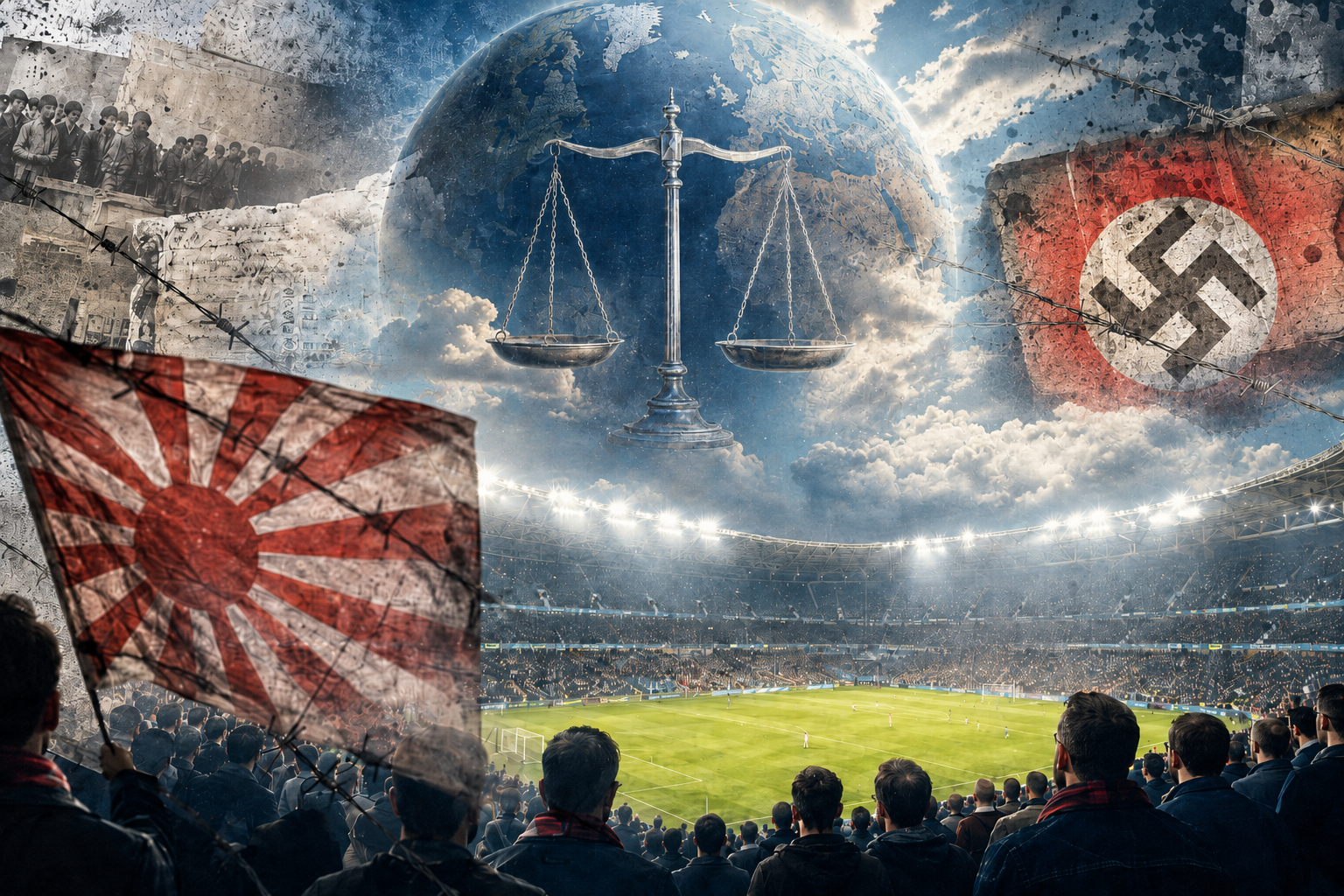
A World Cup flag controversy has brought one of East Asia’s longest-running historical disputes back into international view. At the center is Japan’s Rising Sun flag, a symbol that some Japanese supporters describe as cultural or traditional, while many Koreans, Chinese, and other Asian communities associate it with Japanese imperial expansion, colonial rule, and wartime violence.
The latest Rising Sun flag dispute gained attention after South Korean professor and public campaigner Seo Kyoung-duk criticized the appearance of the flag during World Cup-related cheering and said he had reported the issue to FIFA. The controversy then spread through Korean news and online communities after Seo said his social media accounts were flooded with hostile messages from Japanese users. Screenshots and reposts turned the issue from a stadium-symbol dispute into a broader debate about historical memory, online harassment, and how international sports should treat symbols linked to wartime aggression.
But the Rising Sun flag controversy should not be viewed only as a Korea-Japan argument. From an international third-party perspective, the fairer question is this: how should global institutions treat symbols connected to imperialism, occupation, and wartime violence when one country sees them as national tradition and another remembers them as signs of humiliation and historical trauma?
Why the Rising Sun Flag Controversy Matters Beyond Korea and Japan
That question is familiar in Europe. If a symbol associated with Nazi Germany appeared at a major international sporting event, few people would treat the controversy as merely a bilateral dispute between Germany and Israel, or between Germans and Jews. The issue would be understood more broadly as a matter of historical responsibility, public safety, and respect for victims of mass violence.
The Korea-Japan dispute over the Rising Sun flag is different in historical detail from the Germany-Jewish or Germany-Israel relationship after the Holocaust, but the moral question is not so different. In both cases, the issue is whether a symbol associated with wartime aggression should be judged only through the view of the country that uses it, or also through the memory of those who suffered under it.
No comparison between historical traumas is perfect. The Holocaust, Japanese colonial rule, forced labor, sexual slavery, wartime massacres, and imperial military expansion each have their own histories, victims, legal frameworks, and postwar politics. But the comparison is still useful because it clarifies the standard. International sports do not need to decide that two histories are identical in order to recognize that symbols of wartime aggression can be harmful in public spaces.
The core question is not whether the Rising Sun flag and Nazi symbols are exactly the same. The core question is whether victims’ historical memory should matter when a symbol is displayed at a global event meant to welcome all nations.
What the Nazi Symbol Comparison Reveals
In the case of Nazi symbols, the answer is usually clear. Germany’s postwar political culture has treated Nazi imagery not as ordinary national heritage but as a symbol of a criminal regime. German law restricts the public use of symbols associated with unconstitutional organizations, including Nazi symbols, with exceptions for civic education, art, science, research, teaching, and historical reporting. Jewish communities and Israel are not expected to accept Nazi imagery as harmless just because someone else claims it has an older or alternative meaning.
That principle is important. A symbol can have more than one history, but when one of those histories includes militarism, genocide, colonization, racial supremacy, or systematic violence, public institutions must take that meaning seriously. Context matters, but context cannot be used as an excuse to erase victims’ memory.
This is where the Rising Sun flag dispute becomes larger than one World Cup incident. Japan’s official position is that the Rising Sun flag is widely used in Japanese culture and should not be considered political or discriminatory. That position should be reported accurately. But it cannot be the only standard used by international institutions. A symbol’s meaning is not determined only by the country that continues to use it. It is also shaped by the communities that experienced violence under it.
Why Many Koreans and Asians Object to the Rising Sun Flag
For many Koreans, the Rising Sun flag is not a decorative sunburst pattern. It is tied to Japan’s colonial rule over Korea from 1910 to 1945 and to imperial Japan’s military expansion across Asia. For many Chinese and other Asian observers, it can also evoke invasion, occupation, and wartime brutality.
Whether every Japanese fan waving the flag intends that meaning is not the only issue. International sporting spaces must also consider how the symbol is received by those who carry the historical wound.
That is the same logic the world already applies to Nazi imagery. The problem with a Nazi flag at a stadium would not depend only on the personal intention of the person waving it. It would be unacceptable because its historical association is clear enough that its display would reasonably threaten, insult, or exclude others. A global tournament cannot be neutral if it allows some spectators to celebrate under symbols that other spectators recognize as signs of historical terror.
The fair standard, then, is not anti-Japanese and not pro-Korean. It is a universal standard: symbols strongly associated with wartime aggression, occupation, racial supremacy, colonial domination, or mass violence should not be displayed as fan identity at international sporting events.
FIFA, World Cup Stadiums, and the Problem of Consistency
That standard should apply across regions. If European fascist symbols are treated as incompatible with global sports, Asian imperial symbols should not be dismissed simply because they are less familiar to Western audiences. Historical pain does not become less real because it is less globally understood.
International institutions also need to avoid another mistake: treating the Rising Sun flag issue as a simple matter of bilateral sensitivity. When Jewish communities object to Nazi symbols, the world does not usually say, “That is just a Germany-Israel dispute.” It recognizes the symbol as part of a broader moral and historical framework.
Likewise, objections to the Rising Sun flag should not be reduced to “Koreans dislike Japan.” The symbol has a regional wartime history, and the objections come from historical experience, not ordinary sports rivalry.
FIFA’s own rules create room for this kind of judgment. The World Cup’s stadium code prohibits political, offensive, or discriminatory materials, including flags, apparel, banners, and symbols. The problem is not that FIFA lacks language for controlling harmful symbols. The problem is whether that language is applied consistently, especially when the disputed history is Asian rather than European.
What Would a Fair International Standard Look Like?
A better international approach would start with clear criteria.
First, does the symbol have a documented association with a regime, military campaign, or ideology responsible for occupation, aggression, or mass violence?
Second, is the symbol being displayed in a celebratory or identity-based context rather than an educational, journalistic, or historical one?
Third, have affected communities repeatedly explained that the symbol causes harm in public international settings?
Fourth, would the same institution allow a comparable European wartime symbol under similar circumstances?
If the answer to those questions points toward harm, restriction is reasonable. That does not require criminalizing every use of the symbol everywhere. It does not require denying that symbols can have older or domestic meanings. It simply means that a global sporting event is not the right place to display a symbol associated with imperial aggression.
What Japan, Korea, FIFA, and International Media Should Avoid
What should not be done is also clear.
Japan should not dismiss Korean, Chinese, or other Asian objections as ignorance, anti-Japanese sentiment, or political exaggeration. Historical pain cannot be erased by saying that a symbol has another meaning at home.
International media should not frame the issue as a strange regional quarrel without explaining the underlying history. The Rising Sun flag controversy is not simply a matter of fan behavior or online anger. It is part of a larger debate about how the world recognizes historical trauma outside Europe.
FIFA should not apply strict rules to some political or offensive symbols while treating other wartime symbols as too complicated to address. If international sports bodies want to present themselves as neutral, they must apply neutral standards consistently.
The Larger Issue: Historical Memory in Global Sports
The goal should not be to make every country accept one side’s national narrative. The goal should be to create a public standard that protects dignity in shared spaces. In a World Cup stadium, no fan should have to sit under a symbol they reasonably associate with occupation, racial hierarchy, military violence, or historical terror.
That standard is already familiar when the symbol comes from Nazi Germany. The challenge is whether global institutions are willing to apply the same moral logic when the history comes from Asia.
The Rising Sun flag controversy is therefore not only about Korea and Japan. It is about whether international sports can recognize historical trauma fairly across regions. A symbol of wartime aggression should not become acceptable simply because its victims are less familiar to the global audience. And opposition to that symbol should not become an excuse for new hatred.
A fair standard must hold both truths at once: historical memory deserves respect, and modern people should not be collectively dehumanized for the crimes of past regimes.
That is the principle international sport should apply. Not Korean revenge. Not Japanese denial. Not Western indifference. One consistent rule: symbols tied to wartime aggression do not belong in global spaces meant to bring nations together.