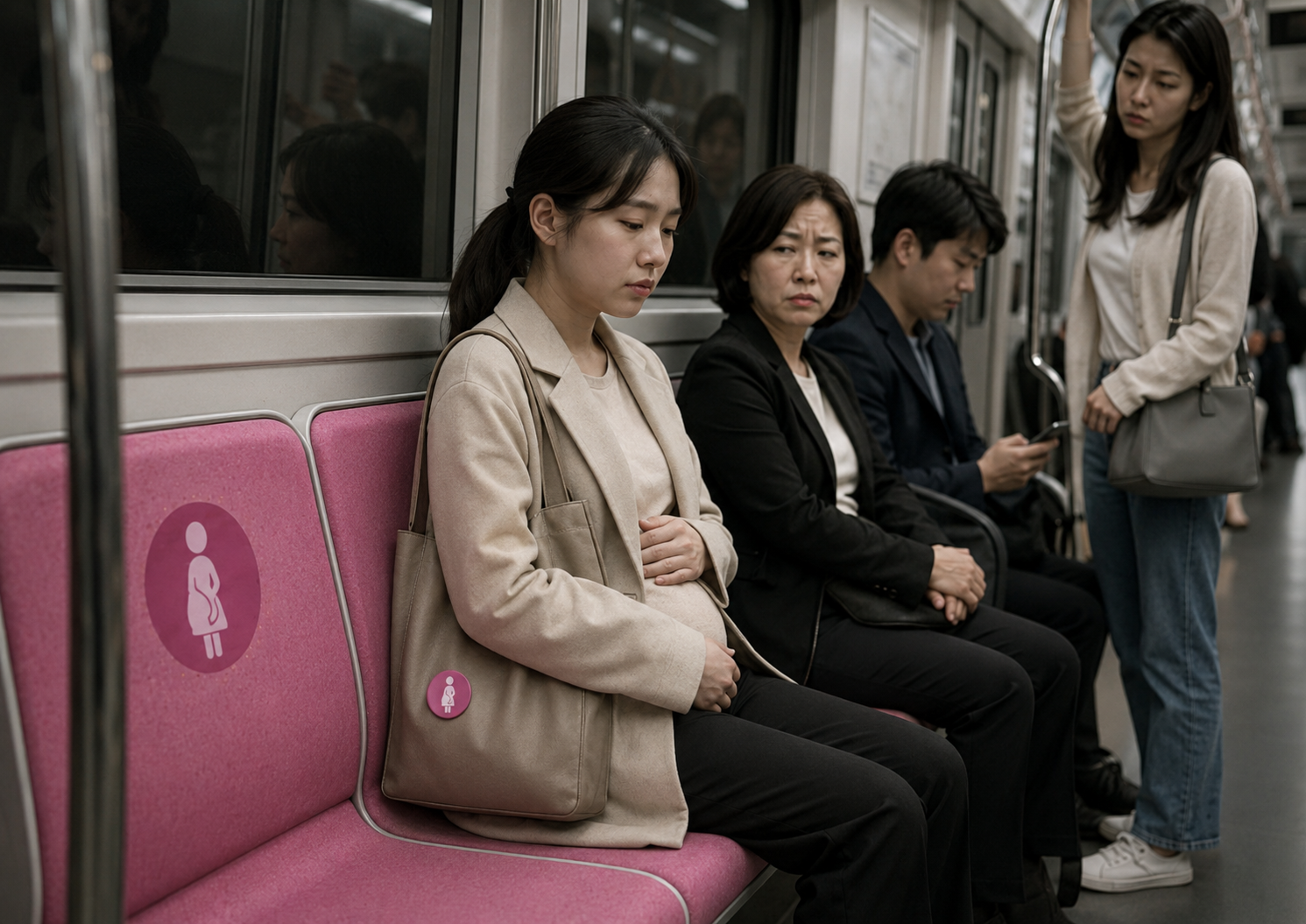
A short-form Korean social-media skit about pregnancy-priority subway seats has turned one pink seat into a larger argument about pregnancy, privacy, and public trust.
The skit uses parody and audition-show logic to mock a familiar situation on Korean public transportation: a woman sits in a pregnancy-priority seat, but instead of being trusted, she is judged. Does she look pregnant enough? Is her stomach visible? Is she wearing a pregnancy badge? Should she have to prove why she is sitting there?
The format is comic, but the criticism is serious. Korea’s pregnancy-priority seats were created because pregnancy is not always visible, especially in the early stages. Yet the public norm around the seat often still depends on visible proof. That contradiction is why the skit resonated: it captured how a courtesy system meant to protect pregnant women can become an informal public inspection of women’s bodies.
Related short-form videos have also used satire to imagine “reform plans” for pregnancy-priority seats, including mock systems such as competition or reservation-based seating. The exact first upload of the most-circulated skit is difficult to verify from open sources, but the broader social-media pattern is clear: Korean creators are using comedy to talk about a real public-space failure.
The Seat Exists Because Pregnancy Is Often Invisible
Korea’s pregnancy-priority seats were designed to solve a visibility problem. Seoul subway pregnancy-priority seats were introduced in 2013 as part of Seoul’s women’s policy and later spread more broadly. Seoul Metro encourages passengers to keep the seats open so pregnant passengers can sit whenever they need to.
That history matters because the current debate reverses the original purpose. The seat exists because strangers cannot reliably judge pregnancy by appearance. But in the actual subway car, pregnant women can still be judged by appearance before being treated as legitimate users of the seat.
This is especially true in early pregnancy. A woman may have severe nausea, dizziness, fatigue, pain, bleeding risk, or other symptoms before her body visibly changes. Yet early pregnancy is also the stage when she is least likely to be recognized by strangers and most likely to face suspicion if she sits in a pregnancy-priority seat.
The “audition” metaphor works because it exaggerates a real feeling. A pregnant woman becomes a contestant. Other passengers become judges. Her stomach, badge, posture, clothing, and facial expression become evidence. The public question is no longer “Does she need the seat?” but “Can she prove she deserves it?”
Public Support Is High, But the Rule Is Confused
The problem is not that Koreans broadly oppose pregnancy-priority seats. Korea Research found that 89% of respondents agreed it is a pregnant woman’s natural right to use a pregnancy-priority seat, while 83% agreed that the policy contributes to protecting socially vulnerable people.
But public support does not automatically produce a clear social norm. Korea Research also found that only 49% said pregnancy-priority seats should usually be left empty because pregnancy may be hard to identify visually. By contrast, many people treat general transportation-priority seats as places where anyone can sit until someone visibly in need appears.
That difference creates the conflict. One side sees the pregnancy-priority seat as a space that should be kept open so pregnant women can sit without asking. Another side sees it as a seat anyone can temporarily use until a pregnant passenger appears. But that second logic depends on visibility, and pregnancy is not always visible.
The survey also suggests that the pink seat carries a stronger social taboo than general priority seating. Among adults who were not elderly, 51% said they had used a general transportation-priority seat despite not being mobility-impaired, while only 29% said they had used a pregnancy-priority seat despite not being pregnant.
That means the seat is already socially marked. But the existence of a taboo has not made the seat comfortable for pregnant women. A public symbol can be highly visible and still fail the people it is supposed to protect.
The Badge Helps — Until It Becomes Proof
Pregnancy badges are supposed to make invisible pregnancy easier for others to recognize. They can be useful, especially in early pregnancy, when a woman may need a seat but may not look visibly pregnant. The badge can reduce the need for a direct request and help strangers understand the situation quickly.
But the badge becomes controversial when it shifts from help to obligation. There is a major difference between “a badge can help people recognize pregnancy” and “a woman must wear a badge before she deserves the seat.”
That distinction is at the center of the current backlash. Much of the online criticism focuses on the idea that pregnancy badges should be helpful signals, not mandatory proof. Once the badge becomes a requirement, a courtesy system starts to look like a verification system.
For some women, the badge is not neutral. It publicly reveals pregnancy, which may still be private for medical, family, workplace, or personal reasons. A woman in early pregnancy may not have told her employer, relatives, friends, or even all family members. She may also be dealing with medical uncertainty. In that context, demanding a badge can become a demand for disclosure.
Women’s Feedback Shows the Real Gap
Survey data shows a wide gap between public self-perception and pregnant women’s lived experience.
The Population, Health and Welfare Association’s 2025 survey found that 82.6% of general respondents said they had shown consideration to pregnant women, but only 56.1% of pregnant respondents said they had felt that consideration. The association described the problem not as a demand for “special treatment,” but as a need for everyday consideration.
The same pattern appears in public-transportation experiences. In the 2025 data cited by Edaily, pregnant women’s experience rate of using pregnancy-priority seats fell to 79.5%, down from 92.3% the previous year. Meanwhile, the share of pregnant women who felt discomfort while using the seats rose to 60.9%, up from 42.4%.
That is a serious policy signal. A seat can exist physically, but still fail socially. If pregnant women avoid using it because they expect stares, awkwardness, refusal, or judgment, the system is not working as intended.
Newsis also reported first-person online accounts that show why the issue feels personal. One woman in her 32nd week of pregnancy said she forgot her pregnancy badge, but her belly was visibly large and still no one yielded. Another woman who wore the badge said people sitting in the pregnancy-priority seats seemed to close their eyes rather than notice it.
These accounts are not just complaints about manners. They show the emotional burden of a system that makes pregnant women choose between asking, standing, wearing a badge, being ignored, or being watched.
The Seat Is Becoming a Public Test
The social-media skit hit a nerve because it showed what many women describe: pregnancy-priority seats can become a public test.
Is she pregnant enough?
Is she showing enough?
Is she wearing the badge?
Is she too young?
Is she too healthy-looking?
Is she just using the seat unfairly?
This is why the debate is not only about transportation. It is about who gets believed in public.
A pregnant woman should not have to perform pregnancy convincingly enough to satisfy strangers. She should not have to reveal private medical information to sit down. And she should not have to choose between protecting her privacy and protecting her body.
The central contradiction is simple: Korea created pregnancy-priority seats because pregnancy is not always visible, but the public culture around the seat often still demands visibility.
Complaints Show This Has Been Building for Years
This is not a one-week online controversy. Seoul Metro has received thousands of pregnancy-priority-seat complaints every year.
According to Newsis, Seoul Metro received 6,286 complaints related to pregnancy-priority seats in 2024, averaging 17.2 complaints per day. Most complaints were about non-pregnant passengers sitting in the seats and not yielding.
The number was lower than previous years, but still high: Newsis reported 7,434 complaints in 2021, 7,334 in 2022, and 7,086 in 2023.
This long-running complaint pattern matters because it shows that the current viral discussion did not create the problem. It gave people a new image for a problem that was already there.
Government and Transit Agencies Still Prefer Campaigns Over Punishment
The official response remains mostly persuasion, not enforcement.
On April 28, 2026, Edaily reported that the Population, Health and Welfare Association held a joint campaign with the Ministry of Health and Welfare, Seoul Metro, and the KBS Announcers Association to encourage a culture of keeping pregnancy-priority seats open. The campaign included pregnancy-experience activities, public pledges, quizzes, and train announcements.
The campaign was built around the same gap that keeps appearing in surveys: many people say they are considerate, but pregnant women report that consideration does not reliably reach them. The campaign also responded to the rise in discomfort among pregnant women using the seats.
Seoul Metro has also used announcements, videos, and social-media campaigns. Newsis reported that Seoul Metro recognizes the need for public-awareness improvement and has used station announcements, in-train broadcasts, related videos, social-media challenges, and offline promotion.
But soft campaigns leave the core ambiguity unresolved. The seats are treated as courtesy seats, not legally exclusive seats. That means the system depends on voluntary behavior, and when voluntary behavior fails, the burden falls back on the pregnant passenger.
Why Tech Solutions Are Tempting — and Complicated
Because voluntary courtesy has not fully worked, some people have proposed stronger technological systems, including sensors, warning sounds, or pregnancy-authentication devices.
Newsis reported that some local transit systems have introduced voice-guidance devices that detect when a passenger sits in a pregnancy-priority seat and play an announcement. But experts quoted by the outlet warned that force-based rules can create budget burdens and intensify social conflict, calling for a careful approach.
Busan offers one of the best-known technology-based experiments. Its “Pink Light” system allows a pregnant passenger to activate a mobile app near a pregnancy-priority seat; a receiver at the seat then uses sound and light to encourage others to yield. Busan Transportation Corporation and Busan City introduced Pink Light in 2017 and launched a mobile app version in May 2024.
Pink Light is important because it tries to reduce direct confrontation. Instead of asking a pregnant woman to verbally request a seat, the infrastructure signals for her. But it also shows the deeper difficulty: Korea is trying to design systems that make pregnancy legible to strangers without making women feel publicly exposed.
That is a hard balance. Too little signaling leaves pregnant women ignored. Too much signaling turns pregnancy into a public announcement.
Why This Became a Gender Issue
The pregnancy-priority seat debate became emotionally charged because it sits at the intersection of several larger Korean issues.
First, it reflects Korea’s low-birthrate anxiety. Korea constantly discusses how to make pregnancy, childbirth, and parenting more supported. But a pregnant person’s daily commute can still become a negotiation with strangers.
Second, it reflects public surveillance of women’s bodies. A woman sitting in a pink seat can become an object of silent evaluation. Her age, stomach, clothing, posture, and badge can all become part of a stranger’s judgment.
Third, it shows the limits of symbolic policy. A pink seat, a badge, a sign, and an announcement all communicate support. But support is not only a message. It is a lived interaction. If a pregnant woman feels embarrassed, doubted, or ignored, the policy has failed emotionally even if it exists physically.
Finally, it exposes a trust problem. The seat was created because pregnancy cannot always be seen. But the public norm still often operates as if pregnancy must be seen before it is believed.
The Real Lesson of the Pregnancy-Seat Debate
The viral social-media skit worked because it said the quiet part out loud. Many pregnant women do not simply sit down. They audition.
They are assessed by strangers before being granted the social legitimacy to use a seat designed for them.
The better norm is not complicated. Do not interrogate. Do not stare. Do not demand proof. Keep the seat open when possible. If someone is already sitting there, do not assume bad faith based on appearance. And if a pregnant passenger signals need — with a badge, a request, or simply by using the seat — treat that signal with trust, not suspicion.
The pregnancy-priority seat was never just about transportation. It was a promise that pregnancy would be recognized even when it was not visible.
The backlash to the pregnancy-seat skit shows how many people believe that promise is still incomplete.
For Korea, the question is bigger than one subway seat: can a society that says it wants to support pregnancy also stop making women prove pregnancy in public?




Leave a Reply