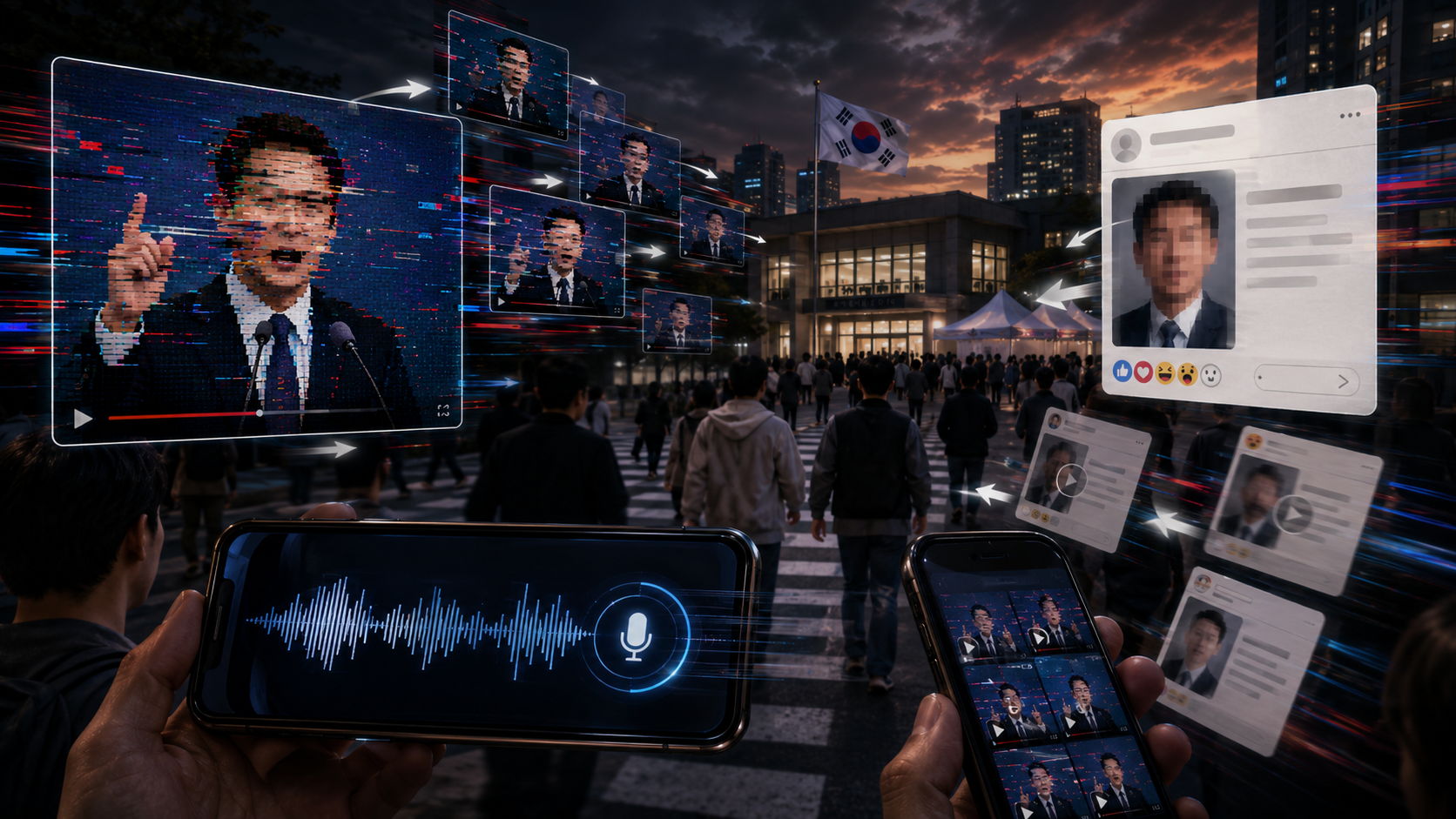
As the June 3 local elections approach, AI-generated campaign videos are testing not only election law but the public’s ability to pause before reacting.
South Korea’s June 3 local elections are becoming a stress test for a problem that now feels less like a future risk than a daily online habit: the political deepfake.
In earlier election cycles, manipulated political material was often treated as an exceptional scandal — something that appeared, was debunked, and then became part of a larger fight over truth. This time, the issue feels more ambient. AI-generated videos, edited campaign clips, synthetic images, and suspicious screenshots now move through feeds and chat rooms at the same speed as ordinary campaign gossip. By the time a clip is checked, many viewers may already have absorbed the emotional point it was designed to make.
That is why the current concern is not only whether a specific video is false. It is whether the online atmosphere around an election can harden before verification has time to catch up.
Korea JoongAng Daily reported that the National Election Commission had already requested the deletion of 8,832 deepfake-related posts connected to the June 3 local elections. More recent reporting, citing government and election-related figures, put the number above 10,000 by late May. Those figures should be read carefully: a takedown request is not the same as a final court finding. Still, the scale matters because it shows that authorities are no longer dealing with a handful of isolated fakes. They are dealing with a volume problem.
The timing also matters. These are local elections, but they are not politically minor. Local races decide governors, mayors, education officials, councils, and other offices that shape daily life. The national electorate is large, the political mood is tense, and online campaigning is fragmented across platforms. A misleading clip does not need to persuade the entire country to matter. It only needs to agitate a community, damage a candidate in a close race, or reinforce what people already wanted to believe.
The new election problem: believable enough, fast enough
Deepfakes do not always have to be perfect. In politics, a piece of manipulated content can work even when some viewers suspect it is fake. It may still raise doubt, produce ridicule, or force a campaign to respond on the defensive. The damage often happens in the interval between first exposure and correction.
That interval is now the central battlefield.
In Korea’s current election environment, the route from creation to circulation can be extremely short. A synthetic clip can be posted on a video platform, reshared in a group chat, copied into a short-form feed, discussed in an online community, and screenshot into another platform before any official response appears. The emotional logic of social media rewards speed, outrage, and recognition. Verification is slower by design.
This gives deepfakes two kinds of power. The first is direct deception: making voters believe that someone said or did something they did not say or do. The second is atmospheric damage: making voters feel that everything is potentially fake, every denial is strategic, and every correction is too late. In that second environment, even real evidence can lose force. A politician can dismiss authentic material as AI-generated, while supporters can ignore inconvenient facts by claiming manipulation. This is often called the “liar’s dividend,” and it may be as damaging as the fake content itself.
Korea already has strict rules — but rules are not the same as control
South Korea is not entering this election without legal tools. The Public Official Election Act restricts election campaigning using realistic AI-generated audio, images, or videos during the 90-day period before election day. Government public messaging has also warned that creating or distributing prohibited deepfake election material can carry serious criminal penalties.
That makes Korea one of the more aggressive democracies in trying to regulate AI-generated election content before it overwhelms the campaign environment. The government has also moved to support detection systems, interagency monitoring, platform cooperation, and rapid takedown procedures.
But the current surge shows the limits of a law-centered approach. Election enforcement still has to identify material, judge whether it falls within the prohibited category, contact platforms or service providers, and pursue warnings, complaints, or investigations where necessary. Meanwhile, users can repost, re-edit, translate, crop, meme, and redistribute the same material across private and semi-private channels.
A public ban can deter campaigns and organized actors. It is less effective against anonymous accounts, overseas users, impulsive sharers, and partisan networks that treat virality as the goal. Once content becomes a mood, deletion does not fully reverse it.
Why Korean online culture makes the issue sharper
Korea’s online ecosystem is especially sensitive to this kind of disruption because political and social narratives often travel across several layers of media at once. News outlets, YouTube commentary, short-form video, anonymous forums, large portal communities, KakaoTalk groups, Instagram reels, and screenshots of screenshots can all become part of the same attention cycle.
That structure creates a high-speed translation machine. A video does not remain just a video. It becomes a caption, a joke, a rumor, a reaction post, a debate topic, and then a signal of where people stand. By the time official information arrives, the clip may have already been converted into political identity.
This is where the anxiety becomes cultural rather than purely technical. Many users are not only asking, “Is this real?” They are also asking, “Can I trust my own reaction?” That is a much deeper problem. When people feel that every image could be synthetic and every denial could be manipulation, online participation becomes more defensive. People share faster but trust less. They accuse faster but verify less. The public sphere becomes louder and more brittle at the same time.
The free speech tension will not disappear
Strict deepfake rules also raise a real democratic tension. If the law is too narrow, malicious actors can exploit loopholes. If it is too broad, satire, parody, labeled AI content, artistic commentary, or legitimate political expression may be chilled.
That tension is already visible. Civil society voices have questioned whether Korea’s deepfake election provisions sweep too broadly by banning certain AI-generated campaign materials during the pre-election period even when the content is labeled or not necessarily false. Election integrity and freedom of expression are not easy to balance when technology makes realistic fabrication cheap and fast.
This is why the debate should not be reduced to a simple choice between “ban deepfakes” and “allow everything.” The more practical question is how to separate deceptive political manipulation from clearly labeled commentary, satire, or creative expression — and how to do that quickly enough during an election.
The hardest cases may not be the most obviously fake videos. They may be the ambiguous ones: a stylized AI image that flatters one candidate, a synthetic voice clip presented as humor, a manipulated video that mixes real footage with fabricated edits, or a misleading montage that is not technically a deepfake but has the same effect on voters.
What voters can do before June 3
The burden should not fall entirely on individual voters. Platforms, campaigns, regulators, and newsrooms all have more responsibility and more tools. But ordinary users still shape the speed of circulation. In the final days before the vote, the most useful habit may be hesitation.
A practical rule is simple: do not share a shocking political video immediately, especially if it appears without a clear original source. Check whether a reliable outlet has reported it. Look for the full context rather than a short clip. Be wary of posts that ask for instant outrage, instant ridicule, or instant certainty. When content seems designed to make verification feel unnecessary, that is exactly when verification matters most.
Campaigns also need to respond differently. A slow denial is often ineffective, but a panicked response can amplify the fake. The better response is rapid, specific, and source-based: identify what is false, provide the original context where possible, and avoid turning every manipulated post into a larger spectacle.
Newsrooms face a similar problem. Reporting on deepfakes is necessary, but repeating the manipulated content too vividly can spread the very material being debunked. The editorial challenge is to explain the stakes without becoming part of the distribution chain.
The deeper significance
The June 3 elections may become an important marker in Korea’s digital politics: the moment when AI manipulation stopped being a niche technology issue and became part of the ordinary election environment.
The danger is not only that voters will believe one fake video. It is that repeated exposure to synthetic political material will train people to experience politics as permanent suspicion. In that climate, truth still matters, but it arrives exhausted. Corrections still happen, but they feel late. Trust becomes harder to rebuild than outrage is to generate.
Korea’s response will be watched because the country combines intense electoral competition, high digital connectivity, active online communities, and unusually direct legal restrictions on election deepfakes. If enforcement works, it could offer a model for other democracies. If it struggles, it will show how difficult it is to govern political media when fabrication is cheap, distribution is instant, and belief is increasingly emotional.
For now, the clearest lesson is this: deepfakes are not only a technology problem. They are a tempo problem. They exploit the gap between how quickly people react and how slowly institutions verify. In an election, that gap can be decisive.


Leave a Reply