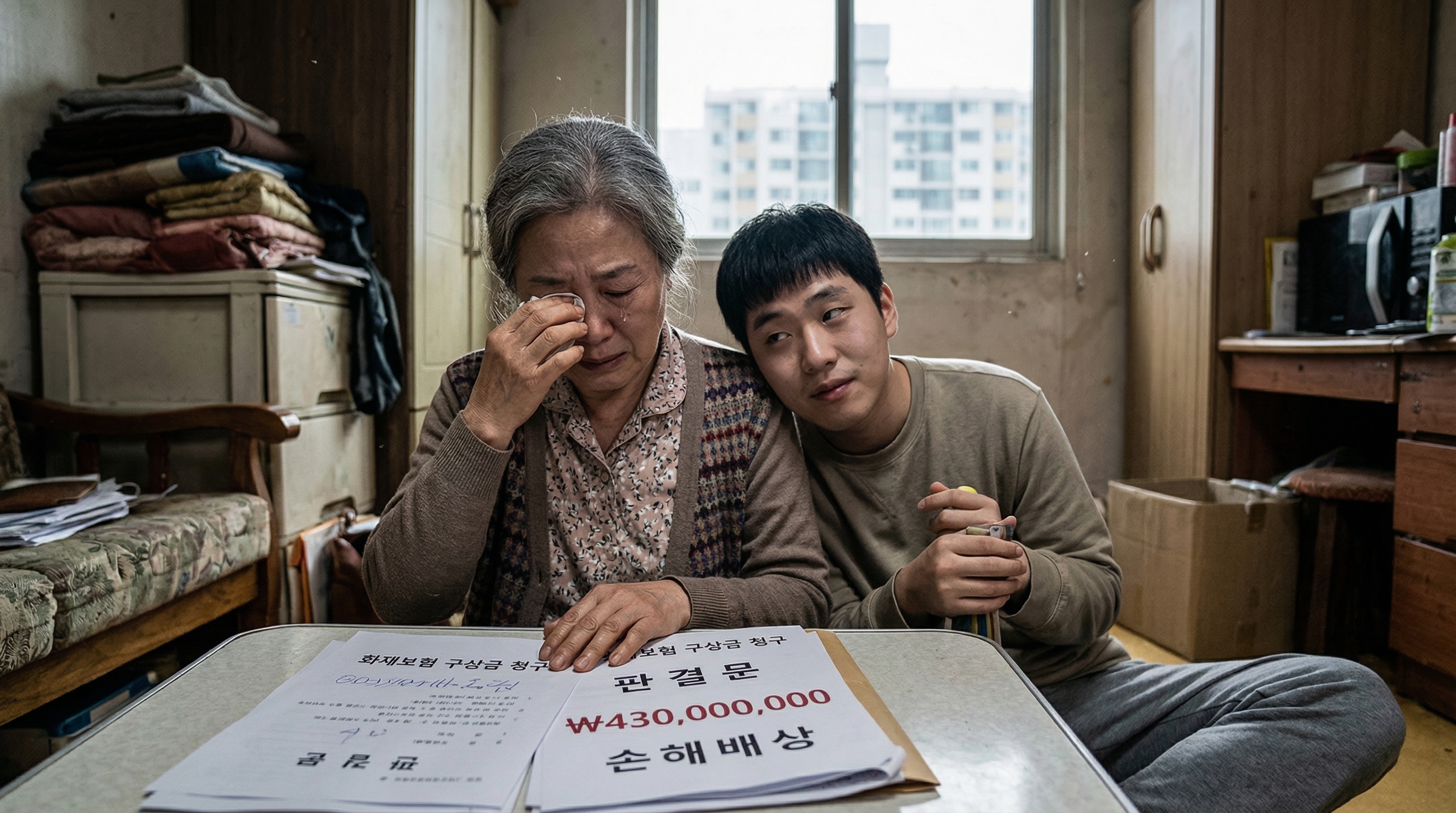
— and why the line “I need to find my disabled son a place to live before I die” is hitting so hard right now.
A Seoul courtroom has handed down a decision that reads, to many families, less like a legal judgment and more like a national message: if the system can’t catch your child, your household will.
The case centers on a 25-year-old autistic adult who set a fire in an apartment recycling area in October 2023, causing significant damage and injuries from smoke inhalation. A fire insurer later filed a subrogation lawsuit, seeking to recover what it paid out. The court ordered the parents to pay about ₩430 million ($300k), assigning them 30% liability on the logic that they were “protective obligors” and had breached a supervision duty given prior warning signs—while also noting, in principle, that responsibility cannot be left to parents alone.
Both sides have appealed. The ruling may change. But socially, the story has already done what big cases do: it has exposed a truth many people sensed, and forced it into daylight.
When “shared responsibility” is written in the judgment—but billed to the parents anyway
Even a “partial” liability share can become a life sentence when the number is nine digits. The deeper contradiction is not the existence of compensation—victims deserve that. The contradiction is who gets treated as the backstop when public supports are missing.
The ruling acknowledges that 24/7 control is unrealistic. Yet the financial burden lands on the family as if the family had the staffing, training, and infrastructure of an institution—without being given the tools an institution has.
That gap between expectation and reality is where anger—and fear—rush in.
“I want to find a place for my disabled son before I die”
Youth/housing anxiety has already become a defining Korean story. But for disability families, housing anxiety isn’t about preference, commute time, or even affordability alone.
It’s existential.
When readers repeat the line—“I want to find a place for my disabled son before I die”—they aren’t reacting to sentimentality. They’re reacting to a terrifying policy gap:
- If supported housing is scarce, a parent’s lifespan becomes the housing plan.
- If staffed community options are limited, “independence” becomes a risk parents are financially punished for.
- If respite and crisis response are thin, every escalation becomes a household emergency with legal consequences.
This is why the court ruling and the housing panic are not two separate issues. They are one story told in two genres: liability and mortality.
The thought parents don’t say out loud—until they do
There is an even darker sentence that sometimes circulates among exhausted caregivers, usually in whispers, usually wrapped in guilt:
Some parents find themselves thinking they hope their disabled child dies before they do.
This is not cruelty. It is not hatred. It is a form of despair—a catastrophic thought produced when a parent cannot imagine a safe adulthood for their child without them. It emerges in the same emotional territory as burnout, depression, and chronic fear: I can’t leave them; and if I’m gone, who will protect them?
A society should treat that sentence like a fire alarm.
Because when caregiving becomes so unsupported that death feels like the only “plan,” the problem is no longer individual resilience. It is public design. It is a policy system that has left families alone for so long that the future starts to look unlivable.
In rich countries, this is exactly the outcome policy tries to prevent
Wealthy societies tend to converge on a basic direction—even if execution is uneven:
- Victims deserve compensation.
- Families should not become insurers of last resort for an adult’s disability-related risks.
- If the state wants community living, it must build the infrastructure for community living—supported housing, respite, crisis response, case management, and continuity after hospital discharge.
Korea is economically capable of this. The question is political will—and administrative priorities.
Because if the national posture becomes: “We endorse inclusion, but when inclusion goes wrong, parents pay,” the predictable result is not safety. It is confinement. Families will be pushed toward the most risk-averse option: restricting freedom, avoiding community exposure, or institutionalizing earlier than they otherwise would—not from cruelty, but from survival.
The real scandal isn’t that a court looked for a responsible party
Courts are designed to assign responsibility after harm occurs. If a fire happened, people were hurt, and losses were paid, civil courts will ask: who could have prevented this? The insurer’s move—suing to recover its payout—is also a standard mechanism, not a uniquely Korean invention.
The scandal is something else:
A country can be globally competitive and still run its disability support system on private heroism.
And when private heroism fails, it converts into private liability.
That’s the flip Korea’s growth story still hasn’t made: from “families endure” to “the state builds.”
What a fairer system would look like (and why it’s cheaper than constant crisis)
If Korea wants fewer tragedies and fewer lawsuits, it needs boring, expensive-sounding things that are actually cheaper than repeated disaster:
- Supported housing with staffing tiers so adult living arrangements don’t hinge on parent survival.
- Real respite (predictable, frequent, accessible), not a waiting-list mirage.
- Specialized crisis response for developmental disabilities so families aren’t trapped between police, ERs, and “handle it at home.”
- Post-discharge scaffolding so “hospital in / discharge out” doesn’t just return risk to the same overwhelmed household.
- A compensation pathway that doesn’t bankrupt caregivers—catastrophic-loss pools, structured insurance mechanisms, or models that recognize shared public responsibility when public systems shape the options families actually have.
If those supports existed at scale, “supervision duty” would stop being a cruel legal fiction. It would become a realistic expectation backed by public infrastructure.
The headline Korea should fear
The loudest lesson of this case isn’t “parents should supervise better.” It’s this:
When the state doesn’t build a place for disabled adults to live, the courts will quietly build a bill for parents to pay.
And the sentences parents repeat—“I need to find a place before I die,” and the even darker thought they hate themselves for having—will keep spreading, not because they are dramatic, but because they are rational responses to an absence of support.
If Korea is wealthy enough to export culture, build megaprojects, and compete at the highest levels, it is wealthy enough to stop financing disability policy with fear—and stop sending families invoices for system failure.




Leave a Reply