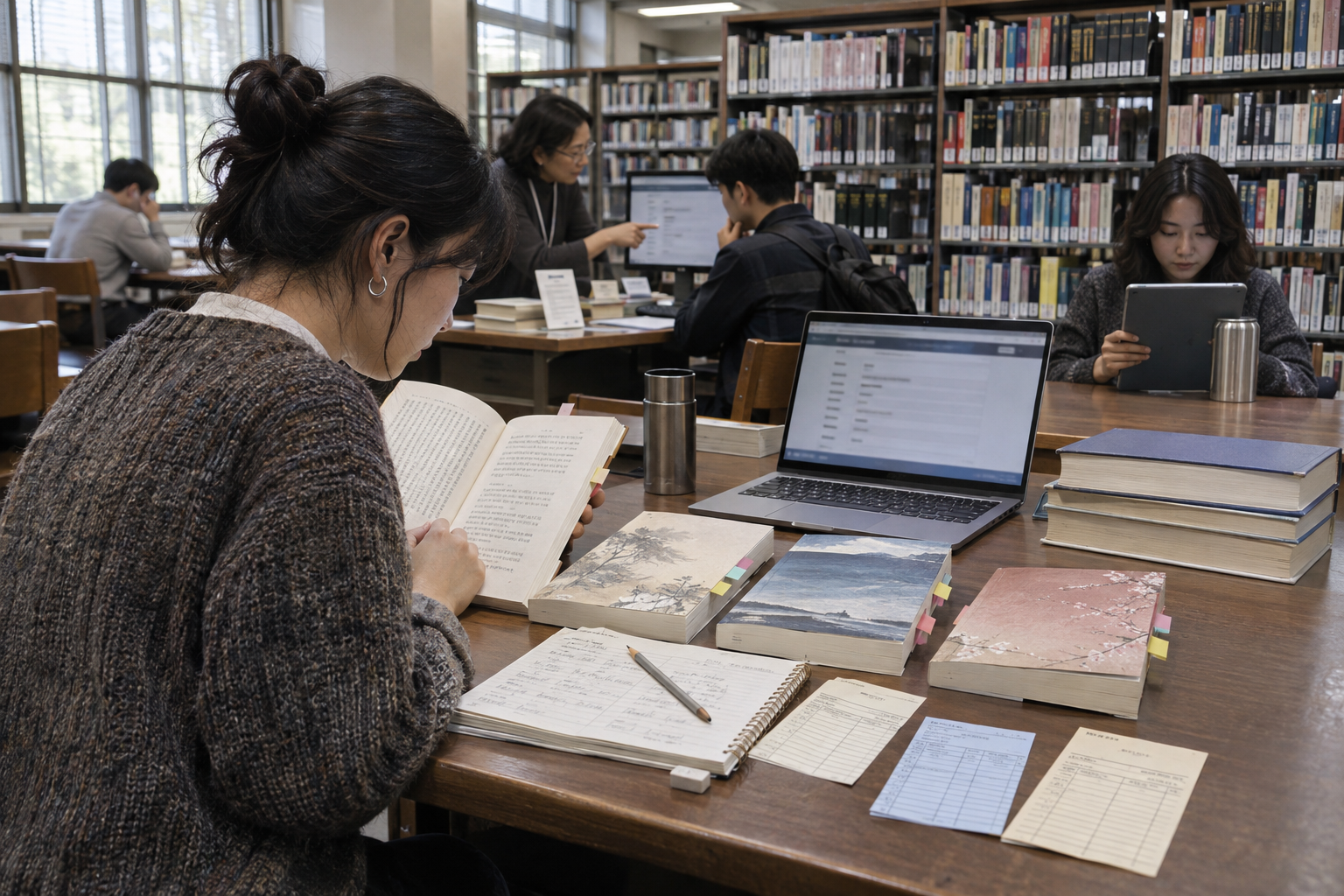
LTI Korea’s public database can confirm a translated title, language, translator, publisher and year. Its separate ebook shelf shows which works can actually be read online.
Finding a Korean book in translation often begins with an incomplete clue: an author’s name, a title seen in another language or a recommendation that does not identify the edition. A retailer search may return one translation, several editions or nothing at all.
The Literature Translation Institute of Korea offers a better starting point. Its Translated Books database is a public multilingual catalog built specifically around Korean literature in translation.
The useful part is not only the number of records. It is the bibliographic detail readers need to tell one edition from another.
Start with the author, not the remembered title
Translated titles change. A literal translation, an international publisher’s title and a retailer’s English rendering may all differ. Names can also appear under more than one romanization.
If a title search fails, search the author and narrow the results by language, country, publication period or classification. A record can identify the translated title, translator, publisher, year and source work. Those fields make it possible to check whether two listings are the same translation or different editions.
This is especially useful when a book has moved across markets. An English edition published in Britain may not share an ISBN, cover or subtitle with a later American edition. A French or Spanish translation may have appeared years earlier. The database lets the reader begin with the work’s translation history rather than the inventory of one shop.
Treat the record as verification, not availability
A catalog entry does not mean the book is currently in stock, still in print or legally available in every country. It confirms that a translation was published and provides the information needed to continue the search.
After finding the record, copy the translated title, translator and publisher into a library catalog or bookseller search. The translator is often the best disambiguating field. It can separate a new translation from a reissue and help a reader follow the work of a translator whose choices they trust.
The “availability” filter is useful, but it should not be read as a guarantee of immediate purchase. Distribution changes faster than a bibliographic database. Check the publisher’s page or a local library for the current status.
The ebook shelf is a different service
LTI Korea also maintains a separate ebook collection. It provides free online access to selected Korean literary works in dozens of languages.
The separation matters. The translated-books database is a discovery and verification tool. The ebook shelf is a reading collection. Not every cataloged translation is available as a free ebook, and readers should not assume that a database record includes the full text.
When a readable edition is available, the ebook page can be the fastest route to trying an author before locating a print edition. It is also useful for readers in places where Korean literature has limited local distribution.
Use the library profile to fill in context
The LTI Korea Library also gathers writer profiles, overseas press and multilingual materials. These can help when a title has little English-language coverage or when a reader wants to see how an author’s work has circulated outside Korea.
The profiles are not substitutes for criticism, and inclusion is not a recommendation. Their value is orientation. They can connect an unfamiliar title to an author’s other translated work, a genre or a publication history.
A practical search sequence
For a clean search, use this order:
- Search the author in the translated-books database.
- Filter by target language and, if necessary, country or publication period.
- Confirm the translated title, translator, publisher and year.
- Check the separate ebook shelf for a readable digital edition.
- Search the exact edition through the publisher, a library or a bookseller.
This sequence does not remove every obstacle. Older editions disappear, international shipping can be expensive and some translations were released in small print runs. It does prevent a common mistake: buying or requesting the wrong edition because two books share an approximate title.
Korean literature in translation is easier to find when the search begins with bibliographic evidence. A reliable record turns a recommendation into something a reader can identify, compare and actually locate.