Korea’s verified local-bookstore system turns a familiar phrase into an infrastructure category. The label can affect public programs, procurement and whether a community still has a place to encounter books in person.
“Local bookstore” sounds self-explanatory. In Korea, it is also an administrative category with consequences for which shops can participate in public programs and how cultural access is measured.
The Korea Publication Industry Promotion Agency, or KPIPA, runs a national verification process alongside certification systems operated by some local governments. A shop is not treated as local simply because it has a street address. The verification asks what kind of bookselling business it is and whether it serves readers as a physical, community-facing bookstore.
That distinction matters because a verified bookstore can be recognized in public support programs designed for local bookselling. It also gives policymakers a way to see where book access is thinning out.
A definition built around public access
KPIPA’s 2026 verification notice separates municipalities that already operate their own local-bookstore certification from places that rely on the national procedure. The agency also publishes a list of local ordinances, making clear that the system is a patchwork of national verification and municipal rules rather than one universal license.
The practical idea is more consistent than the paperwork: a local bookstore is a physical bookselling business embedded in a community, not a warehouse, a purely online seller or a business whose connection to ordinary readers is incidental.
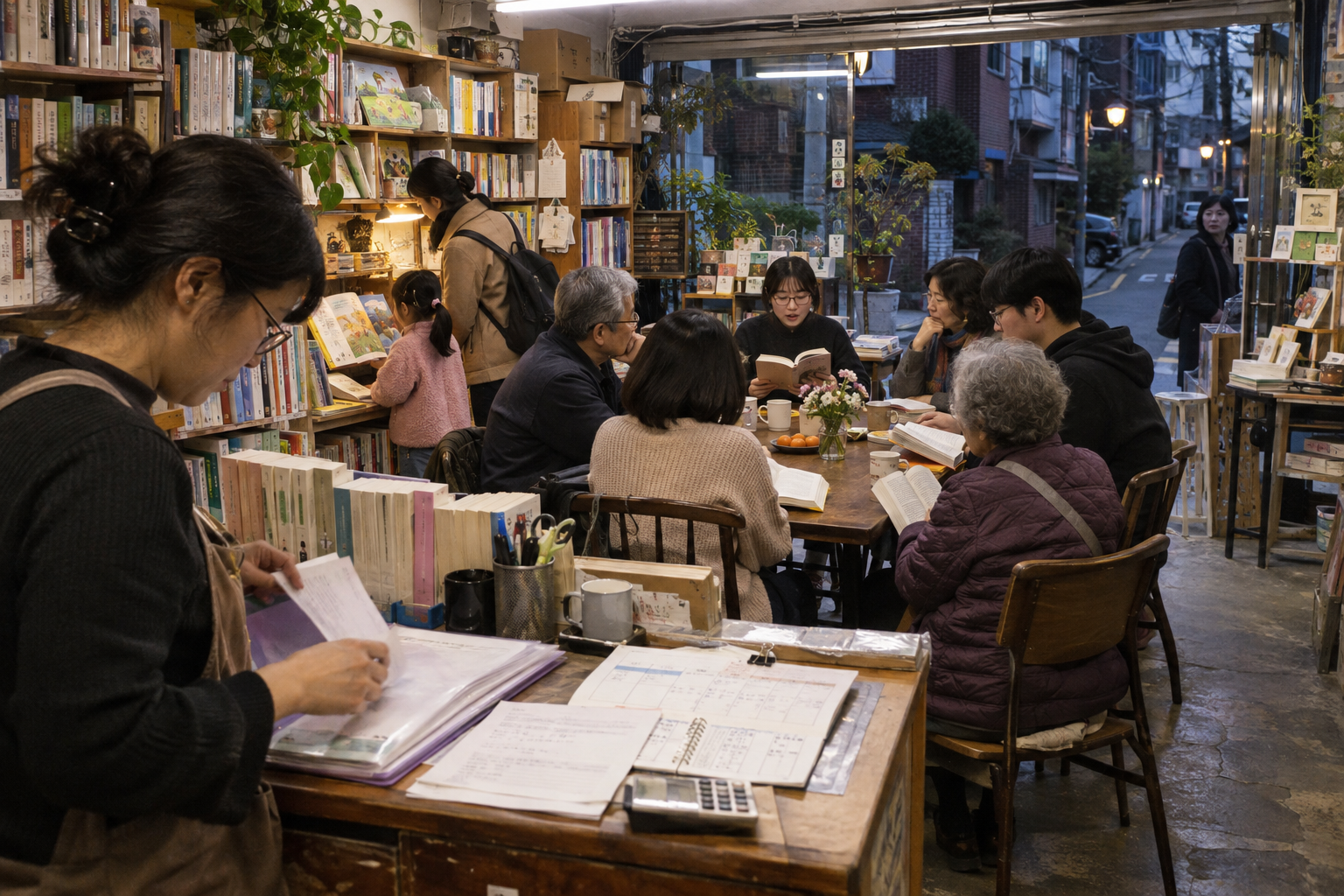
That makes the label less romantic and more useful. It can identify the shops able to host a reading, order a school title, recommend a small-press book or give a reader somewhere to browse without already knowing what to search for.
The map shows an access problem
KPIPA’s analysis of the 2024 local-bookstore survey counted 3,295 bookstores, then excluded 964 that did not meet the local-bookstore criteria. The resulting count was 2,331 qualifying local bookstores, or 4.55 per 100,000 residents nationally.
The national average hides sharp geographic gaps. The same analysis identified six counties—Imsil, Sunchang, Cheongsong, Bonghwa, Ulleung and Uiryeong—with no qualifying local bookstore.
For residents, that absence changes the cost of reading. Buying a book may require a longer trip or an online order. Browsing becomes an intentional purchase rather than a low-pressure encounter. Events, author visits and children’s programs have fewer natural hosts. A local library can cover part of that role, but a library and a bookstore do different work: one lends a public collection, while the other connects readers to what can be bought, gifted or brought into a household.
Bookstores are also cultural venues
KPIPA’s 2026 Life Reading × Life Bookstore program recruited 200 bookstores for cultural programming. The program’s structure reflects how policy increasingly treats these shops: not only as retailers, but as small public-facing venues where books organize conversation.
That role can be overstated. A bookstore remains a business with rent, staffing and inventory costs. Cultural programming does not remove those pressures, and verification does not guarantee survival. The category is valuable because it makes those pressures visible without pretending that every verified shop has the same model or resources.
What readers should take from the label
When a shop describes itself as a local bookstore, the useful questions are concrete. Does it maintain a physical bookselling space? Can readers visit during regular hours? Does it participate in a municipal certification or KPIPA verification system? Does it host programs, order books or work with nearby schools and libraries?
Those questions turn a pleasant phrase into evidence about access. The definition can influence public purchasing and program eligibility, but its deeper value is descriptive: it shows whether a neighborhood still has a front door through which an unfamiliar book can enter ordinary life.
Korea’s system does not settle every boundary. Municipal rules differ, and a verified category cannot capture the personality of an individual shop. It does, however, make one consequence measurable. A community with no qualifying bookstore has lost more than a retail outlet. It has lost one of the few places where reading can begin before a reader has chosen a title.