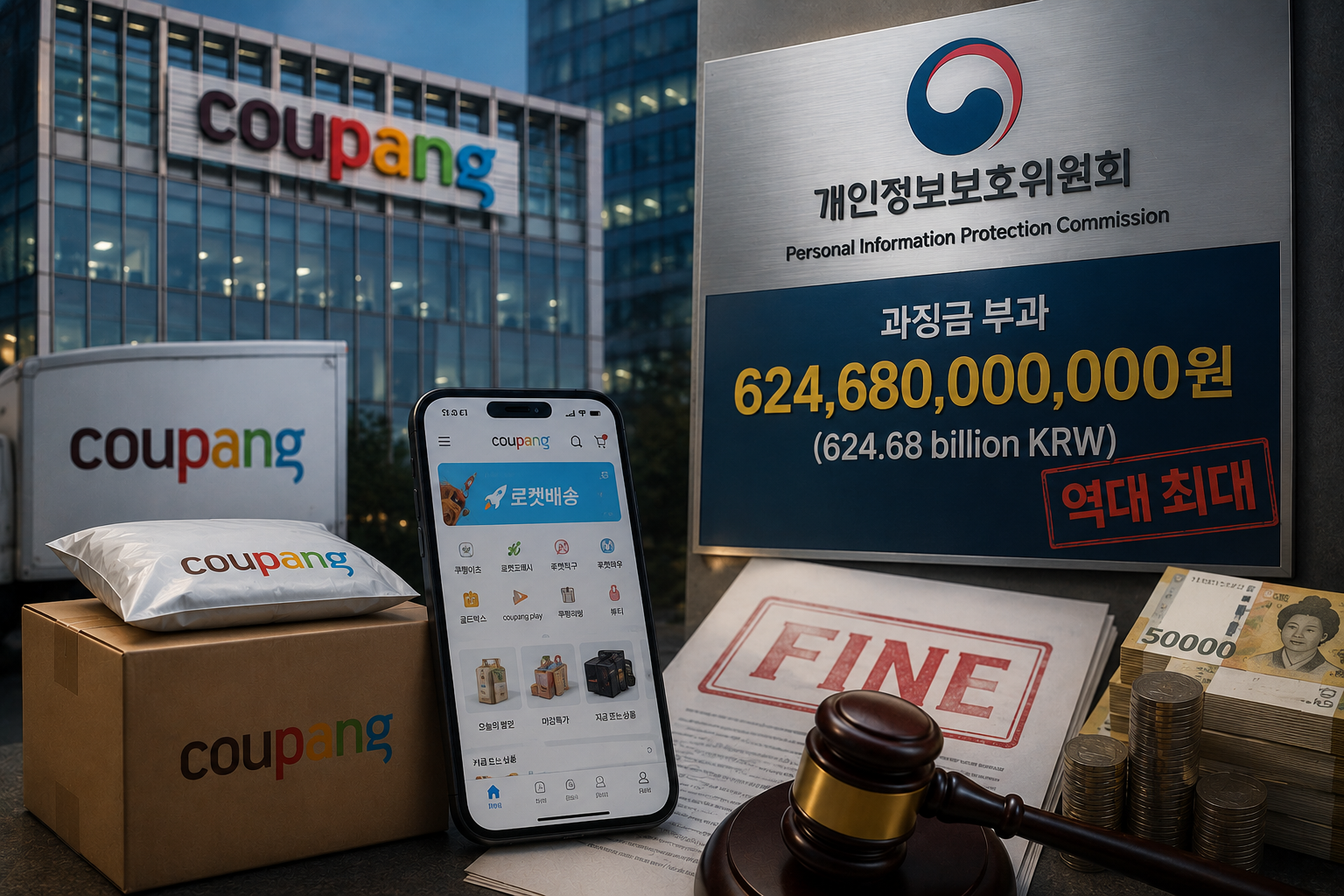
South Korea’s latest privacy reckoning is not only about a data breach. It is about the bargain that has shaped much of modern Korean digital life: faster delivery, easier ordering, tighter personalization, and less visible friction in exchange for ever-expanding amounts of personal data.
That bargain is now under pressure after South Korea’s Personal Information Protection Commission imposed a record 624.68 billion won penalty on Coupang, the country’s dominant e-commerce platform, over a massive data leak and unauthorized collection of user activity data. Korean reporting described the case as the regulator’s largest-ever sanction against a company, while English-language coverage framed it as the largest privacy fine in South Korean history.
The size of the penalty matters. But the public meaning of the case is larger than the number itself.
Coupang is not a marginal service. It is part of the operating system of everyday Korean life. For many households, it is where groceries are ordered, household goods are replenished, emergency purchases are made, prepared food is delivered, and routine consumption is compressed into a few taps. Its “Rocket” delivery model helped normalize the expectation that a product ordered at night should arrive by morning, and that the inconvenience of shopping, waiting, comparing, and planning could be absorbed by the platform.
That is exactly why the case resonates beyond business regulation. When a company becomes part of daily infrastructure, a privacy failure no longer feels like a distant corporate incident. It feels like a failure inside the ordinary systems people have come to depend on.
The regulator’s findings cut at two layers of trust. The first is security: whether a company holding vast amounts of personal information had adequate safeguards, access controls, and internal monitoring. The second is consent: whether users meaningfully understood and authorized how their activity data was collected and used.
Those are related problems, but they are not the same. A data breach can be framed as a failure to defend information. Unauthorized activity-data collection raises a broader question: whether the architecture of convenience was built around forms of surveillance that users did not fully see.
Together, the allegations make the Coupang case a referendum on both protection and permission.
For years, Korea’s platform economy has rewarded speed. E-commerce companies competed on delivery windows, inventory depth, app design, membership benefits, food delivery, streaming bundles, personalized recommendations, and logistics scale. Consumers benefited in obvious ways. A busy office worker could order groceries late at night. A parent could replace a school item before morning. A small household could rely on delivery as an extension of the pantry. A last-minute purchase could become a solved problem instead of a disruption.
Convenience became not a luxury, but a practical utility.
But convenience has hidden dependencies. It requires dense logistics, predictive systems, stored addresses, payment flows, device identifiers, browsing patterns, location information, customer profiles, delivery instructions, and a constant feedback loop between user behavior and platform optimization. The smoother the service feels, the more invisible the data system behind it becomes.
That invisibility is now part of the backlash.
Users are not only asking whether names, phone numbers, addresses, order information, or residential access details were exposed. They are also asking why so much information was stored, how long it remained accessible, who could reach it, whether access was properly revoked, and whether activity tracking had a lawful basis. The discomfort is not simply “my data leaked.” It is “how much of my life was being held, inferred, connected, and exposed in the first place?”
This is why the case is circulating not just as a technology or retail story, but as a public judgment on Korea’s convenience-first platform culture.
Coupang has indicated that it disagrees with aspects of the regulator’s decision and is expected to challenge the matter through legal proceedings. That process matters. The company is entitled to contest the findings, the penalty calculation, and the interpretation of its compliance obligations. The legal outcome may refine the boundaries of corporate responsibility in future data-protection cases.
But the cultural impact has already arrived.
The case has shifted from a technical incident into a broader question of platform trust. In a country where app-based services are deeply integrated into daily life, privacy is no longer an abstract policy concern. It is a household issue. It is a consumer issue. It is a labor issue for the workers who depend on the platform economy. It is a civic issue because personal data is now part of the infrastructure through which people move, shop, eat, pay, and communicate.
Korea is one of the world’s most digitally sophisticated consumer markets. Rapid mobile payment, delivery apps, online marketplaces, food delivery, platform memberships, streaming bundles, and real-time promotions are not novelties. They are ordinary parts of life. That sophistication gives Korean consumers enormous convenience. It also increases the scale of exposure when the same platforms become data chokepoints.
This is the contradiction at the center of the Coupang case: the services people rely on most are often the services that know the most about them.
For Coupang, the challenge is therefore not only regulatory. It is reputational and behavioral. A fine can be paid, challenged, reduced, or absorbed over time. Trust is harder to repair because it depends on a private calculation repeated by millions of users: Is this service still worth the risk?
Many people may continue using Coupang because the convenience is difficult to replace. That does not mean the damage is minor. Platform loyalty under constraint is not the same as trust. A user may keep ordering groceries while feeling uneasy. A household may maintain a membership because the alternative is inefficient. A customer may delete saved information, reduce activity, avoid certain features, or become more selective without leaving the service entirely.
In a convenience economy, distrust often appears not as mass abandonment but as friction returning to the relationship.
That matters because Coupang’s success was built on removing friction. The company trained users to expect that retail could be faster, smoother, and more dependable. The privacy scandal reverses part of that psychological achievement. It reminds users of the hidden systems behind the seamless interface. It reintroduces doubt at the exact point where the platform needs confidence.
This is also why the case extends beyond Coupang. Every major Korean platform now faces a sharper version of the same question: how much convenience can be built on data practices that users do not fully understand?
Regulators are signaling that scale can no longer be treated as a shield. If a company becomes essential enough to touch tens of millions of people, its privacy obligations become more serious, not less. The larger the platform, the greater the damage when controls fail. The more personalized the service, the stronger the need for clear consent. The deeper the integration into everyday life, the less acceptable it becomes to treat data protection as a technical back-office issue.
There is an industry lesson here. Fast service is no longer enough.
The next phase of platform competition may depend on whether companies can make privacy and security feel as reliable as delivery speed. That means stronger access governance, clearer consent flows, stricter data minimization, faster breach detection, simpler user notices, and a visible commitment to collecting less when less is enough. It also means moving away from the assumption that customers will accept vague data practices because the service is convenient.
For years, the consumer-facing promise of Korean platforms was speed. The emerging promise may need to be restraint.
That would be a major shift. The platform economy has often treated data as an asset to be accumulated: more signals, more targeting, more personalization, more prediction. But privacy regulation pushes in the opposite direction. It asks whether data collection is necessary, authorized, proportionate, secured, and limited. It asks whether companies can explain not only what they do with user information, but why they need it at all.
The Coupang case brings that tension into public view because the company is such a powerful symbol of Korean convenience culture. Coupang did not invent the pressures that made fast delivery appealing. Long working hours, dense urban living, small households, high mobile adoption, and intense time scarcity all helped create a market where frictionless ordering felt almost inevitable. Coupang succeeded because it understood those pressures and turned them into a logistics and platform model that millions of people found useful.
Now that same symbol is being reinterpreted.
The question is no longer only how quickly a package arrives. It is what kind of personal-information ecosystem makes that arrival possible.
For readers outside Korea, the case may look like another example of a major platform facing a data-protection penalty. Inside Korea, it carries a more intimate charge. This is not simply about whether one company violated privacy law. It is about whether the ordinary convenience of modern life has been built on a data bargain that users never fully negotiated.
That is why the record fine lands with such force. It turns privacy from a legal category into a cultural question. How much exposure is too much? How much tracking should be allowed in the name of personalization? How much risk should consumers tolerate because a service is useful? And when a platform becomes hard to live without, what does meaningful consent really look like?
Coupang’s future will not be decided by this fine alone. The company remains deeply embedded in Korean consumer life, and its services continue to solve real problems for millions of people. But the terms of trust have changed. The next test for Korea’s platform economy is whether convenience can be rebuilt around accountability, restraint, and clearer consent.
The lesson from Coupang’s record penalty is not that Koreans will suddenly give up digital convenience. They will not.
The lesson is that convenience is no longer enough to quiet privacy anxiety. In a market where platforms have become everyday infrastructure, trust must be engineered as carefully as speed.




Leave a Reply