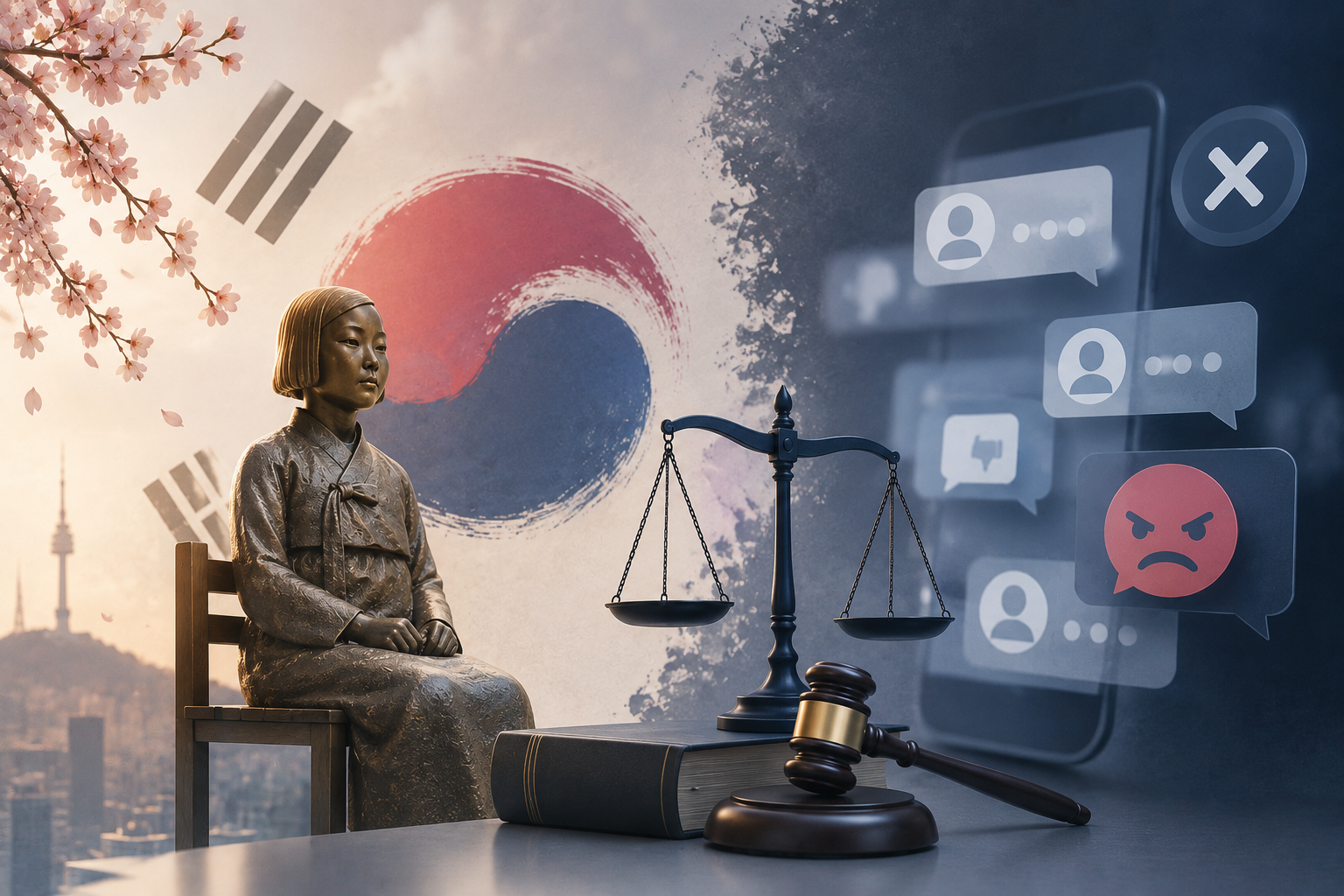
South Korea’s latest debate over online hate is not unfolding through one law, one website, or one historical dispute. It is emerging through a convergence of issues that have long been treated separately: the public defamation of Japan’s wartime military sexual slavery victims, the culture of online ridicule associated with far-right communities, and the unresolved question of how democratic societies should regulate platform-based cruelty.
A revised law that took effect on June 11 now allows criminal punishment for spreading false information that defames victims of Japan’s wartime military sexual slavery, often referred to by the euphemism “comfort women.” The penalties can reach up to five years in prison or a fine of up to 50 million won. The measure is aimed at repeated historical distortions and insults directed at the victims, especially claims that deny coercion or reduce survivors to degrading stereotypes.
At the same time, a separate proposal known informally as the “anti-Ilbe” bill has kept South Korea’s censorship-versus-hate-speech argument alive. The bill would push online platform operators to remove content categorized as derision or hate speech and could create stronger sanctions against operators that repeatedly allow such material to circulate. Ilbe, whose Korean name can be translated as Daily Best Archive, is not just one online forum in Korean discourse. It has become shorthand for a wider internet style built around humiliation, provocation, anti-democratic mockery, and attacks on victims of national trauma.
The two developments are legally different. One is an enacted victim-protection law focused on false claims about wartime sexual slavery victims. The other is a proposed platform-regulation measure focused on online hate and derision. But culturally, they are being read together because both ask the same larger question: when does speech stop functioning as argument and start functioning as organized harm?
A Narrow Law With a Much Wider Signal
The new comfort women law is narrow in its stated target. It does not ban all discussion of wartime history, nor does it prohibit academic, artistic, research, or journalistic activity. Its focus is the public spread of false information that defames victims and damages their dignity.
That legal distinction matters. South Korea is not simply criminalizing disagreement about history. The law is aimed at a specific pattern: public claims that present victims of Japan’s wartime military sexual slavery as liars, willing participants, or people undeserving of public honor. These claims have circulated not only in books and lectures, but also through rallies, livestreams, online posts, protest signs, and confrontations around memorial spaces.
This is why the law has drawn attention beyond legal circles. It treats denial not only as misinformation but as an attack on victims in the present. For survivors and their families, historical distortion is not an abstract argument. It can operate as a second injury, forcing victims to defend their testimony decades after their suffering became part of Korea’s public memory.
The measure also reflects a generational shift. As the number of surviving victims continues to decline, the responsibility for memory is moving from living testimony to institutions: archives, schools, civic groups, courts, memorials, and now criminal law. South Korea is preparing for a time when direct witnesses will no longer be able to answer denial themselves.
That is the deeper reason the law feels larger than its text. It is not only about punishing falsehood. It is about protecting the civic status of memory.
Why Ilbe Became the Symbol of a Larger Problem
The anti-Ilbe bill enters the debate from a different direction. It is not centered on the comfort women issue alone. Instead, it responds to a broader online culture in which derision of victims, regional hatred, misogyny, attacks on democratic movements, and jokes about tragedy have circulated as a form of group identity.
Ilbe has long occupied a symbolic place in Korean digital culture. To supporters, it has often been defended as an irreverent online community where taboo opinions can be expressed. To critics, it represents a toxic far-right style that turns social pain into entertainment. The site’s name has become a cultural label, used far beyond the site itself, for a kind of internet behavior built on provocation and plausible deniability.
That symbolic function is what makes the current proposal politically explosive. The debate is not only about shutting down or sanctioning one online community. It is about whether Korean platforms should continue treating hate as just another genre of engagement.
The proposed bill reportedly defines illegal derision and hate-related information as content that insults, mocks, degrades, disparages, or ridicules certain individuals or groups, including victims and bereaved families of national or social tragedies. It would require stronger action from operators and could allow sanctions when platforms knowingly allow repeated circulation of such content.
For supporters, this is overdue. They argue that organized hate is not ordinary speech and that platform operators should not profit from traffic generated by cruelty. For critics, the danger lies in vagueness. Terms such as mockery, hate, disparagement, and ridicule can be difficult to define with legal precision. A law written to punish cruelty could, if applied broadly, chill satire, political criticism, minority speech, or unpopular opinion.
That is the unresolved constitutional tension at the heart of the anti-Ilbe debate.
The Rise of Mockery Politics
The connecting thread between the comfort women law and the anti-Ilbe proposal is what can be called mockery politics.
Mockery politics is not simple criticism. It is a mode of political participation that turns humiliation into performance. It relies on coded language, altered slogans, inside jokes, gestures, memes, livestream stunts, and ambiguous references that allow participants to deny intent while still signaling contempt to an in-group.
In South Korea, this style has targeted many subjects: victims of the May 18 Gwangju democratic uprising, families of the Sewol ferry disaster, women, migrants, people with disabilities, regional communities, political opponents, and victims of wartime sexual slavery. The content often avoids direct threats. That makes it harder to regulate. But its social function is clear: it turns pain into a bonding ritual.
This is why many Koreans see the debate as larger than Ilbe or any single far-right community. The question is whether the country’s digital spaces have normalized a participatory cruelty that no longer stays online. A meme becomes a rally sign. A coded insult becomes a corporate controversy. A fringe gesture becomes a public performance at a memorial site. A denialist claim becomes a video, a lecture, or a fundraising tool.
The boundary between online subculture and public politics has collapsed.
Memorials Are Now Media Battlegrounds
The politics of comfort women memory shows this most clearly. The Statue of Peace, the memorial figure associated with victims of Japan’s wartime military sexual slavery, is not only a statue. It is also a media object.
Supporters photograph it, clean it, gather around it, and use it to teach younger generations. Opponents target it precisely because it is visible and emotionally powerful. Any confrontation around the statue can be turned into content: a livestream, a short-form video, a protest clip, or a viral argument.
This is one reason the comfort women law specifically matters in the platform era. Historical denial no longer travels only through formal publications or academic claims. It travels through networked spectacle. A false statement can be repeated across social media, rallies, online forums, video platforms, and public events until it becomes a recognizable political signal.
The new law acknowledges that reality. It treats public defamation of victims as something that moves across formats. The anti-Ilbe proposal goes one step further by asking whether platforms themselves should bear responsibility when they repeatedly host similar forms of degradation.
Together, the two developments suggest that South Korea is beginning to treat memory abuse as a networked act rather than a series of isolated comments.
The Free Speech Problem Is Real
The case for regulation is emotionally powerful, but the free speech problem cannot be dismissed.
Democracies depend on the ability to criticize institutions, challenge historical narratives, and express unpopular views. A society that gives the state too much authority to decide which interpretations are acceptable risks turning memory into an official doctrine. That danger is especially serious in polarized political environments, where today’s anti-hate law can become tomorrow’s tool against dissent.
This is why legal precision matters. The comfort women law includes exemptions for legitimate artistic, academic, research, and reporting activity. That carve-out is essential. Without it, the law would be vulnerable to criticism that it punishes inquiry rather than harm.
The anti-Ilbe bill faces an even harder test. A platform law aimed at derision and hate must define its terms carefully. It must distinguish between harassment and criticism, between victim mockery and political satire, between organized abuse and ordinary disagreement. If it fails to do so, it may strengthen the very argument its critics are already making: that hate-speech regulation can become censorship by another name.
The challenge is not choosing between dignity and freedom. The challenge is designing a framework that protects both.
Platform Responsibility Is the Next Frontier
The most important shift in the anti-Ilbe debate is the focus on operators, not only individual users.
For years, online hate has often been treated as a user behavior problem. Someone posts something offensive, the platform reacts or does not react, and the controversy moves on. But South Korea’s current debate asks a more structural question: what if the platform’s business model depends on the repeated circulation of mockery and hate?
This is where the issue becomes part of a global platform-governance debate. Social media companies, forums, video platforms, and online communities do not merely host speech. They organize attention. Their design choices shape what spreads, what is rewarded, and what becomes culturally visible. If outrage and humiliation generate traffic, platforms may have little incentive to intervene unless law or public pressure forces them to.
Supporters of stronger regulation argue that operators should not be able to hide behind neutrality while profiting from abuse. Critics argue that forcing platforms to remove vaguely defined content will lead to over-removal, political pressure, and private censorship.
Both concerns are legitimate. But the status quo is no longer politically stable. South Korea’s current debate suggests that platform neutrality is losing credibility when platforms become repeat venues for attacks on victims and marginalized groups.
Why This Debate Is Especially Korean
The issues involved are global, but the Korean context is specific.
South Korea’s online communities have long shaped political language, fandom culture, gender conflict, election discourse, and youth identity. Digital spaces are not secondary to Korean public life; they are central to it. Online jokes can become newsroom subjects. Community slang can become corporate risk. Platform controversies can enter presidential politics.
At the same time, South Korea’s modern history gives mockery politics unusually sensitive targets. The country’s democratic identity is tied to memories of authoritarian violence, colonial trauma, labor struggle, student movements, state failure, and national tragedy. When online communities mock these events or their victims, the insult is not received as ordinary offensiveness. It is read as an attack on the moral foundations of the republic.
That is why the comfort women law and the anti-Ilbe bill resonate beyond their immediate legal content. They are part of a larger effort to decide what kind of speech a democratic society must tolerate, and what kind of repeated cruelty it must refuse to normalize.
The Risk of Overreach
The strongest argument against these measures is not that hate speech is harmless. It is that the state may not be the safest institution to define and punish it.
If the law is too vague, enforcement may become selective. If sanctions are too broad, platforms may remove lawful speech to avoid liability. If site shutdown powers are used aggressively, users may migrate to harder-to-monitor spaces, including overseas-hosted sites or encrypted communities. A symbolic shutdown may satisfy public anger while doing little to address the underlying culture.
There is also a risk that anti-hate regulation becomes politically performative. Governments may target notorious communities while leaving broader structural problems untouched: misogyny, regional prejudice, disability discrimination, migrant hostility, anti-LGBTQ rhetoric, and the algorithmic amplification of outrage.
A serious anti-hate framework cannot be built only around punishment. It requires platform transparency, clear reporting systems, independent oversight, digital literacy, victim support, and anti-discrimination protections. Without those, the law may punish symptoms while leaving the ecosystem intact.
The Case for Drawing a Line
Still, the argument for action is also strong.
A society does not protect free expression by pretending all speech has the same social function. A survivor’s testimony and a campaign to call that survivor a liar are not equivalent. A political joke and a coordinated attempt to humiliate victims of disaster are not the same. A controversial opinion and repeated degradation of a vulnerable group do not produce the same harm.
South Korea’s emerging anti-hate debate is an attempt to make those distinctions legally and culturally visible. The comfort women law draws a line around false claims that defame victims of wartime sexual slavery. The anti-Ilbe proposal attempts to draw a wider line around platform-enabled hate and derision. Whether that second line can be drawn with enough precision remains the central question.
What is clear is that the old approach is breaking down. Telling victims, families, and targeted communities to simply ignore online cruelty no longer works when that cruelty is designed for circulation, monetization, and political performance.
A Test for Korean Democracy
The real test for South Korea will be whether it can build an anti-hate framework that is democratic, precise, and durable.
That means protecting victims without criminalizing good-faith scholarship or reporting. It means holding platforms accountable without giving the state unchecked power to suppress unpopular speech. It means recognizing the difference between offensive expression and organized humiliation. It means refusing to let far-right mockery define the limits of public discourse, while also refusing to let anti-hate politics become an excuse for censorship.
The comfort women law and the anti-Ilbe bill belong to the same moment because they both confront a hard truth: online hate is no longer just online, and mockery is no longer just a joke. It has become a form of political participation, a platform economy, and a weapon against memory.
South Korea is now asking where the democratic line should be drawn. The answer will shape not only one website or one historical issue, but the future of Korean digital public life.



Leave a Reply