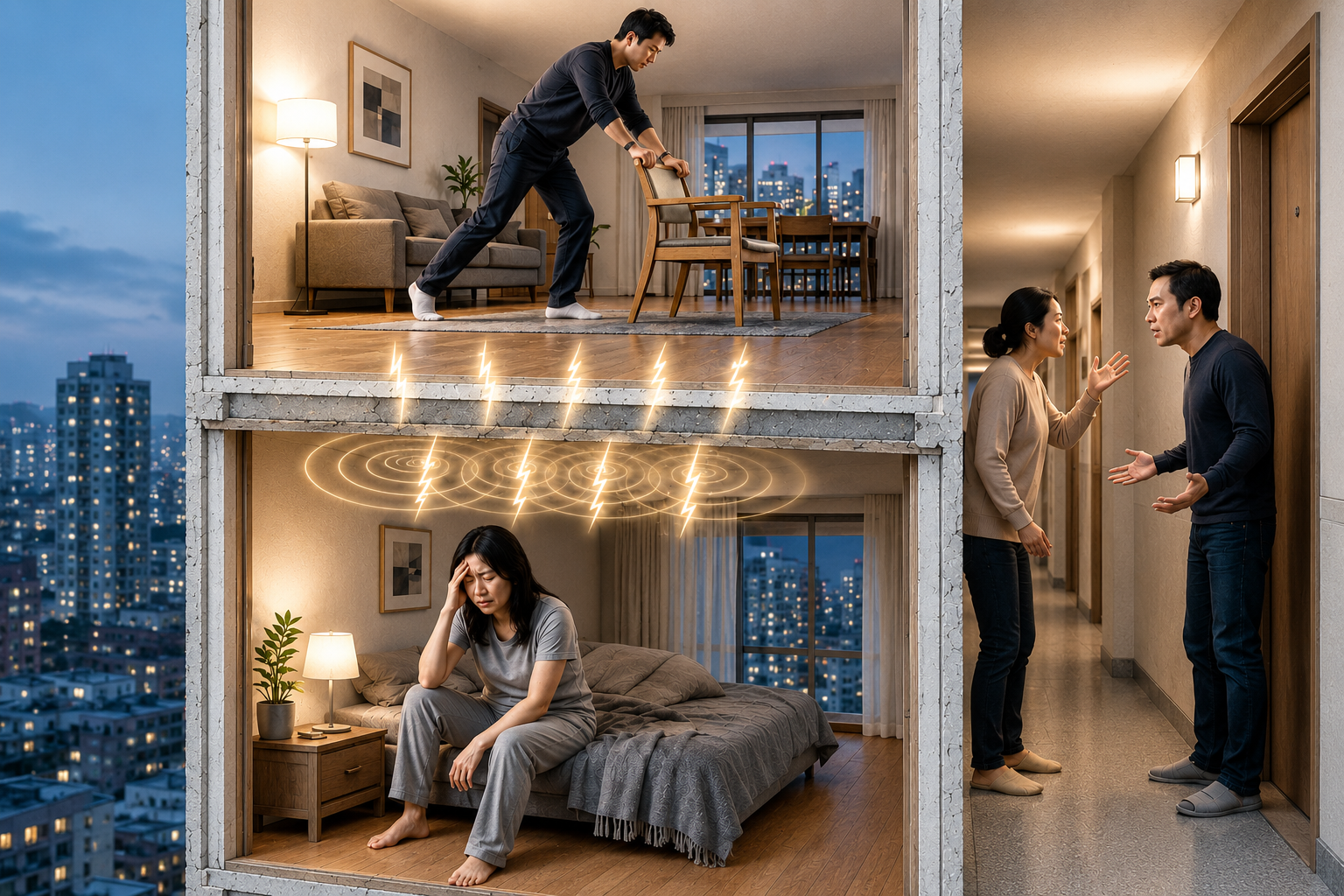
Apartment noise disputes in Korea are not new, but they have become one of the country’s most revealing everyday social issues. What may begin as the sound of footsteps, a child running, a chair scraping, or a late-night thud can quickly turn into something much larger: a debate over parenting, housing quality, emotional stress, neighbor etiquette, and the limits of tolerance in dense urban life.
The reason these disputes keep going viral is simple. They are ordinary enough for almost everyone to understand, but personal enough to make people angry. Unlike celebrity scandals or political controversies, apartment noise is not distant. It happens inside the home, in the place where people expect rest, privacy, and control.
In Korea, this issue has special force because apartment living is central to modern housing culture. According to the 2024 Population and Housing Census, 53.9% of general households lived in apartments, making apartment life a majority experience rather than a niche one. That means disputes over sound are not just private inconveniences. They are a mass urban experience shaped by how millions of people live side by side, above and below one another.
Why Apartment Noise Feels So Personal
The most recognizable issue is inter-floor noise, meaning sound that travels between floors in multi-unit housing. In Korean apartment life, this often refers to impact sounds such as running, jumping, heavy walking, furniture dragging, or objects being dropped.
But the emotional problem is larger than the sound itself. Noise from another household can make people feel that their private space has been invaded. A person may be inside their own home, but still feel controlled by someone else’s habits upstairs, downstairs, or next door. This is why apartment noise can produce a level of anger that seems disproportionate to outsiders.
A loud step is not always heard as just a loud step. It may be interpreted as carelessness, disrespect, bad parenting, or deliberate provocation. On the other side, the household accused of making noise may feel unfairly attacked for ordinary living sounds. Parents may argue that children cannot be expected to move silently. Elderly residents may say they cannot control every footstep. Tenants may blame building design rather than personal behavior.
This is what makes the issue socially explosive: both sides can feel wronged at the same time.
The Data Shows a Persistent Social Problem
Official data supports the idea that apartment noise is more than an occasional complaint. According to Korea Environment Corporation data reported in 2026, there were 102,124 inter-floor noise consultations from 2023 to 2025. Annual consultations remained high: 36,435 in 2023, 33,027 in 2024, and 32,662 in 2025.
The most common complaints are often the most ordinary sounds. Reports based on the same Korea Environment Corporation data found that running and walking sounds were the leading source of complaints, with 15,254 cases over three years. This matters because the most disputed noises are not always extreme behaviors like loud parties or construction. They are often the basic sounds of daily life.
That is precisely why the conflict is so difficult to resolve. If the problem were only loud music at 2 a.m., the moral line would be clearer. But when the problem is walking, children playing, or routine movement, the dispute becomes a question of how much ordinary life one household is allowed to impose on another.
The Legal Category Is Narrower Than the Public Debate
Public discussion often groups many apartment frustrations together: upstairs footsteps, barking dogs, renovation noise, loud voices, washing machines, children running, and furniture being moved. Socially, these all feel like “neighbor noise.” Legally, however, Korea treats the issue more narrowly.
Korean guidance defines regulated inter-floor noise as noise generated by residents’ activities in multi-family housing that harms other residents, including some noise between adjacent homes. It generally distinguishes between direct-impact noise, such as running or walking, and airborne noise, such as television or audio equipment.
This distinction matters because not every annoying sound is handled under the same framework. Voices, pet noise, and remodeling noise may be experienced as part of the same apartment-life problem, but they are not always treated identically under inter-floor noise rules. The result is a gap between public emotion and formal procedure. Residents may feel harmed, but the available legal or administrative path may not match the way they experience the problem.
Current Korean standards also show how technical the issue becomes once it enters official channels. The strengthened direct-impact noise standard lowered the one-minute equivalent sound level from 43 decibels during the day and 38 decibels at night to 39 decibels during the day and 34 decibels at night. What feels like a personal conflict is therefore translated into measurement periods, decibel thresholds, and categories of sound.
For residents, that process can feel unsatisfying. A person who has lost sleep for months may not care whether the sound meets a technical definition. They care that home no longer feels peaceful.
Why These Stories Go Viral Online
Apartment noise posts spread quickly on Korean online communities because they invite public judgment. A post usually presents a small domestic scene: an upstairs family with children, a downstairs neighbor leaving angry notes, a resident banging on the ceiling, someone installing a speaker in retaliation, or a management office refusing to intervene.
Readers are then asked, implicitly or explicitly, to decide who is wrong.
That judgment structure is what makes these posts so shareable. The details are familiar, but the moral answer is rarely simple. Was the upstairs household inconsiderate, or was the downstairs neighbor too sensitive? Was the complaint reasonable, or did it become harassment? Should parents control children more strictly, or should neighbors accept that apartments are not silent spaces? Should the construction company be blamed? Should the building management office have acted sooner?
The comment section often becomes a courtroom for modern apartment life.
This is also why the issue is so emotionally charged. Apartment noise is not just about sound. It becomes a proxy debate about fairness. People ask whether residents have become too selfish, whether parents are failing to teach consideration, whether older buildings were poorly built, whether new luxury apartments are overpromising comfort, and whether Korean urban life has become too compressed for people to treat one another generously.
Holiday Spikes Reveal the Family-Life Dimension
Apartment noise also becomes more visible during family holidays. Reports based on Korea Environment Corporation data found that complaints after the Lunar New Year holiday exceeded those after the autumn harvest holiday every year from 2023 to 2025.
This pattern is socially revealing. During holidays, more people gather indoors. Children visit relatives. Families stay home longer. Meals, movement, and late-night conversations increase. The home becomes more active, and the building absorbs the sound.
For one household, this may be normal family life. For another, it may mean several days of noise, disrupted sleep, and rising frustration. The same event can be interpreted as warmth by one family and intrusion by another.
This is one of the central tensions in apartment living: private family life does not stay fully private. In dense housing, one household’s celebration, parenting style, or daily rhythm can become another household’s stress.
Retaliation Is Becoming Part of the Debate
Another reason apartment noise attracts attention is that disputes can escalate. Some residents respond to noise with direct confrontation, angry notes, repeated intercom calls, ceiling banging, or retaliatory sound.
Recent reporting has highlighted the rise of suspected intentional hammering-type retaliation. One 2026 report said complaints involving hammer-like sounds rose from 729 cases in 2023 to 1,223 in 2025, an increase of about 68%.
This escalation changes the nature of the issue. The original noise may be accidental or ambiguous, but retaliation is often interpreted as intentional. Once residents believe the other side is acting deliberately, the conflict becomes far harder to mediate.
At that point, the dispute is no longer simply about reducing sound. It becomes about restoring trust, and trust is much harder to measure than decibels.
Government and Local Authorities Are Treating It as a Management Problem
One important shift in 2026 is that apartment noise is increasingly being treated not only as a private dispute, but as a building-management and governance issue.
In Gyeonggi Province, officials announced in April 2026 that 1,377 out of 1,510 eligible apartment complexes, or 91.2%, had established inter-floor noise management committees. These committees became mandatory for apartment complexes with 700 or more households after a related legal revision in October 2024. Their role includes hearing complaints, checking facts, supporting voluntary mediation, and providing prevention education.
This policy direction is significant. It suggests that authorities recognize a simple truth: telling neighbors to “work it out” is often not enough. By the time people file complaints, emotions may already be high. A neutral structure inside the apartment complex can help prevent disputes from becoming personal battles.
Busan has also announced a broader apartment management plan that includes consulting on inter-floor noise disputes, conflict support, and prevention-oriented apartment management. This shows that the issue is being absorbed into a wider conversation about how apartment communities should be governed.
Construction Quality Is Part of the Conflict
The public often frames apartment noise as a manners problem, but construction standards are just as important. Residents may blame one another because the neighbor is visible, while the building structure is not. Yet poor sound insulation can turn ordinary movement into a serious disturbance.
This is why recent policy has also focused on builders. In 2026, construction firms were preparing for stricter post-completion noise checks. Reports said that if new apartments fail to meet the standard level in post-verification procedures, local governments can require corrective construction or damages.
That changes the moral frame. If a building transmits normal footsteps too easily, the problem cannot be solved only by asking residents to tiptoe. The issue belongs partly to developers, construction companies, regulators, and housing policy.
This is one reason online debates become so broad. A single complaint about an upstairs neighbor can quickly become a discussion about apartment design, floor thickness, construction shortcuts, and whether buyers are receiving the quality they were promised.
The Issue Is Expanding Beyond Traditional Apartments
Although apartments remain the center of the conversation, Korea’s noise problem is not limited to large apartment complexes. Smaller multi-unit housing, studio-style residences, low-rise multi-family buildings, and mixed-use studio-style buildings often face similar problems.
This matters because some residents outside traditional apartment complexes have historically fallen into weaker protection or mediation systems. In 2025, the Ministry of Environment expanded noisy-neighbor mediation to some non-apartment housing in the Seoul metropolitan area, including low-rise multi-family buildings, mixed-use studio-style buildings often used as residences, and other multi-family homes.
That expansion reflects a broader reality: Korea’s shared-housing stress is not only vertical. It is also horizontal. People hear neighbors through walls, hallways, bathrooms, windows, and shared building systems. In small units, even modest noise can feel intimate and invasive.
For young adults, students, and single-person households, this kind of noise can be especially stressful. A small room is not just a bedroom; it may be a workplace, study space, dining area, and private refuge all at once. When that space is acoustically exposed, the resident may feel that there is nowhere to withdraw.
Apartment Etiquette Has Become a Social Code
Because legal enforcement is limited and mediation can be slow, etiquette plays a major role. Korean apartment culture has developed strong expectations around indoor behavior: using floor mats for children, avoiding heavy footsteps late at night, not dragging furniture, controlling pets, limiting late-night appliances, warning neighbors before renovations, and responding politely to complaints.
These expectations are not just about politeness. They are survival rules for dense living.
The difficulty is that etiquette depends on shared norms, and shared norms are weakening. One household may believe it is already being careful. Another may believe the same behavior is intolerable. A parent may see children’s movement as unavoidable. A downstairs neighbor may see repeated running as negligence. A night-shift worker may need daytime quiet while others assume daytime sound is acceptable.
Apartment life forces strangers to negotiate standards without necessarily having a relationship. That is why small incidents can become hostile so quickly. Without trust, every sound becomes evidence.
Why the Online Reaction Is So Intense
The viral power of apartment noise comes from recognition. Readers do not need specialized knowledge to understand the conflict. They can immediately imagine lying in bed while hearing footsteps overhead, or trying to keep a child quiet while a downstairs neighbor complains.
These stories also allow people to express a larger frustration with Korean urban life. Many residents feel squeezed by housing prices, long work hours, family pressure, and limited personal space. In that context, noise becomes a symbol of lost control. The home is supposed to be the one place where a person can recover. When even that space feels unstable, anger builds quickly.
This is why apartment noise can feel more emotionally intense than its physical volume might suggest. The sound is the trigger, but the deeper issue is the right to rest.
Conclusion: A Small Sound With a Large Social Meaning
Apartment noise in Korea keeps going viral because it captures one of the central contradictions of modern urban life. Apartments offer convenience, security, access to schools and transit, and a familiar model of middle-class stability. But they also require people to live extremely close to strangers whose habits, schedules, families, and mistakes can pass through floors and walls.
The conflict is therefore not only about noisy neighbors. It is about the fragile boundary between private life and shared life. It is about whether dense housing can still provide rest. It is about how much responsibility belongs to individuals, how much belongs to construction companies, and how much belongs to the systems that manage apartment communities.
The popularity of these disputes online shows that apartment noise has become one of Korea’s clearest everyday examples of social stress. It is ordinary, repetitive, and deeply personal. A footstep, a chair, or a child running across the floor can become a viral debate because behind the sound is a larger question: in a crowded city, what does it mean to feel at home?



Leave a Reply