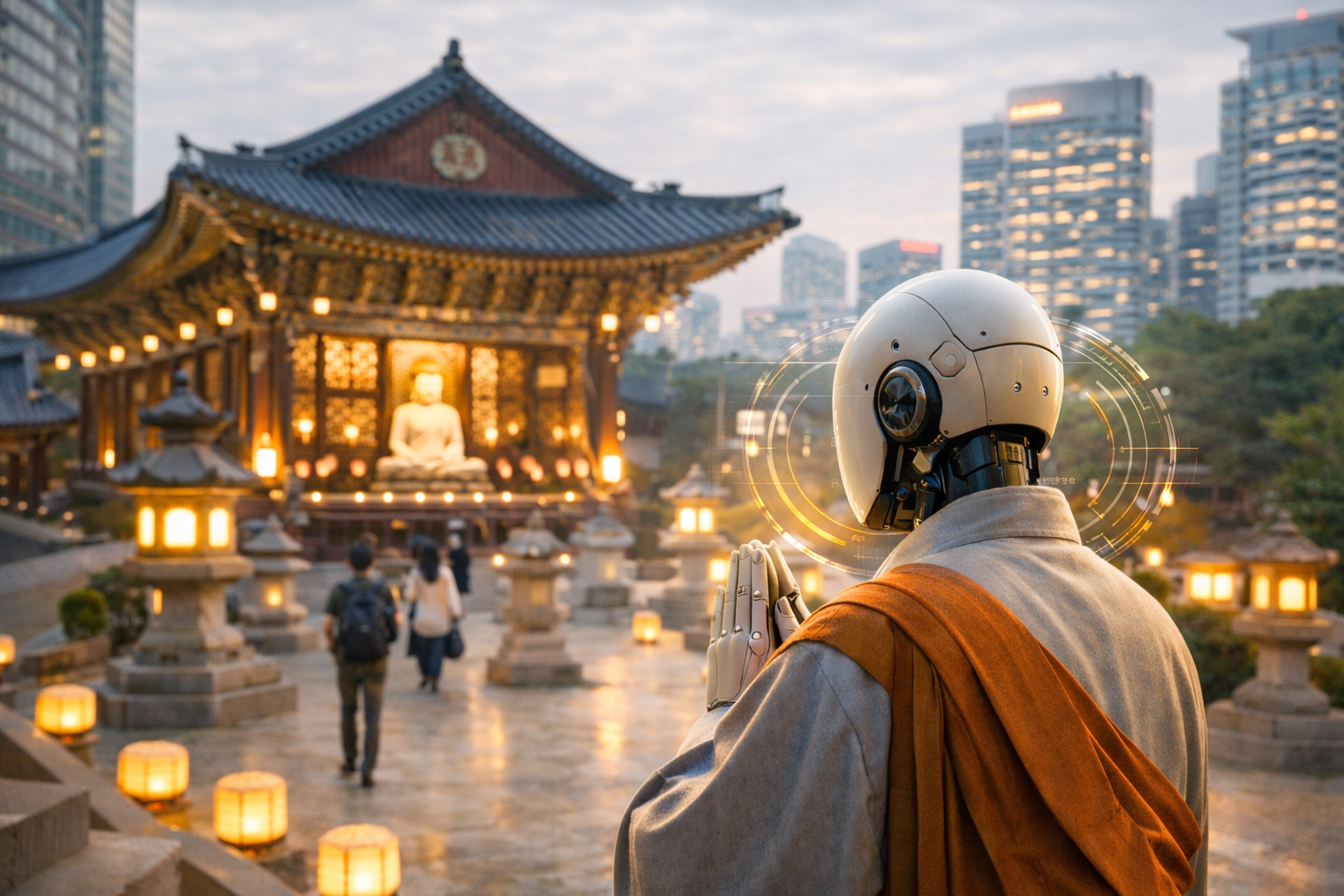
In South Korea, even the temple gate is becoming an interface.
That is the cultural backdrop to Ven. Hyean, an AI-powered “robot monk” that has drawn attention in Korean media after appearing at Bongeunsa, one of Seoul’s best-known urban temples. In local reporting, Hyean is presented not as a replacement for clergy, but as a new kind of temple guide: a machine that can greet visitors, explain basic Buddhist etiquette, answer simple questions, and assist foreign guests in English.
On the surface, it is an irresistible headline. A robot monk in one of the world’s most technologically saturated societies practically writes itself. But the deeper story is not the novelty. It is what this project reveals about contemporary Korea, where AI is increasingly normalized not only as a productivity tool, but as a social presence woven into daily life, public service, and now spiritual outreach. That broader framing is visible in Korean Buddhist discussions about the arrival of AI in everyday religious language and practice.
According to Korean reports, Hyean was developed by Dongguk University as part of an effort to create a practical AI Buddhist guide. BTN reported that the robot can help with visitor guidance, support basic understanding of Buddhist teachings, and provide simple information, with the added advantage of being usable even in places with limited internet access. In a later on-site demonstration at Bongeunsa, Korean media described Hyean greeting monks with palms together and guiding foreign visitors in English, emphasizing real-world usability over mere spectacle.
That distinction matters. Korean coverage does not mainly frame Hyean as a theological rupture. It frames the robot as an extension of temple hospitality. It can reduce the friction of entering a traditional religious space, especially for newcomers who may not know how to behave, what rituals mean, or where to go. In that sense, the robot monk is less about replacing spiritual authority than about making a historically formal space feel more approachable.
This is also why the story feels particularly Korean. South Korea has spent years absorbing advanced technologies into ordinary social life at remarkable speed. AI is no longer confined to labs, software suites, or corporate demos. It appears in education, retail, translation, entertainment, and public-facing services. When AI arrives at a temple in Korea, the question is not only whether the technology works. It is whether it can make a space feel more legible, less intimidating, and more emotionally accessible. Korean Buddhist leaders have also been speaking openly about an “AI and digital convergence” future, suggesting that this is not viewed as an isolated gimmick but as part of a wider adaptation to technological society.
Still, Hyean opens a real cultural fault line. Information and spiritual presence are not the same thing. A machine can explain temple etiquette. It can answer basic questions. It can guide a visitor who feels lost. But can it offer comfort that feels genuinely human? Can it mediate grief, doubt, or moral struggle in a meaningful way? Korean Buddhist commentary has already started to draw this boundary, arguing that while AI can provide information and connection, the inner work of prayer, practice, and compassion remains irreducibly human.
That tension is exactly what makes Ven. Hyean culturally significant. The robot monk sits at the intersection of three modern Korean instincts: comfort with digital mediation, concern about loneliness and emotional strain, and a willingness to modernize tradition without fully discarding it. The result is not a clean replacement of religion by technology. It is a distinctly Korean compromise: preserve the symbolic and human core of spiritual life, while using technology to widen access to it.
For observers of Korean culture, that may be the most revealing part of the story. Korea is often discussed through exported symbols such as K-pop, K-dramas, beauty, food, and design. But one of the country’s most important cultural habits is its ability to domesticate the future quickly. Technologies that seem experimental elsewhere often become socially ordinary in Korea with startling speed. Ven. Hyean suggests that this instinct now extends into the spiritual sphere as well.
Whether robot monks become common is almost beside the point. The symbolic threshold has already been crossed. A major Seoul temple has tested AI not simply as a spectacle, but as a service interface. That makes Ven. Hyean more than a curiosity. It makes the project a small but telling portrait of South Korea in 2026: a place where AI is no longer only about efficiency, but about presence.




Leave a Reply