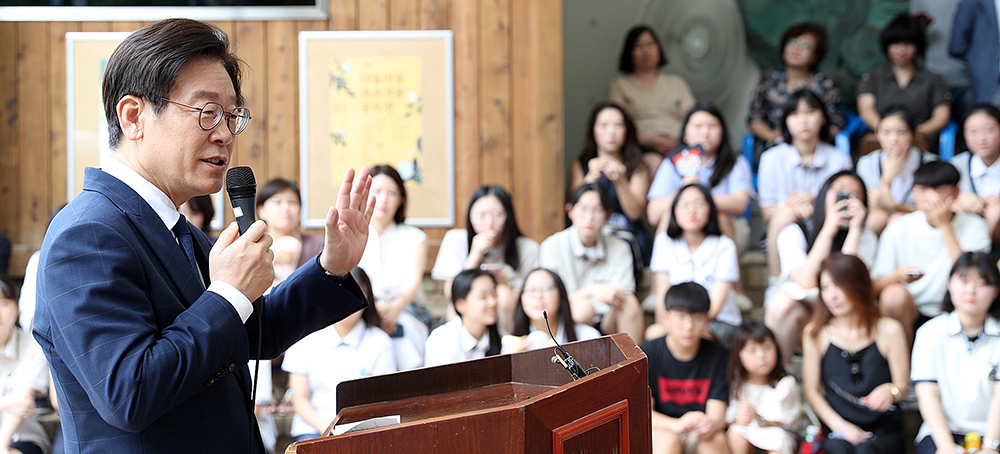
In a message marking International Women’s Day, President Lee Jae Myung pledged to restore and strengthen gender-equality policies scaled back in recent years. The statement may prove to be more than ceremonial, hinting at a broader political and cultural recalibration in a country still deeply divided over what equality should look like.
A Symbolic Date, A Political Message
On International Women’s Day, South Korean President Lee Jae Myung chose symbolism with intent. In a message marking March 8, Lee pledged to restore and strengthen gender-equality policies that had been weakened in recent years, presenting the effort not as a narrow ideological project but as part of building a more inclusive society where social differences do not become discrimination.
That phrasing did important work. In a country where gender issues have increasingly been drawn into partisan conflict, Lee’s message suggested an attempt to shift the terms of debate. Rather than treating gender equality as a culture-war flashpoint, he framed it as a matter of democratic fairness and state responsibility.
More Than a Commemorative Statement
International Women’s Day statements are often easy to applaud and easier to forget. What made Lee’s stand out was its direct acknowledgment of policy rollback. By pointing to gender-equality measures that had been scaled back in previous years, he positioned his administration as offering not just rhetorical support, but institutional reversal.
That matters because gender policy in South Korea has, in recent years, become a barometer of broader political mood. Ministries, mandates and support systems have not simply been administrative questions; they have served as symbols in a larger fight over identity, representation and who gets to define fairness in modern Korea.
The Battle Over Equality’s Meaning
The difficulty, of course, is that “gender equality” no longer functions as a universally accepted public good in South Korea’s political discourse. It is a phrase that now carries competing meanings depending on who is using it. For some, it signals overdue structural reform in work, safety, caregiving and representation. For others, it has become shorthand for a politics they believe excludes or overlooks male frustration and insecurity.
That divide is one of the central realities any administration now has to navigate. The policy challenge is no longer only about expanding protections or improving opportunity. It is also about persuading a skeptical public that equality is not a selective benefit, but a stable social principle.
From Culture War Back to Governance
Lee’s message appears aimed at exactly that shift. By linking gender equality to the idea of an inclusive society, he attempted to move the issue away from grievance politics and back toward governance. The emphasis was less on ideological victory than on social architecture: what kind of country South Korea wants to be, and whether public institutions will actively work to reduce discrimination rather than merely debate its existence.
This is where the pledge becomes politically significant. A government can speak the language of inclusion with ease. It is much harder to embed that language into labor protections, family policy, education, public safety frameworks and administrative priorities. The real meaning of Lee’s statement will depend on whether it becomes visible in those areas.
A Test of Policy, Not Just Tone
For supporters, the Women’s Day pledge will sound like overdue correction. For critics, it may raise familiar concerns about symbolism, favoritism or political messaging. But the real test lies elsewhere. It is not whether the statement was welcomed on March 8, but whether it leads to concrete policy that people can actually feel in everyday life.
That is what makes this moment worth watching. Lee has signaled that gender equality will again be treated as an active responsibility of government rather than a politically inconvenient concept to downplay. In today’s South Korea, that alone is a meaningful shift. Whether it becomes a lasting one will depend on what follows after the ceremony, after the headline, and after the applause fades.
Photo: Gyeonggi Provincial Government / 경기도청, via Wikimedia Commons (KOGL Type 1)


Leave a Reply