
Since BigHit introduced The City Arirang Seoul as part of BTS’s March 20 ARIRANG comeback, the initiative has moved decisively from announcement to lived experience. What began as a promotional framework has become a citywide overlay—reshaping movement patterns, commercial activity, and visitor behavior across Seoul.
As residents adjust to the changes, travelers arriving for the comeback are encountering a parallel reality: tighter hotel availability, rising prices in select districts, and a city recalibrating in real time to accommodate global demand without tipping into disruption.
How the City Is Experiencing the Project
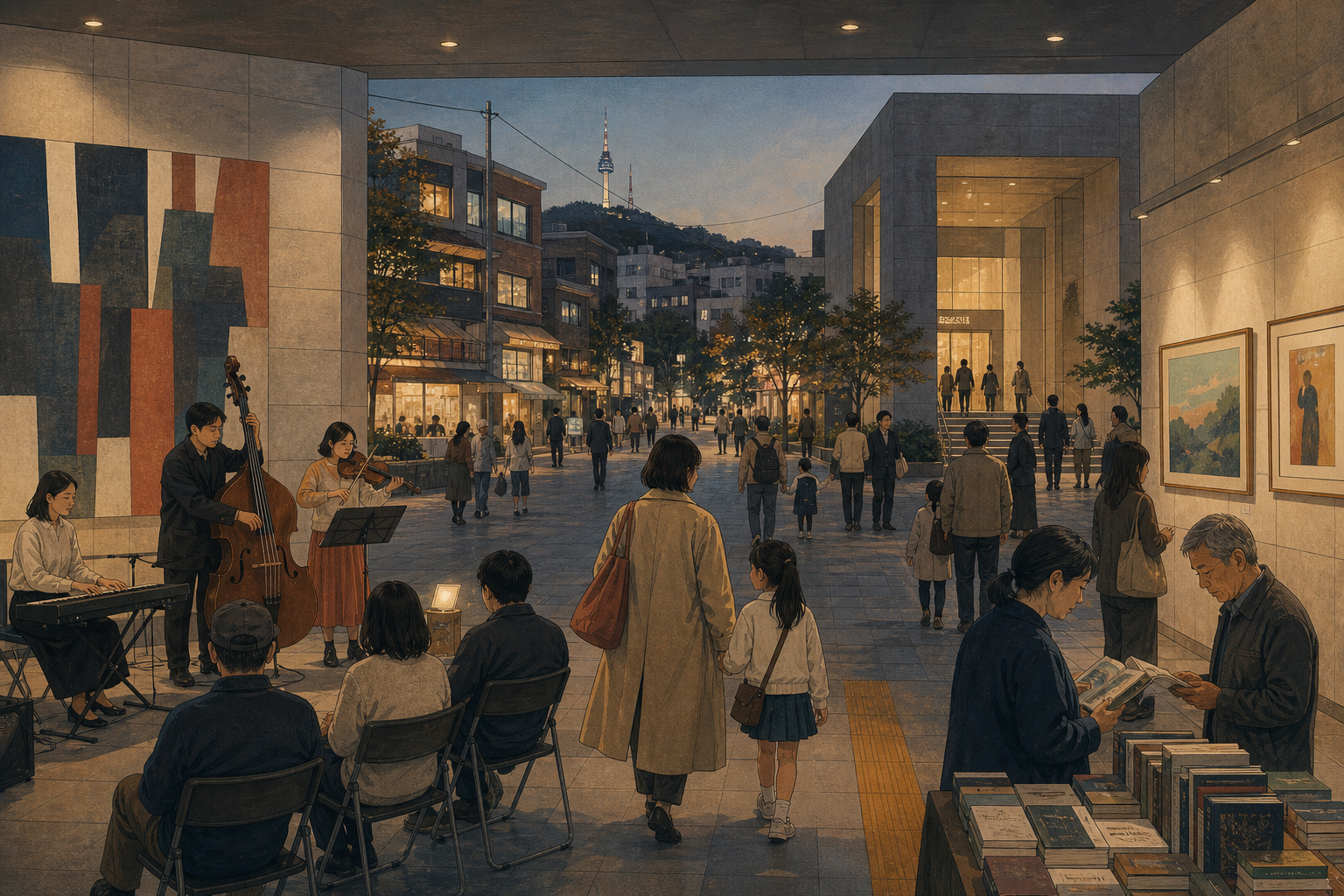
Across districts tied to The City Arirang Seoul, changes are increasingly visible. Multilingual signage has expanded in subway stations, pedestrian traffic has intensified near activation zones, and local businesses have extended hours in anticipation of sustained demand.
For residents, the shift feels less like a sudden influx and more like a gradual reweighting of everyday flow. Unlike past BTS-related gatherings concentrated in a single plaza or venue, this project disperses activity across multiple neighborhoods, creating persistent but moderated visibility rather than acute congestion.
Citizen Reactions: Pride Tempered by Practicality
Local response reflects a careful balance. Many residents express pride in seeing familiar neighborhoods reframed as global cultural touchpoints, reinforcing Seoul’s role as both a creative capital and a functional city capable of hosting large-scale attention.
At the same time, fuller trains during peak hours and busier streets in certain districts are becoming part of daily routine. Notably, frustration has remained muted. The absence of a single pressure point has reduced the sense of being overwhelmed, and for many, the project registers as inconvenient but manageable rather than disruptive.
Small Businesses and Neighborhood Economics
For small businesses, especially in food, fashion, and lifestyle retail, the impact is measurable. Shops near programming sites report increased walk-in traffic from visitors who are not simply attending an event but exploring surrounding neighborhoods.
What distinguishes this moment is duration. Rather than a one- or two-day surge, the extended timeline of The City Arirang Seoul is encouraging longer stays and repeat visits. Business owners are responding cautiously—scaling staffing and inventory gradually rather than gambling on a short-term spike—suggesting a more sustainable form of pop-culture-driven commerce.
Visitor Perspective: Hotels, Prices, and Practical Friction
From the visitor’s point of view, the scale of the project is already being felt most clearly in the accommodation market. Hotels in central and well-connected districts—including Jongno, Myeongdong, Hongdae, and areas near major subway interchanges—have seen noticeable tightening in availability around the comeback window.
Room rates in these areas have risen, particularly for mid-range and boutique properties favored by international travelers. Budget accommodations remain available, but often require earlier booking or greater flexibility in location. Visitors staying farther from activation zones are relying heavily on Seoul’s transit system, which has proven reliable but more crowded during peak hours.
Despite these pressures, major travel disruptions have been limited. There have been no widespread reports of transport shutdowns or access restrictions, and city signage and information services appear designed to accommodate non-Korean speakers. For most travelers, the primary challenge is not navigation, but cost and timing—securing lodging early enough to avoid premium pricing.
City Management and Public Space Strategy
From an urban management perspective, the project continues to function as a live stress test. Transportation flow, crowd monitoring, and multilingual communication are being closely observed as international arrivals increase ahead of March 20.
Officials have emphasized decentralization as a guiding principle, encouraging visitors to move across districts rather than cluster in a single area. Early indicators suggest this approach is helping to distribute economic benefits while limiting strain on residential zones.
What Residents Are Watching Next
As the comeback date approaches, residents are less focused on scale and more on aftermath. Will installations and programming wind down smoothly, allowing neighborhoods to return to baseline without lingering congestion? Will economic benefits reach smaller districts included in the rollout? And crucially, will this model remain a BTS-specific exception, or become a blueprint for future large-scale cultural projects?
For many Seoulites, success will be measured not by crowd size, but by equilibrium—how quickly routines normalize, and whether improved infrastructure and crowd management systems remain in place.
What This Signals Going Forward
The City Arirang Seoul reflects a more mature phase in the relationship between K-pop, tourism, and urban life. BTS’s comeback is not operating as an external spectacle imposed on the city, but as a distributed cultural layer that residents, businesses, and visitors are collectively navigating.
If the balance holds, the project may redefine how global pop culture events are hosted: less about momentary takeover, more about temporary coexistence. In that sense, ARIRANG is not only a musical return—it is a case study in how a global fandom intersects with a living city.



Leave a Reply